
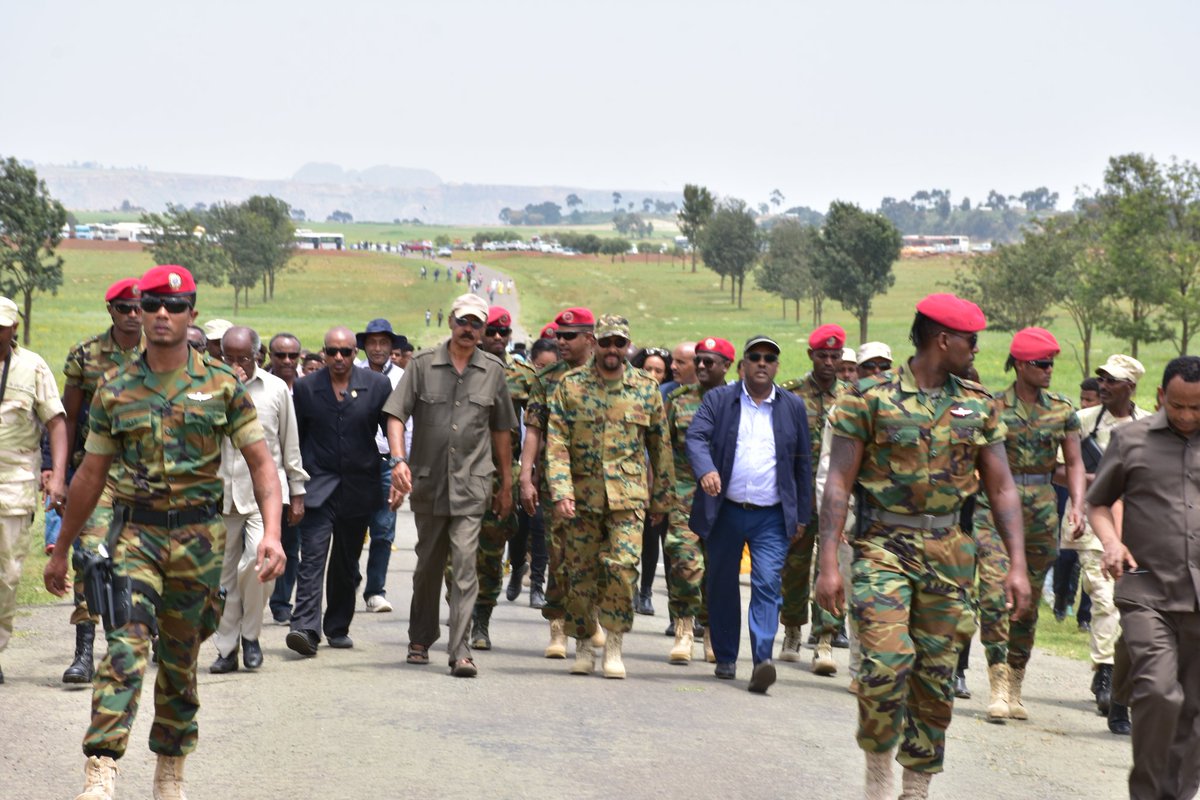
The peace that followed the 2018 rapprochement between Ethiopia and Eritrea is visibly eroding again, replaced by public accusations, military signalling and a regional environment that makes escalation easier and mediation harder. A full-scale interstate war is not inevitable, but the risk of a limited clash — sparked by border incidents, proxy violence or miscalculation — is rising.
Why the war question is back now
Three tracks are converging.
First, Ethiopia’s post–Tigray-war settlement is fraying. The UN Secretary-General has warned that renewed tensions in Tigray risk sliding into a wider conflict, even as the region is still trying to rebuild from the 2020–2022 war.
Second, Addis Ababa and Asmara have shifted from quiet suspicion to formal, public accusation — the kind that narrows leaders’ room to compromise.
Third, the Horn of Africa is increasingly entangled with overlapping crises and rivalries: Sudan’s war, the Red Sea’s militarisation, and the competitive push by Gulf states and regional powers to shape outcomes on both shores.
What the two governments are accusing each other of
Ethiopia has now put its allegations in writing and in public.
On 8 February 2026, Ethiopia’s Foreign Minister Gedion Timothewos accused Eritrea of “military aggression,” alleging Eritrean forces are occupying Ethiopian territory and backing armed groups inside Ethiopia. Ethiopia demanded an “immediate withdrawal” and said it remained open to dialogue — including on contentious maritime issues — but framed the baseline as Eritrea respecting Ethiopia’s sovereignty.
Eritrea’s response has been categorical. On 9 February, Eritrea rejected Ethiopia’s claims as “false and fabricated,” describing them as part of a long-running hostile campaign and warning against what it portrayed as manufactured pretexts for conflict.
The proxy dimension is also moving from insinuation to allegation. In mid-January, Ethiopian federal police said they seized 56,000 rounds of ammunition in Amhara and alleged the shipment was destined for the Fano-associated insurgency and linked to Eritrea — a claim Asmara dismissed.
Has the rhetoric changed in a meaningful way
Yes — and that matters because hardened narratives can become self-fulfilling.
In early February, Prime Minister Abiy Ahmed, speaking to parliament, officially accused Eritrean troops for the first time of mass killings during the Tigray war, including atrocities in places such as Axum and Adwa. Eritrea’s information minister dismissed the accusations as unfounded and politically motivated.
That is a significant escalation: it reframes Eritrea not merely as a difficult neighbour, but as a perpetrator whose impunity must be confronted — a framing that can increase domestic pressure on Abiy to “act,” even if he prefers to avoid another front.
Are troops massing, or is it still mostly political theatre
Verified, open-source proof is mixed, but credible reporting suggests at least some military preparation.
Reuters previously reported that Eritrea ordered a nationwide mobilisation in mid-February 2025 (citing a human-rights group), and that Ethiopia deployed troops toward the Eritrean border (citing diplomatic sources and Tigrayan officials), while noting it could not independently verify all claims.
Even if the current moment remains largely rhetorical, the danger lies in what mobilisation does to decision-making: it shortens reaction times, increases the frequency of encounters along contested areas, and makes leaders more likely to interpret local incidents as intentional escalation.
What the dispute is really about
It’s not one issue. It’s three stacked on top of each other — and that’s why it’s volatile.
- Borders and unresolved wartime legacies
Ethiopia and Eritrea fought a devastating border war from 1998 to 2000, and although the 2018 thaw promised a new era, the relationship has repeatedly reverted to suspicion. Today’s allegations of “occupation” revive the oldest casus belli. - Tigray as the tripwire
Tigray is where grievances, armed actors and geography collide. Instability there creates space for proxy accusations and opportunistic moves. If factions in or around Tigray believe an Eritrea–Ethiopia confrontation could improve their bargaining position, the incentives to provoke — or to misread provocations — grow. - The Red Sea as the strategic prize
Abiy has repeatedly argued that sea access is existential for landlocked Ethiopia. Reuters has reported that he has insisted Ethiopia has “no intention” of going to war for access — but in Eritrea, such language can still read as pressure on sovereignty, especially because Eritrea’s Assab port is the most obvious nearby outlet. When one side frames access as existential and the other frames territory as non-negotiable, compromise becomes politically expensive.
How Sudan’s war and external rivalries raise the stakes
The Horn is not insulated anymore.
A Reuters investigation published 10 February 2026 reported that Ethiopia is hosting a secret camp in Benishangul-Gumuz near Sudan to train fighters for Sudan’s Rapid Support Forces (RSF), citing multiple sources and satellite imagery. Reuters reported that eight sources — including Ethiopian officials and diplomats — said the UAE financed and supported the operation, though the UAE denied involvement.
That matters for Ethiopia–Eritrea in two ways:
- It tightens Ethiopia’s alignment with a powerful external patron at the same time as the Horn’s fault lines are sharpening.
- It increases the risk that any Ethiopia–Eritrea crisis becomes entangled with Sudan’s battlefield dynamics, supply routes and intelligence competition.
Meanwhile, Egypt is also being pulled deeper into Sudan’s conflict. Reuters reported that Egypt deployed Turkish-made Bayraktar Akinci drones to a remote airstrip near Sudan, citing officials, experts and satellite imagery.
On the diplomatic chessboard, Ethiopia is also confronting shifting alignments around Somalia and Egypt. In October 2024, Egypt, Eritrea and Somalia agreed to boost security cooperation — a move widely read as leaving Ethiopia more isolated amid its disputes over the Nile and over Ethiopia’s port ambitions in the Somali region.
And Eritrea’s recent withdrawal from IGAD added another stressor, weakening one of the few formal regional platforms where de-escalation could be organised.
Will they actually go to war
A major, conventional interstate war is not the most likely outcome — but it’s no longer unthinkable.
Reasons both sides may avoid a large war:
- Ethiopia is already stretched by internal insecurity (including Amhara) and economic pressures, making a second major war politically and fiscally risky.
- Eritrea’s security model is built on tight domestic control; a prolonged conventional conflict would be costly and could create unpredictable internal strain.
Why a limited clash is plausible:
- Mobilisation and forward deployments increase the chances of a border incident.
- Proxy allegations create incentives for retaliation without admitting direct responsibility.
- External patrons and regional rivalries can harden positions and reduce the space for quiet compromise.
The most realistic pathway is not a formal declaration of war, but a chain reaction: a local clash, a retaliatory strike, a rapid escalation in propaganda, then a widening set of targets before mediators can slow the momentum.
What to watch next
Four indicators are especially worth tracking:
- Verified deployments along the Eritrean frontier (not just social media claims).
- Additional formal ultimatums or diplomatic rupture — expulsions, downgraded ties, cancelled flights, closed crossings.
- Evidence of proxy pipelines — seizures, arrests, financing claims, or imagery of supply routes.
- New alignment moves — security pacts, base access, drone or air-defence positioning tied to Sudan spillovers.
The risk is real, and it’s growing — less because either capital “wants” a conventional war tomorrow, and more because the region is crowded with armed actors, unresolved grievances and external interests that make accidents harder to contain.