
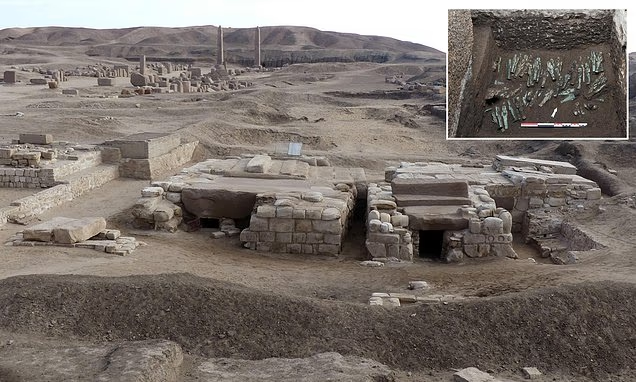
A cache of 225 funerary figurines has been unearthed inside a tomb in the ancient Egyptian capital of Tanis, revealing a rare discovery that also resolves a long-standing archaeological puzzle.
The find marks the first time since 1946 that figurines have been recovered intact from a royal tomb in the Tanis necropolis.
French Egyptologist Frédéric Payraudeau said no similar discovery has occurred in the Valley of the Kings since Tutankhamun’s tomb was opened in 1922.
Payraudeau, who leads the French Tanis excavation mission, said the team uncovered the objects on 9 October while working around an imposing, unnamed sarcophagus.
He said the sight of several figurines clustered together signalled the magnitude of the discovery, prompting the team to work through the night.
Archaeologists spent 10 days removing the 225 green ushabti, which were arranged in a star formation around a trapezoid-shaped pit and in horizontal rows at its base.
The figurines, intended as servants for the afterlife, were notable for their unusually high number of female figures.
Tanis, founded around 1050 BC, served as Egypt’s royal capital during the 21st dynasty after widespread looting forced the abandonment of the Valley of the Kings.
A royal symbol carved on the figurines has now revealed the identity of the tomb’s occupant as Pharaoh Shoshenq III, who ruled from 830 to 791 BC.
The attribution surprised researchers because Shoshenq III’s name appears on the walls of a different, larger tomb at the site.
Payraudeau said the mismatch raises questions about disrupted succession during a turbulent reign marked by civil conflict between Upper and Lower Egypt.
He added that later relocation of the pharaoh’s remains is possible but unlikely given the difficulty of moving a massive granite sarcophagus.
The figurines will be studied before going on public display in Egypt.