
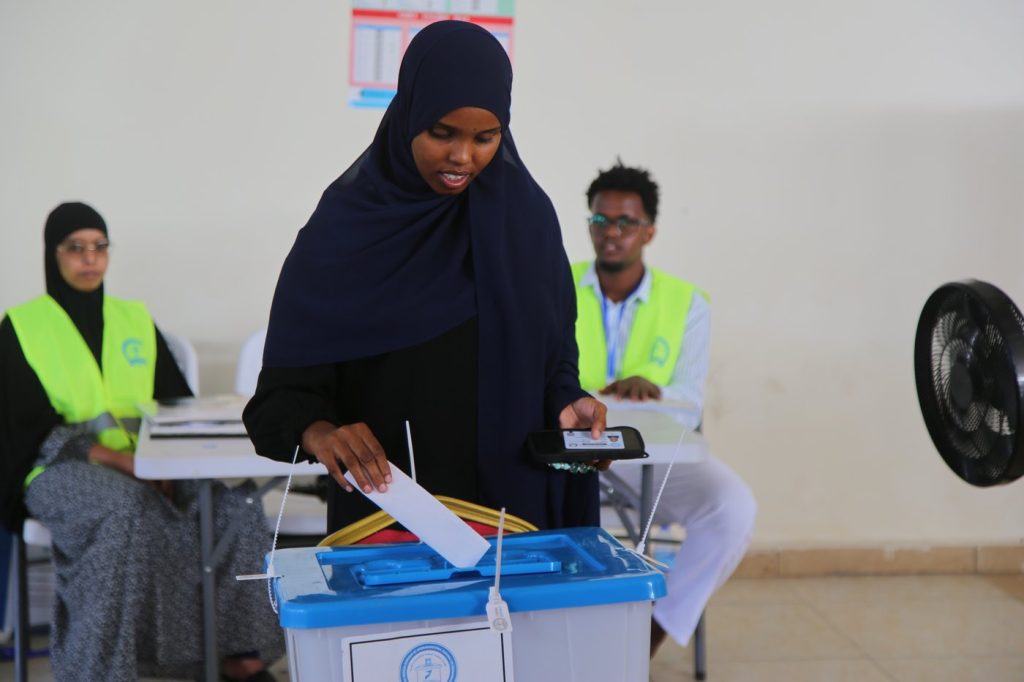
Residents of Somalia’s capital went to the polls on Thursday in the city’s first direct local elections in more than five decades, a landmark moment for the country’s democratic ambitions overshadowed by opposition boycotts and security concerns.
Polling stations opened early across Mogadishu, with voters casting ballots to elect district council representatives for the first time since 1969. President Hassan Sheikh Mohamud described the vote as the beginning of a “new chapter” in Somalia’s political history.
Around 500,000 voters registered to choose 390 district council members, with more than 1,600 candidates competing across hundreds of polling centres. Authorities deployed nearly 10,000 police officers and imposed a citywide lockdown, suspending traffic and flights into Mogadishu amid fears of attacks.
Security in the capital has improved this year, but the government remains locked in a conflict with al Shabab, the al Qaeda linked group that continues to stage major assaults, including a deadly attack in October.
Officials hailed the vote as a revival of democratic practice after decades of indirect rule. Somalia has not held direct elections since a military coup in 1969 ushered in decades of authoritarian rule, followed by years of civil war after the collapse of the state in 1991.
Since 2004, Somalia has relied on an indirect, clan based electoral system in which elders select lawmakers, who then elect the president. The system has long been criticised as opaque and deeply contested.
President Mohamud, who came to power through that process, pledged in 2023 to move the country toward universal suffrage. His government secured parliamentary backing for constitutional reforms and set up a national electoral commission, steps that have drawn sharp resistance from major opposition figures.
Several prominent politicians boycotted the Mogadishu vote, arguing that the process lacked consensus and legitimacy. Two federal member states, Puntland and Jubbaland, rejected the electoral framework altogether, while opposition leaders warned the vote could deepen political divisions.
Analysts said the local elections were symbolically important but politically limited. While the government exerts strong control over Mogadishu, the absence of opposition support and international backing raised questions about the broader transition to direct national elections.
The vote comes as Somalia faces mounting security and political pressures. Al Shabab has regained ground in parts of the country, while funding shortfalls threaten a UN backed African Union peacekeeping mission. The US has also signalled a reduced diplomatic and security footprint, adding to uncertainty over Somalia’s fragile path toward stability.