
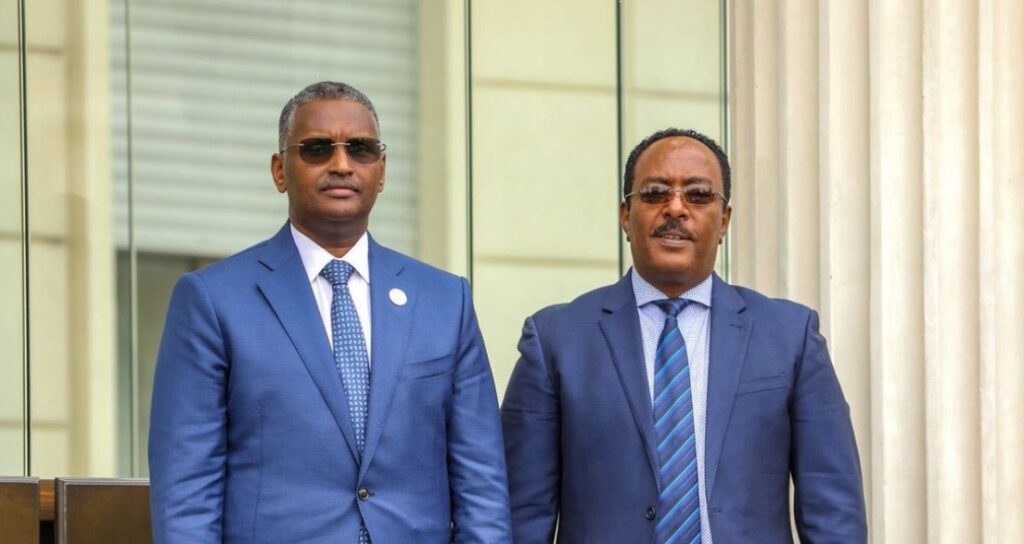
Ethiopia’s intelligence chief Redwan Hussein made an unannounced visit to Somalia on Tuesday amid rising regional tensions.
Hussein met Somali President Hassan Sheikh Mohamud at Villa Somalia to deliver a message from Ethiopian Prime Minister Abiy Ahmed, undisclosed publicly.
He also held talks with Mahad Salad, head of Somalia’s National Intelligence and Security Agency, at the agency’s headquarters in Mogadishu.
Neither government issued an official statement, leaving the purpose and details of the meetings largely a matter of speculation.
The visit comes after Israel’s controversial Dec. 26 decision to recognize Somaliland as an independent and sovereign state, drawing widespread criticism.
Somaliland has governed itself since declaring independence from Somalia in 1991 but has never received formal international recognition as a separate nation.
Critics condemned Israel’s move as illegal, warning it could destabilize the region and threaten broader international peace and security.
Tensions increased after Ethiopia signed a January 2024 deal with Somaliland for access to the port of Berbera, angering Somalia over sovereignty violations.
Türkiye mediated subsequent talks between Somalia and Ethiopia, resulting in the Ankara Declaration in December 2024 to ease maritime and bilateral tensions.
Under the Ankara Declaration, both countries agreed to pursue arrangements allowing Ethiopia sea access under Somalia’s sovereign authority, aiming to stabilise relations.
Hussein’s visit signals ongoing efforts to navigate these sensitive diplomatic challenges, reflecting the Horn of Africa’s complex geopolitical landscape.
The unannounced nature of the trip underscores urgency in dialogue as Ethiopia and Somalia manage competing interests and regional pressures.
Observers suggest the meetings may focus on security coordination, intelligence sharing, and broader regional stability in response to shifting alliances.
The Horn of Africa remains a strategic and fragile region, with disputes over sovereignty, maritime access, and recognition continuing to spark tensions.
Ethiopia and Somalia’s ability to maintain dialogue could prove critical in preventing escalations and fostering cooperation under fragile regional agreements.