
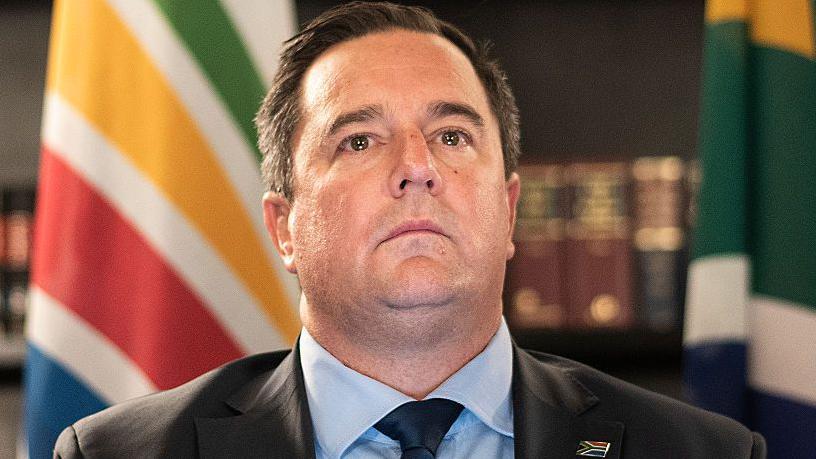
South Africa’s Democratic Alliance leader John Steenhuisen has announced he will not seek re-election when the party holds its leadership contest in April, a decision that could add fresh uncertainty to the country’s coalition government.
Steenhuisen, who has led the Democratic Alliance since 2019, said he would instead focus on his role as agriculture minister, citing the country’s worsening foot-and-mouth disease outbreak.
“For the rest of this term of office, I will focus all of my time and energy as minister of agriculture on defeating the most devastating foot-and-mouth disease outbreak our country has ever seen,” he told a press briefing.
The DA is South Africa’s second-largest party and entered a coalition government with its long-time rival, the African National Congress, in 2024 after the ANC lost its parliamentary majority for the first time since the end of apartheid. Steenhuisen currently serves in President Cyril Ramaphosa’s cabinet.
The 49-year-old was widely expected to seek another term as DA leader and was reportedly set to run unopposed. However, local media have linked his decision to a series of controversies, including a public fallout with former environment affairs minister Dion George and allegations of misuse of a party credit card, of which Steenhuisen was cleared in January.
He has also faced criticism over his handling of the foot-and-mouth disease outbreak, with farmers accusing the agriculture department of hampering efforts to contain the crisis. The highly contagious virus has spread to most of South Africa’s provinces in recent years, severely affecting the livestock sector by reducing productivity and permanently lowering the value of infected animals.
Steenhuisen began his political career at the age of 22, when he was elected to the council of Durban for the Democratic Party, the DA’s predecessor. He later rose through local and regional ranks before becoming leader of a party traditionally associated with a largely white voter base.
Under his leadership, the DA agreed to join the ANC-led government of national unity, an unprecedented step for a party that had long defined itself in opposition to the ruling movement that brought democratic rule in 1994 under Nelson Mandela. The coalition has been marked by internal tensions, but it has so far held together.
Steenhuisen and Ramaphosa publicly demonstrated that cooperation last year during a high-profile visit to Washington, where they jointly pushed back after then US President Donald Trump raised discredited claims of a “white genocide” in South Africa. Steenhuisen told Trump that most white farmers wanted to remain in the country, a moment widely seen as reinforcing the coalition’s credibility at home.
No candidates have yet declared their intention to contest the DA leadership. Cape Town mayor Geordin Hill-Lewis has been mentioned as a possible successor, although he has previously indicated he would not run against Steenhuisen, whom he considers a close ally.