
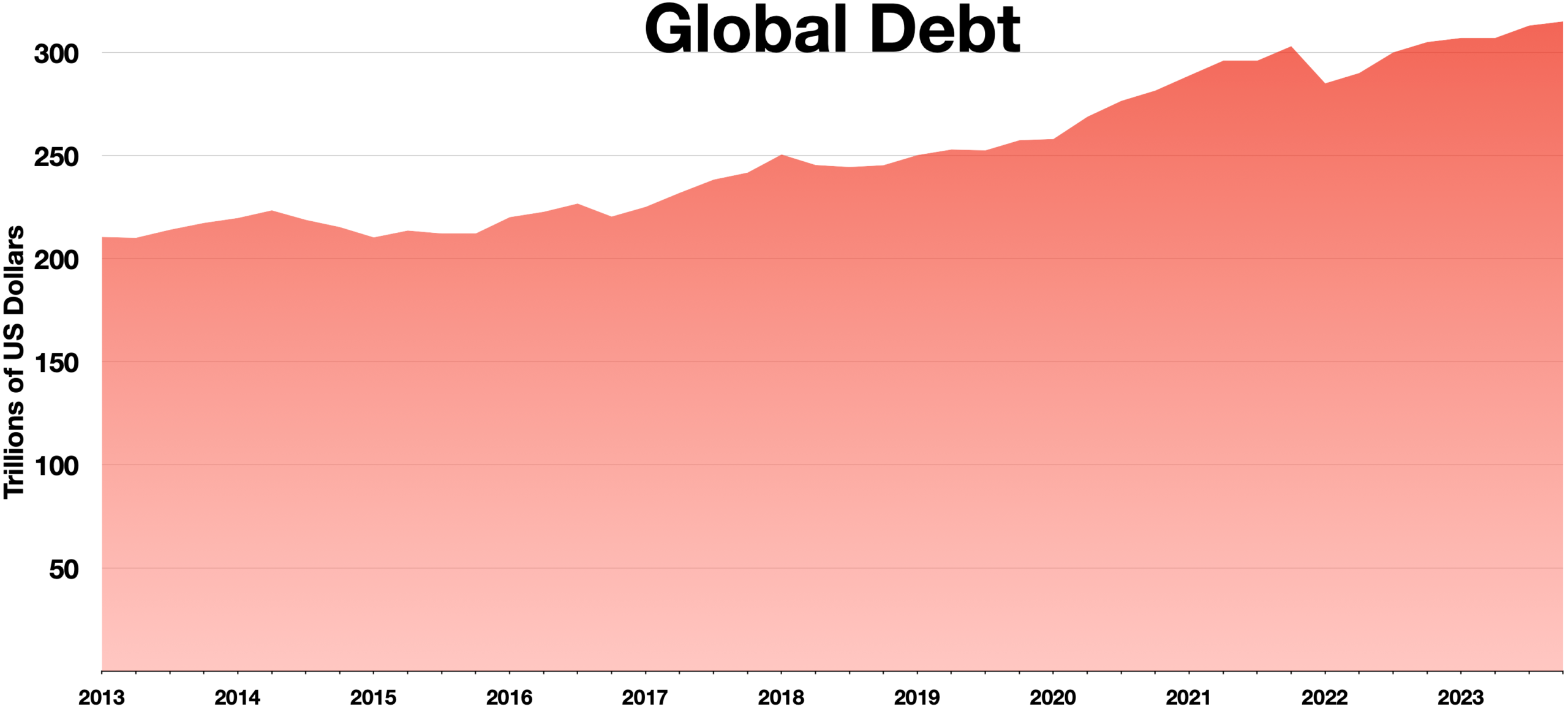
Global debt surged by nearly $29 trillion in 2025, reaching an unprecedented $348.3 trillion, the IIF reported.
The pace of debt accumulation accelerated sharply last year, marking the fastest rise since the pandemic years, highlighting global financial strain.
Advanced economies contributed roughly two-thirds of the increase, driven largely by higher fiscal deficits and extensive government borrowing across sectors.
Debt levels in both advanced and emerging markets hit record highs, reflecting a broad-based, almost unstoppable, accumulation across the global economy.
Total debt in advanced economies reached $231.7 trillion by year-end, while emerging markets climbed to $116.6 trillion, the report detailed.
Despite soaring nominal debt, the global debt-to-GDP ratio fell for the fifth consecutive year, declining to around 308 percent in 2025.
In emerging markets, however, the debt-to-GDP ratio continued climbing, surpassing 235 percent, marking a historic peak for these economies.
Household debt reached $64.6 trillion, non-financial corporate debt $100.6 trillion, public debt $106.7 trillion, and financial sector debt $76.4 trillion globally.
Over $10 trillion of the increase came from public borrowing, mostly concentrated in China, the United States, and the eurozone, the report said.
European debt expansion was largest in France and Italy, followed by Germany, while Brazil, Mexico, Russia, and China drove emerging market increases.
Debt ratios to GDP showed slight falls in households, corporate, and financial sectors, while public debt ratios rose globally from 93 to 94.8 percent.
In Türkiye, household debt rose to 10.1 percent of GDP, corporate debt to 38.2 percent, while public and financial sector debts slightly declined last year.
The IIF forecast that global debt accumulation will remain robust, propelled by continued public borrowing in the US, China, Germany, Japan, and India.