
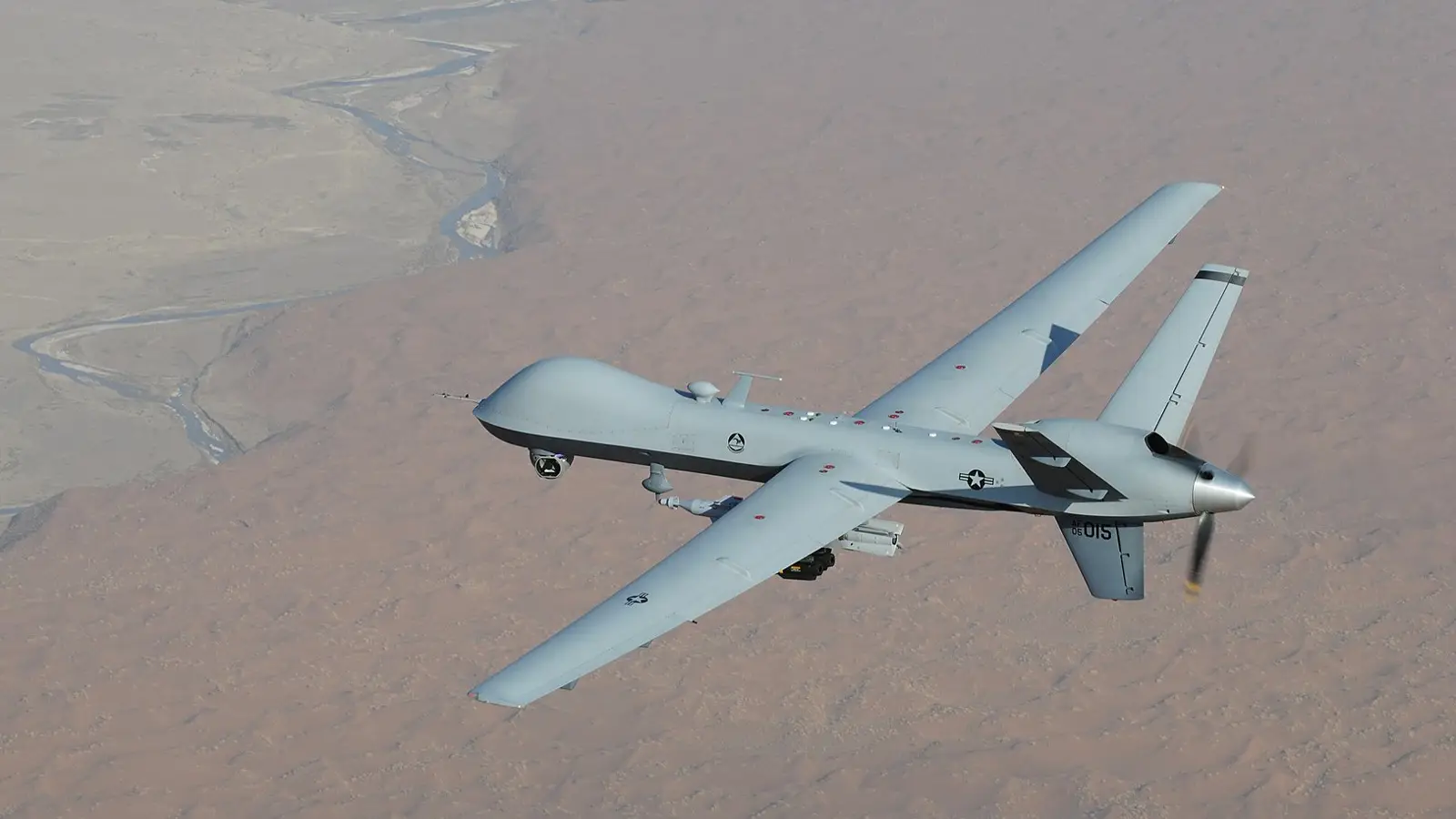
The United States has deployed MQ-9 Reaper drones and around 200 troops to Nigeria to support counterinsurgency operations, marking a renewed American security footprint in West Africa after its withdrawal from Niger.
US and Nigerian officials said the deployment is focused strictly on intelligence gathering and military training, with no direct combat role. The drones are not conducting airstrikes but are instead providing surveillance to assist Nigerian forces battling Islamist insurgents across the country’s north.
The US personnel are also not embedded on frontlines, reinforcing what both sides describe as a “non-combat support framework.”
The move signals a recalibration of Washington’s regional strategy following the closure of its $100 million drone base in Niger in 2024, after the military junta in Niamey expelled Western forces. That exit created a significant intelligence gap across the Sahel, where groups linked to ISIS and al-Qaeda have continued to expand.
US officials say the Nigeria deployment is intended to rebuild situational awareness and support local forces confronting a rapidly evolving threat landscape.
Nigerian military spokesperson Major General Samaila Uba confirmed that US assets are operating from Bauchi airfield in the northeast, forming part of a joint intelligence fusion structure between the two countries.
“This cooperation is enabling our forces to identify, track and respond to terrorist threats more effectively,” Uba said, stressing that US involvement remains limited to advisory and intelligence roles.
No timeline has been set for the deployment, with both sides indicating it will be determined jointly based on operational needs.
The MQ-9 Reaper drones, capable of remaining airborne for more than 27 hours, provide persistent surveillance over vast and difficult terrain. While designed to carry out precision strikes, officials emphasized that their current mission in Nigeria is limited to intelligence collection.
The renewed US engagement comes amid rising insecurity in Nigeria, where a 17-year insurgency led by Boko Haram and ISWAP continues to destabilize the northeast, while violence in the northwest is increasingly raising concerns of overlap between criminal banditry and jihadist networks.
A recent suicide bombing targeting a military position underscored the continued ability of insurgent groups to strike high-value targets, even in fortified areas.
US involvement had previously included intelligence flights from Ghana and, more controversially, airstrikes in northwest Nigeria in late 2025. Washington said those strikes were aimed at preventing attacks on Christian communities — a claim Nigerian authorities and analysts have pushed back on, warning against oversimplifying the conflict’s complex drivers.
Despite sustained military pressure, Nigerian officials acknowledge that insurgent groups remain adaptive and opportunistic.
“They continue to evolve,” Uba said. “We expect them to pursue high-visibility attacks to maintain relevance.”
The latest deployment highlights a broader shift in US counterterrorism posture in Africa — from large, fixed bases toward more flexible, partner-led operations — as Washington seeks to contain militant expansion without deep direct engagement.