
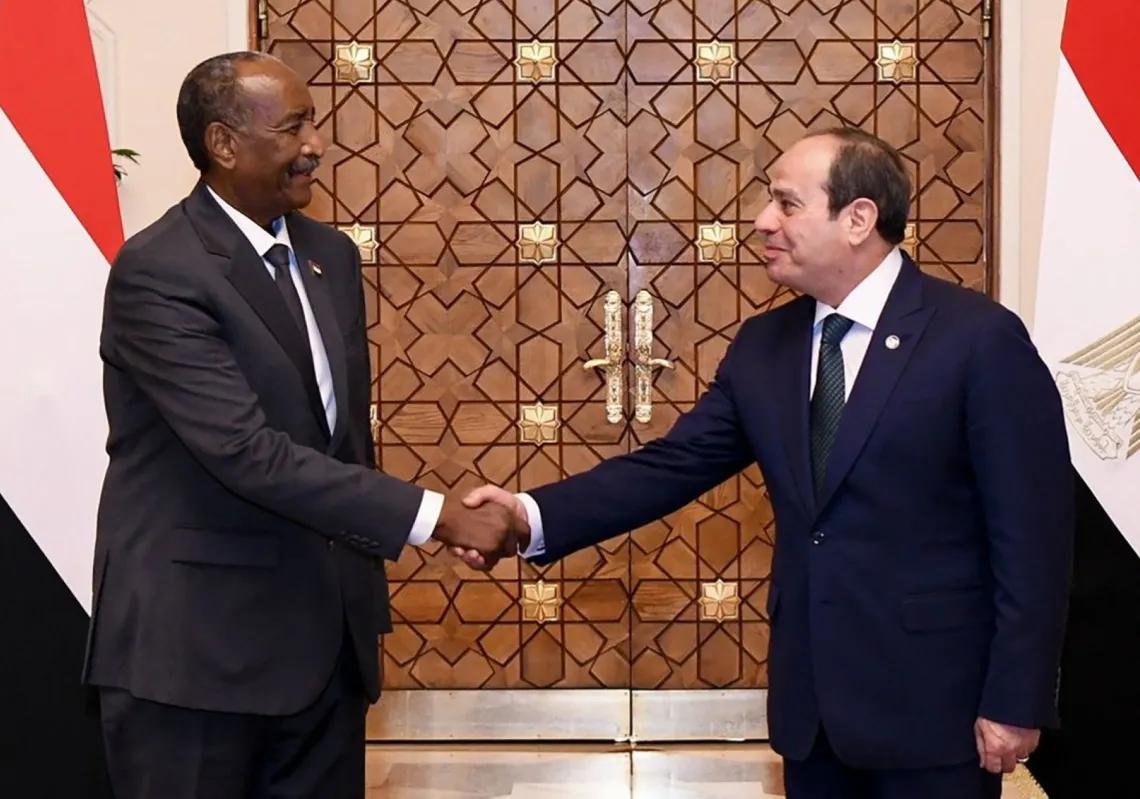
An emerging analysis circulating among Sudanese political observers is reigniting debate over Egypt’s role in Sudan’s collapse, arguing that Cairo has been a central — if largely unacknowledged — actor from the fall of civilian rule to the country’s descent into war.
The argument reframes Sudan’s crisis not as an isolated internal breakdown, but as part of a wider regional power struggle in which Egypt has sought to secure a military-aligned authority in Khartoum under General Abdel Fattah al-Burhan.
According to the analysis, the groundwork was laid immediately after the 2019 uprising, when networks opposed to civilian rule regrouped with backing and coordination space in Egypt. The goal, it claims, was not simply to influence Sudan’s transition, but to steer it away from civilian governance altogether.
That trajectory, the text argues, culminated in the October 2021 coup, when Sudan’s military dismantled the transitional government. The analysis describes a pattern of pressure — political, economic and security-related — that weakened civilian actors while consolidating the position of the SAF leadership.
Egypt has long denied any direct interference. Officials in Cairo maintain that their position is consistent: supporting Sudan’s stability and preserving state institutions. But critics say that framing has effectively translated into backing military rule.
Events surrounding the outbreak of war in April 2023 have added weight to those concerns. Independent reporting confirmed that Egyptian troops and aircraft were stationed at Sudan’s Merowe airbase when fighting erupted — a presence both sides said was linked to joint exercises, but one that underscored the depth of military ties.
Social media footage from the time appeared to show Egyptian personnel captured at the base, while officials reiterated the deployment was routine. For some analysts, however, the episode marked a turning point in how Egypt’s role was perceived, with commentary increasingly questioning not just its involvement, but its extent.
Beyond the battlefield, Egypt’s diplomatic posture has also drawn scrutiny. Following the 2021 coup, Sudan was suspended from the African Union, yet Cairo intensified engagement with the military leadership, advocating for the preservation of what it termed “state institutions.”
Analysts cited in the discussion say this stance aligns with Egypt’s broader regional doctrine under Abdel Fattah el-Sisi, which prioritizes centralized, military-backed governance models.
The analysis also situates Sudan within Egypt’s strategic calculations over the Nile, particularly in its dispute with Ethiopia regarding the Grand Ethiopian Renaissance Dam. A cooperative leadership in Khartoum, it suggests, is seen as essential to Cairo’s long-term water security.
The analysis echoes a growing body of regional reporting that has pointed to external actors shaping the trajectory of Sudan’s war. Allegations of military support and operational coordination involving multiple countries — including Egypt — have circulated widely, though they remain contested.
What is less disputed is the scale of the fallout. Sudan’s conflict has fragmented state authority, accelerated economic collapse, and fueled instability across the Red Sea corridor, with implications reaching far beyond its borders.
Whether Egypt’s role proves as decisive as the analysis suggests remains a matter of debate. But the questions it raises — about influence, intent and accountability — are likely to remain central as efforts to end Sudan’s war continue.