
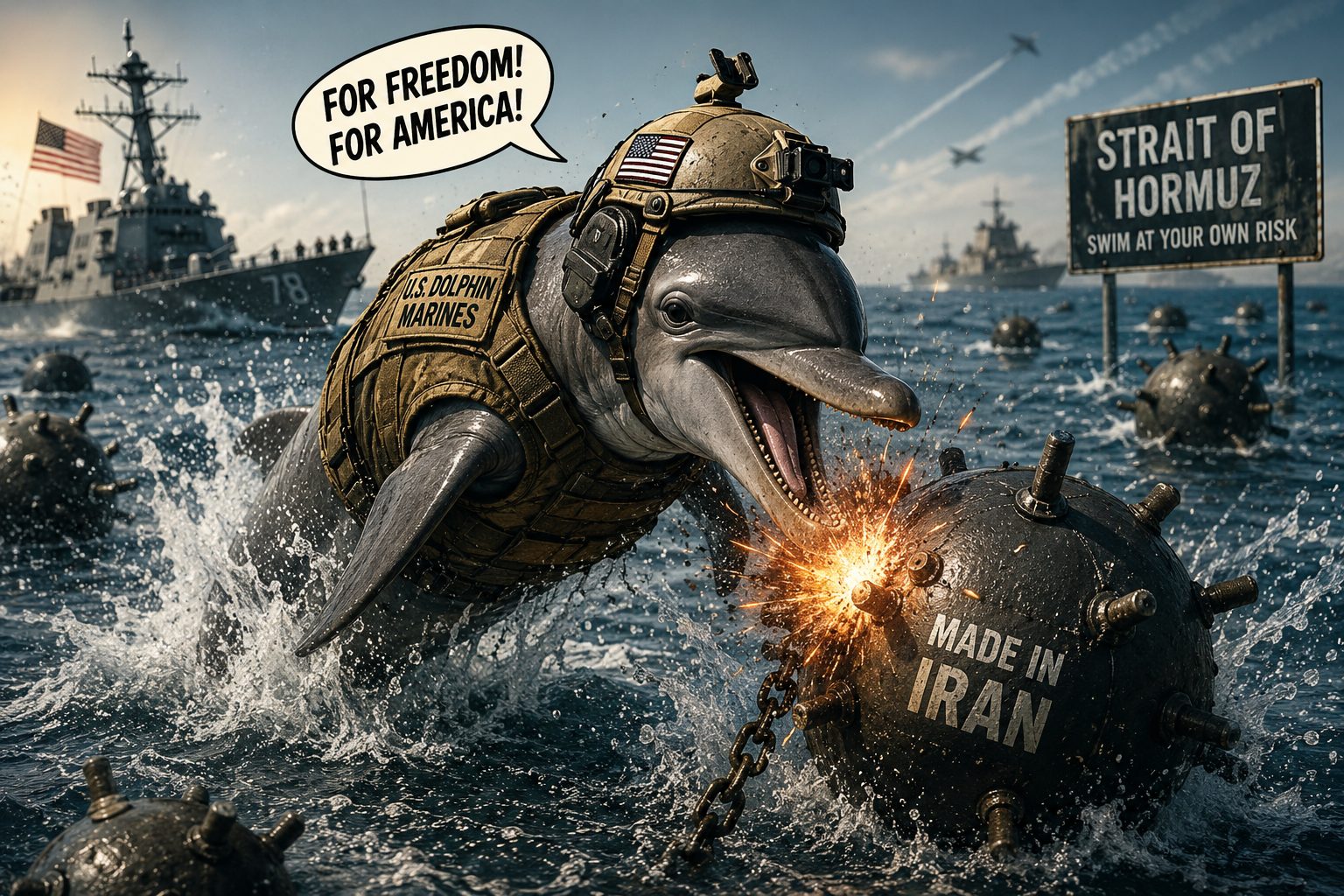
U.S. Defense Secretary Pete Hegseth has refused to confirm or deny whether Washington possesses so-called “kamikaze dolphins,” turning an already bizarre question about the Strait of Hormuz into a viral flashpoint over secret military capabilities.
The exchange came during a Pentagon briefing on Tuesday, when Hegseth and Joint Chiefs Chairman Gen. Dan Caine were asked about reports that dolphins could be used in military operations in the Strait of Hormuz.
Hegseth firmly rejected the idea that Iran has such a capability. But when the question shifted to the United States, his answer was more carefully worded.
“I can’t confirm or deny whether we have kamikaze dolphins, but I can confirm they don’t,” Hegseth said, according to video and multiple reports.
Caine appeared surprised by the question, joking: “Like sharks with laser beams?” — a line that quickly became the dominant social media takeaway.
The moment spread rapidly across X, Instagram, Reddit and short-video platforms, with users highlighting the same point: Washington was not confirming the existence of attack dolphins, but it was also not denying it.
Several outlets framed the exchange around that ambiguity. CNBC posted that Iran does not have “kamikaze dolphins,” while noting the long history of military marine mammals. Firstpost and CGTN Europe circulated the “can’t confirm or deny” quote, while the New York Post framed the answer as leaving the U.S. question open.
The online reaction reflects how a single evasive answer can transform an obscure military question into a broader debate about classified systems, information warfare and the limits of public knowledge during conflict.
The U.S. Navy does operate a long-running Marine Mammal Program, using dolphins and sea lions for mine detection, object recovery and underwater security. The Navy says dolphins are trained to locate and mark undersea mines, while sea lions help recover equipment and detect unauthorized swimmers or divers.
But the Navy has historically denied training dolphins for lethal attack missions against ships or people. Business Insider, citing the Pentagon briefing and the history of the program, reported that the U.S. officially describes the animals’ roles as surveillance, detection and defensive support, not suicide attacks.
That official position has not stopped speculation. The phrase “kamikaze dolphins” gained traction because it sits at the intersection of three real facts: the U.S. has trained marine mammals for decades; Hormuz is currently at the center of a high-stakes naval confrontation; and Hegseth chose not to issue a clean denial about U.S. capabilities.
For now, there is no public evidence that the United States or Iran is deploying explosive-laden dolphins in the Strait of Hormuz. But Hegseth’s refusal to rule it out has given the story political life — and turned a strange briefing-room question into one of the most viral symbols of the Hormuz crisis.