
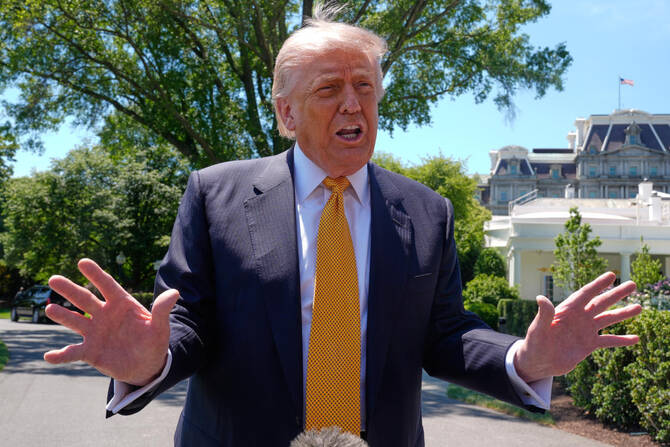
U.S. President Donald Trump said on Wednesday that Washington does not need China’s help to end the war with Iran or ease tensions in the Strait of Hormuz, ahead of high-level talks with Chinese President Xi Jinping in Beijing.
Speaking before departing for China, Trump downplayed Beijing’s influence over the conflict despite expectations that Iran and regional security would dominate discussions during the summit.
“I don’t think we need any help with Iran. We’ll win it one way or the other, peacefully or otherwise,” Trump told reporters.
The remarks came as Iran appeared to strengthen its control over the Strait of Hormuz, a critical maritime chokepoint that carries roughly one-fifth of the world’s oil supply.
Sources familiar with the matter said Tehran has reached new arrangements with Iraq and Pakistan to transport oil and liquefied natural gas through the region, a move analysts say could deepen Iran’s leverage over global energy routes.
Iranian officials increasingly framed control over Hormuz as a strategic objective following months of war and escalating regional tensions.
“After this war ends, there will be no place for retreat,” an Iranian army spokesperson said in comments carried by ISNA news agency.
Despite a fragile ceasefire that took effect last month, negotiations between Washington and Tehran remain stalled. The United States continues to demand that Iran dismantle its nuclear programme and relinquish control over the strait, while Tehran is seeking compensation for wartime damage, an end to the U.S. blockade and a halt to Israeli military operations across the region, including Lebanon.
Trump dismissed Iran’s demands as “garbage.”
Meanwhile, ship-tracking data showed a Chinese supertanker carrying two million barrels of Iraqi crude successfully crossed the Strait of Hormuz on Wednesday, marking one of the few known tanker passages through the waterway since U.S. and Israeli strikes on Iran began in late February.
The Trump administration also said U.S. and Chinese officials agreed last month that no country should be allowed to impose tolls on maritime traffic in the region.
The war continues to shake global energy markets. The International Energy Agency warned on Wednesday that disruptions linked to the Iran conflict could reduce global oil supplies by nearly 3.9 million barrels per day this year, pushing supply below demand.
Brent crude prices remained elevated at around $108 per barrel after several days of gains linked to uncertainty in Hormuz.
Trump also brushed aside concerns over rising economic pressure on Americans amid the conflict.
“I don’t think about Americans’ financial situation,” he said. “I think about one thing: We cannot let Iran have a nuclear weapon.”
The comments came after new inflation data showed U.S. consumer prices accelerated in April, with rising costs for food, rent and airfare.
Public opinion surveys suggest growing unease over the war ahead of November’s midterm elections. A Reuters/Ipsos poll found that two-thirds of Americans believe Trump has not clearly explained why the United States entered the conflict.
Meanwhile, violence continued in Lebanon despite a U.S.-brokered ceasefire announced last month. Lebanese health authorities said Israeli airstrikes on vehicles Wednesday killed 12 people, including two children, with some strikes hitting areas south of Beirut outside the main conflict zone.