
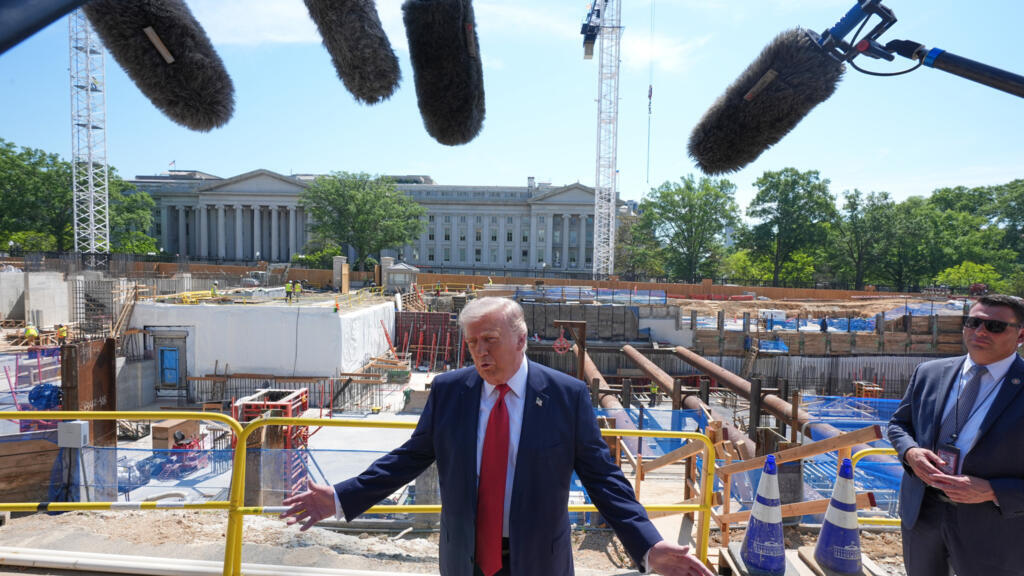
U.S. President Donald Trump said Washington was prepared to resume attacks on Iran if Tehran fails to agree to a peace deal, while suggesting he could wait “a few days” for what he called the “right answers.”
Speaking to reporters on Wednesday, Trump said the situation remained “right on the borderline” and warned that any escalation could happen quickly.
“Believe me, if we don’t get the right answers, it goes very quickly. We’re all ready to go,” Trump said at Joint Base Andrews. Asked how long he would wait, he said: “It could be a few days, but it could go very quickly.”
The remarks came six weeks after Trump paused Operation Epic Fury under a ceasefire arrangement. Talks aimed at ending the war have shown little progress, while rising gasoline prices have added political pressure on the White House ahead of U.S. congressional elections in November.
Trump again said Iran must not be allowed to obtain a nuclear weapon.
“We’re in the final stages of Iran. We’ll see what happens. Either have a deal or we’re going to do some things that are a little bit nasty, but hopefully that won’t happen,” he told reporters earlier in the day.
Iran warned that any renewed attack would trigger a wider conflict.
“If aggression against Iran is repeated, the promised regional war will extend beyond the region this time,” Iran’s Revolutionary Guards said in a statement.
Iranian President Masoud Pezeshkian said Tehran remained open to talks, but rejected pressure from Washington.
“Forcing Iran to surrender through coercion is nothing but an illusion,” he wrote on X.
Foreign Ministry spokesman Esmaeil Baghaei said Iran was negotiating “with seriousness and good faith,” but added that Tehran had “strong and reasonable suspicion” about Washington’s conduct.
Trump also spoke with Turkish President Tayyip Erdogan, who welcomed the extension of the ceasefire and told the U.S. president that a “reasonable solution” remained possible, according to Ankara.
Pakistan, which hosted the only round of peace talks so far, has continued to act as a channel between Washington and Tehran. Baghaei said the two sides were still exchanging messages through Pakistani mediation.
Iran submitted a new proposal to the United States this week. Tehran’s demands reportedly include an end to sanctions, compensation for war damage, the release of frozen funds, withdrawal of U.S. troops, and recognition of its control over the Strait of Hormuz.
Trump said on Tuesday that he had come within an hour of ordering renewed strikes this week following requests from several Gulf states.
The Strait of Hormuz remains a major flashpoint. Iran has largely restricted shipping through the waterway since U.S.-Israeli attacks began on February 28, creating one of the largest disruptions to global energy supplies in modern history. Washington responded last month by imposing its own blockade on Iranian ports.
Iran released a map on Wednesday identifying a “controlled maritime zone” at the strait and said ships would need authorization from a newly created authority to pass through.
Two large Chinese tankers carrying a combined 4 million barrels of oil exited the strait on Wednesday after Iran eased transit rules for Chinese vessels. South Korea also said one of its tankers was crossing the strait in coordination with Tehran.
Shipping monitor Lloyd’s List said at least 54 ships passed through the strait last week, nearly double the previous week’s figure, though still far below the roughly 140 daily crossings recorded before the war.
U.S. Treasury Secretary Scott Bessent told Reuters that he viewed elevated yields and inflation as temporary and expected both to ease once the conflict ends.
“The strait will open, and we’ll normalize energy prices,” he said.
The U.S.-Israeli bombing campaign has killed thousands in Iran since late February, before it was paused under the ceasefire in early April. Israel’s wider military operations have also killed thousands in Lebanon and displaced hundreds of thousands more, while Iranian strikes on Israel and Gulf states have killed dozens.
Trump and Israeli Prime Minister Benjamin Netanyahu launched the war saying their objectives were to dismantle Iran’s nuclear program, destroy its missile capabilities, curb Tehran’s support for regional armed groups, and weaken the clerical leadership.
But Iran has retained its stockpile of near-weapons-grade enriched uranium, while maintaining missile, drone and proxy capabilities that continue to alarm Washington and its allies.