
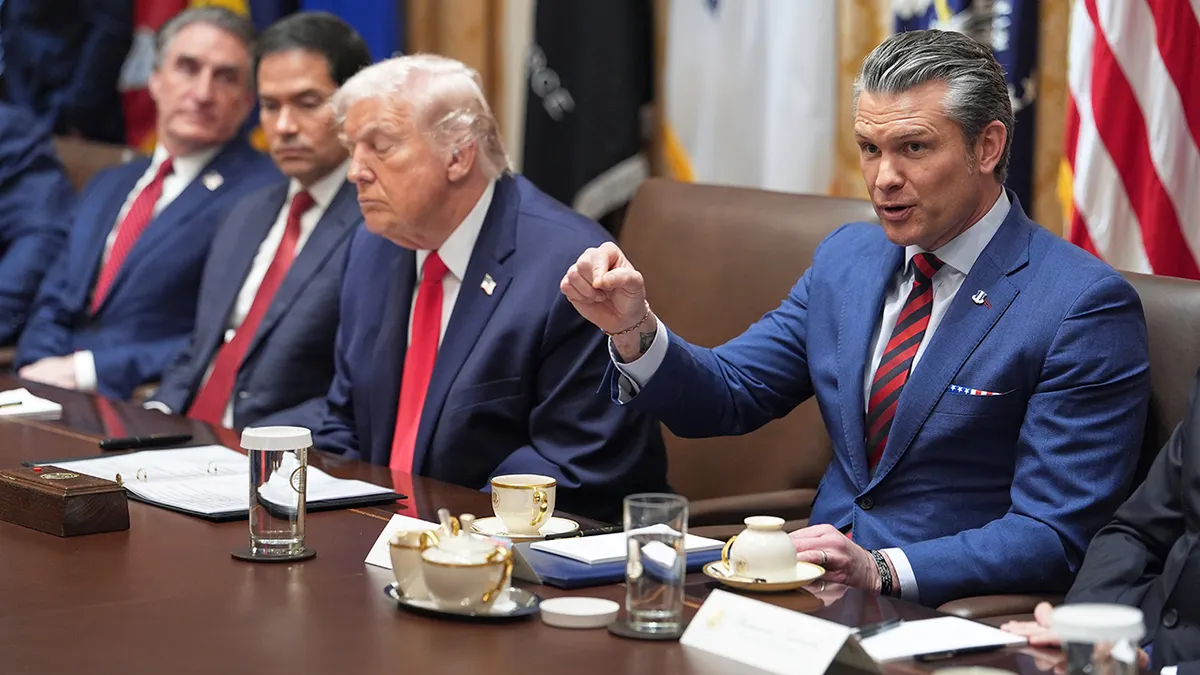
U.S. President Donald Trump has sparked controversy with sharply worded remarks about the future of the Strait of Hormuz, saying Washington would ensure the strategic waterway remains open and warning against any attempt to place it under the control of Iran or Oman.
Speaking during a White House cabinet meeting, Trump said the strait would remain “open to everyone,” rejecting any arrangement that would give a single country control over one of the world’s most important maritime chokepoints.
“No, the strait will be open to everybody. It’s international waters. Nobody is going to control it. We’re going to guard it,” Trump said in response to a question about possible transitional arrangements for managing the waterway.
He then made remarks that triggered diplomatic concern, appearing to warn Oman directly if it tried to impose control over the strait.
“Oman will behave like any other country, or we’ll have to blow it up,” Trump said, before adding in a separate phrasing that if it did not “behave,” Washington would have to “blow them up.”
The White House did not immediately issue a clarification on whether Trump had misspoken or intended to refer to Iran rather than Oman, a long-standing U.S. partner that has often played a mediation role between Washington and Tehran.
The U.S. State Department later reposted video and a transcript of Trump’s remarks without correction or clarification, giving the comments added political weight and reducing speculation that they were simply a slip of the tongue.
The remarks come amid continuing, largely undisclosed discussions over the future of navigation security in the Strait of Hormuz, as Iran seeks to reshape maritime arrangements in the region away from U.S.-led security structures.
Iranian Foreign Ministry spokesman Esmail Baghaei said the administration of the strait “has nothing to do with the United States,” adding that coordination was taking place between Tehran and Muscat.
Ali Bagheri Kani, deputy secretary of Iran’s Supreme National Security Council, has also said Iran and Oman are holding talks on a “new system” for vessels passing through the Strait of Hormuz. Observers say such a move would aim to establish a regional security framework in place of Western-led arrangements.
Oman, which maintains balanced relations with Washington, Tehran and Gulf capitals, is seen as attempting to position itself as a central mediator in any new security formula for the strait, while arguing that maritime security should remain a regional responsibility.
The political dispute comes as the fallout from the recent military confrontation involving the United States, Israel and Iran continues to weigh on global energy markets.
Since the war began on February 28, before a ceasefire was announced between Washington and Tehran on April 8, shipping through the Strait of Hormuz has faced severe disruption, amounting in practice to a near-blockade of maritime traffic.
The disruption pushed oil prices above $111 a barrel, raising fears of broader shocks to global energy supplies and higher fuel and industrial costs in several countries.
Trump has also appeared confused on several occasions during remarks on Iran, at one point appearing to mix up Iran and Venezuela while referring to a country that “no longer has a navy or air force,” language he has previously used to describe Iran after U.S. and Israeli strikes.
He has also given unclear answers on the future of a nuclear agreement with Iran and the possible expansion of the Abraham Accords, before referring some questions to an adviser. The adviser said Washington was continuing efforts to encourage more Arab states, including Saudi Arabia and Qatar, to join the accords.