
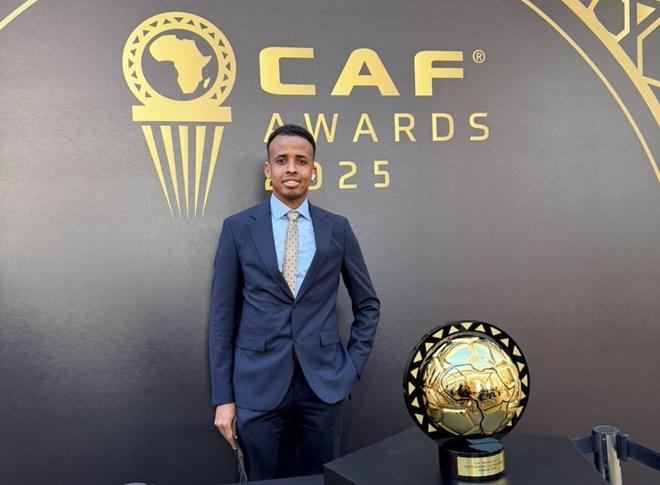
Somali football referee Omar Abdulkadir Artan returned to Mogadishu on Wednesday to a hero’s welcome after being denied entry to the United States ahead of the World Cup, a decision that has sparked anger and disappointment among Somali fans.
Artan, named Africa’s referee of the year in 2025, had been expected to become the first Somali official to take part in football’s biggest tournament. But he was turned back by US Customs and Border Protection over the weekend after arriving in Miami from Istanbul.
The Trump administration said Artan had been denied entry because of alleged links to “suspected members of terror organizations.” US officials later said he was deemed inadmissible over vetting concerns and described as a national security threat.
Speaking to reporters after landing in Mogadishu, Artan struck a calm tone and said he accepted what had happened.
“What happened has happened and it was fate. I am grateful for the support FIFA gave me,” he said.
“Somalia is ours, whether things are good or bad. I want to tell our youth not to lose hope in our country,” he added. “I am now in my country, and there is no other place I want to be.”
Later in the day, thousands of supporters gathered at a stadium in the Somali capital, where Artan was received as guest of honour at a football match. Fans carried Somali flags and photos of the referee, chanting in support of a man many said had already made history regardless of Washington’s decision.
“As young people, we really felt his pain. We all also have dreams. He made such a huge effort to reach the stage he reached and was eventually let down,” student Abdulqadir Ali Abokor told Reuters.
“For us and for many around the world, he is a champion, and this decision doesn’t make a difference,” he said.
Former referee and fitness instructor Abdi Abdulle Baasaale said the crowd had come to send a clear message of solidarity.
“We are here to show him that we stand with him,” he said.
Somali Prime Minister Hamza Abdi Barre, who met Artan on Wednesday, praised him as a national inspiration.
“Omar Artan has done more than unite the footballing world, he has ignited hope in every child who dares to dream beyond the horizon,” Barre wrote on X. “Dreams may be deferred, but they are never defeated.”
Artan’s case has drawn international attention, including from World Health Organization chief Tedros Adhanom Ghebreyesus, who said the referee had inspired a generation despite being kept away from the tournament.
“You reached the summit of your profession and inspired a generation back home just by getting there,” Tedros wrote on X, adding that the episode would not be the end of Artan’s story on the world stage.
Somali officials said Artan had been issued a diplomatic passport for his World Cup travel in an effort to avoid complications. A Somali diplomat in Nairobi said the passport had been provided specifically to ensure he did not face obstacles.
A US official, however, said Artan did not attempt to enter the United States using a diplomatic passport, without addressing whether he possessed one.
Somalia’s foreign ministry said it deeply regretted the US decision and said diplomatic efforts to secure Artan’s travel had failed.
FIFA said Artan would no longer be able to train or officiate at the tournament, which is being hosted by the United States, Mexico and Canada and begins on Thursday.
The incident has renewed scrutiny of the Trump administration’s strict immigration policies ahead of the World Cup, including a travel ban imposed last year on citizens of 12 countries, among them Somalia.
It remains unclear which match or matches Artan had been expected to officiate, as World Cup referee appointments are usually announced only a few days before games.