
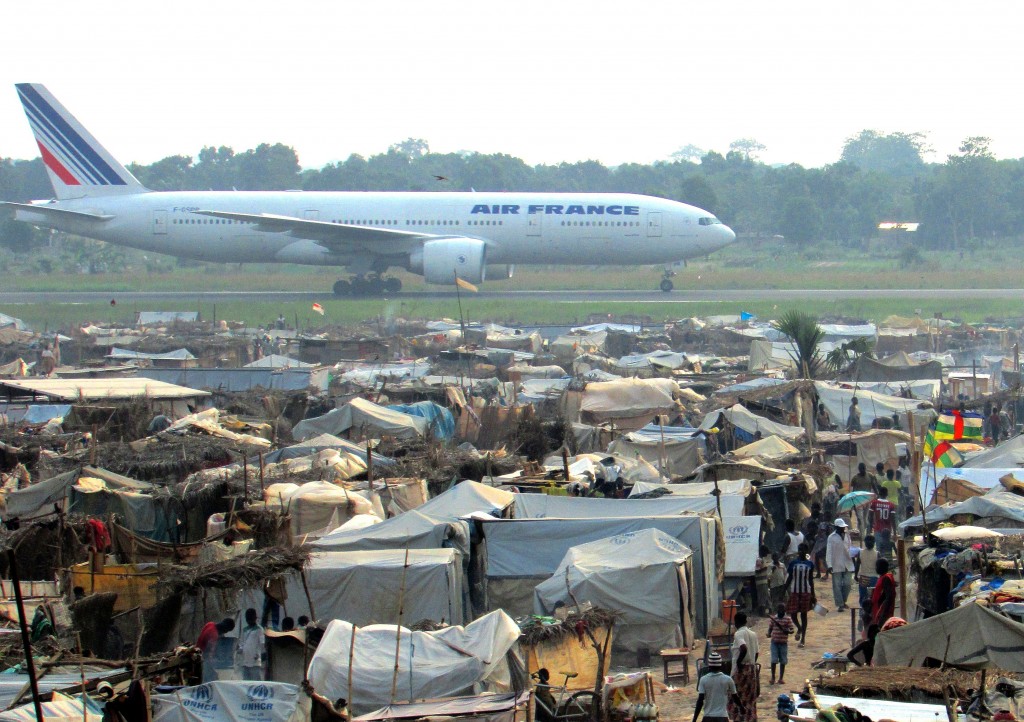
The Trump administration is preparing to deport several Iranians and other migrants to the Central African Republic, a country long affected by conflict, poverty and political instability, according to two lawyers and an official briefed on the matter.
The deportations would be carried out under a third-country agreement recently reached between Washington and Bangui, allowing the U.S. to send migrants to a country other than their homeland.
Among those expected to be deported are two Iranian women who could face torture or persecution if returned to Iran, their lawyer Emily Trostle said. One is a Christian convert, while the other is a pro-democracy activist.
Both women arrived in the United States in November 2024 and were detained after entering the country. They later applied for asylum and were granted withholding of removal by a U.S. immigration judge, Trostle said.
That protection is granted when a judge determines that a person faces a greater than 50% chance of persecution or torture if sent back to their home country.
The first deportation flight to the Central African Republic is expected to carry around 20 people, including Iranians, Syrians and Afghans, the official briefed on the matter said. Two lawyers said the plane could depart as early as Thursday.
A Turkish national who fled political persecution and was also granted withholding of removal may also be on the flight, according to the person’s lawyer, who spoke on condition of anonymity.
The U.S. State Department and the presidency of the Central African Republic did not immediately respond to requests for comment.
The Trump administration has increasingly relied on third-country deportation deals to remove migrants it cannot legally send back to their countries of origin. Washington has defended the practice as lawful, while rights groups and immigration advocates say the agreements are opaque and can leave vulnerable people exposed to further danger.
Central African Republic’s neighbour, the Democratic Republic of Congo, has also entered into a similar arrangement with the United States. Congo is currently facing an Ebola outbreak.
The planned deportations come as Washington remains deeply involved in the war with Iran. The United States and Israel launched major strikes on Iran in late February, triggering a conflict that has now lasted three months.
Trump told reporters in April that he believed Iranians should rise up against their government if a ceasefire were declared, though he acknowledged the danger they would face.
Ali Rahnama, interim legal director at the Iranian American Legal Defense Fund, said the deportation plan exposed a contradiction in U.S. policy.
“At the very moment the United States is promising the Iranian people freedom and support for standing against the Islamic Republic, it is sending Iranian asylum seekers who fled that same regime back toward their demise,” Rahnama said.
The deportees are expected to be housed in apartments in Bangui, the capital of Central African Republic, and are not expected to be immediately repatriated, the official briefed on the matter said.
Hundreds of migrants could eventually be sent to the country under the agreement, the official added.
The New York Times first reported the plan to deport Iranians to Central African Republic earlier on Thursday.
The U.S. Department of Homeland Security said last week that all deportees would receive full due process.
The International Organization for Migration said it would provide post-arrival humanitarian assistance to migrants sent to Bangui at the request of the Central African government. A spokesperson said the agency was not involved in the removals and would provide support only on a voluntary basis and in line with international standards.
The United States awarded $85 million to the IOM this year for operations in Central African Republic.
Central African Republic has endured repeated cycles of unrest since gaining independence from France in 1960. Much of its population of around 5.5 million people remains in poverty.
President Faustin-Archange Touadera signed peace deals last year with several rebel groups, while others have been weakened by Russian mercenaries, Rwandan troops and United Nations peacekeepers deployed to support the government.