
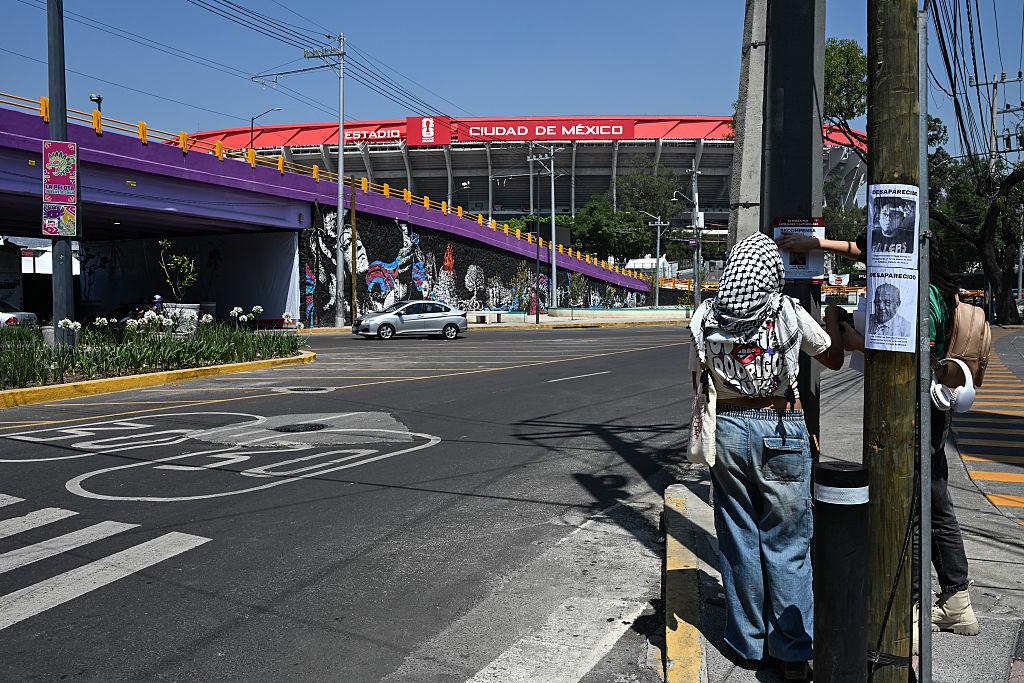
Families of Mexico’s disappeared marched in Mexico City as the World Cup opened, accusing authorities of staging a global football celebration while more than 134,000 people remain missing across the country.
The protesters were not calling out football. They were calling out abandonment.
Mothers, fathers and relatives of missing people carried photographs, banners and search posters near the opening of the tournament, demanding that Mexico’s disappearance crisis not be buried under FIFA branding, security cordons and televised celebration.
Their message was simple and impossible to dismiss: if Mexico can mobilise thousands of police, millions in public resources and a full state apparatus to protect a football tournament, then it can no longer pretend it lacks the capacity to search for its own missing citizens.
Mexican media reported that several protest currents converged around the World Cup opening. Families of the disappeared marched to denounce the country’s missing persons crisis, while teachers and other groups raised separate demands over labour rights, public spending and state priorities.
Not all the protesters came from the same movement. But the message converged: as Mexico staged a global football celebration, families of the disappeared, teachers and other demonstrators accused the state of burying its crises behind the World Cup.
The anger is not abstract. In Mexico, disappearance is a daily terror. People vanish on their way to work, after encounters with criminal groups, during disputes, after detention, or simply because they were in the wrong place at the wrong time. For many families, the search has become a lifetime sentence, carried out with little official help and at enormous personal risk.
The World Cup gave those families something the state has repeatedly denied them: visibility.
Authorities deployed heavy security around the stadium and restricted access to the area. Reports also described clashes near the stadium involving hooded protesters and police, separate from the families’ search collectives. But the broader image of the day was impossible to separate from Mexico’s deeper crisis: inside the stadium, FIFA spectacle; outside it, families asking why their sons, daughters, parents and siblings are still missing.
For the government, the World Cup was meant to showcase Mexico to the world.
For the families of the disappeared, it became a chance to show the world what Mexico has failed to confront.