
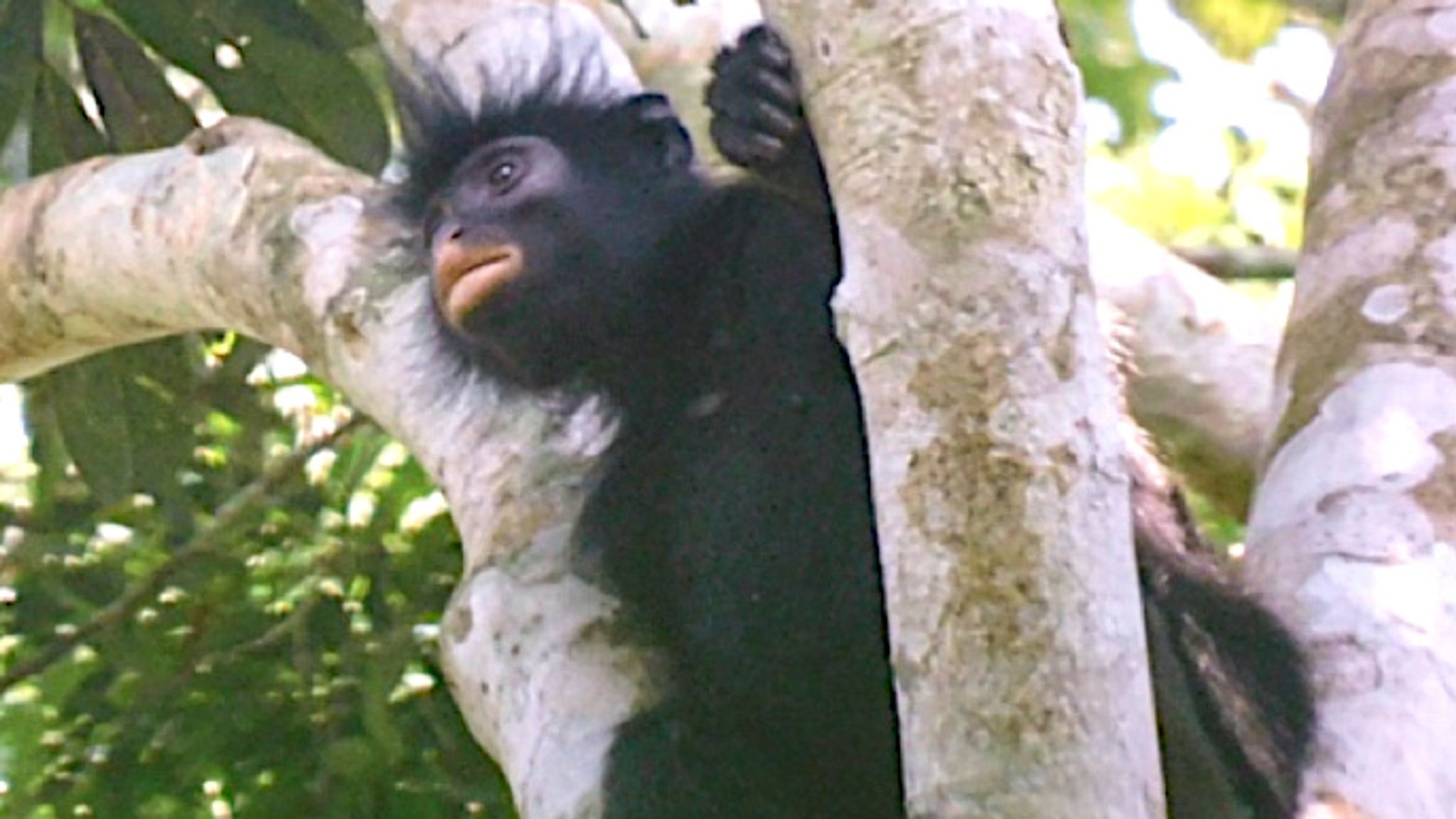
A rare monkey with striking pinkish-orange lips and a black face has been confirmed as a new species after years of research in the forests of the Democratic Republic of Congo.
The black-furred primate, known locally as Likweli, lives high in the dense tree canopy of Lomami National Park in the central-eastern part of the country.
Conservationists first reported seeing the unusual monkey in 2008, but obtained only a single blurry photograph. Another sighting a decade later prompted an international team of researchers to launch a detailed investigation.
Using photographs, audio recordings and genetic analysis, the scientists established that the animal was a previously unidentified species. Their findings were published in the scientific journal PLOS One.
The monkey has been given the Latin name Colobus congoensis, recognising the biodiversity of the Democratic Republic of Congo. It is only the fifth African monkey species to be formally described in the past 75 years.
Junior Amboko, a doctoral researcher at Florida Atlantic University who played a leading role in the study, said encountering an animal known to so few people was an extraordinary experience.
Researchers interviewed residents in 52 villages near the monkey’s habitat, but people in only eight villages reported having seen the animal. Amboko said the monkeys were shy and usually remained hidden high in the forest canopy.
Colobus congoensis belongs to the wider family of colobus monkeys, a group of leaf-eating African primates that lack thumbs.
Professor Kate Detwiler of Florida Atlantic University said colobus monkeys played an important ecological role by processing seeds and contributing to forest regeneration.
Researchers believe the monkey’s bright facial markings may help individuals recognise one another or could serve as a signal when attracting mates.
The newly identified species also produces a distinctive, resonant roaring call. Researchers said the monkeys were often heard before they were seen.
Scientists believe the species is rare and may be confined to a relatively small area of forest that provides the habitat and food it needs.
The monkeys are also hunted for meat, raising concerns about their long-term survival. Researchers hope that recognising Colobus congoensis as a distinct species will support efforts to grant it formal protection.
Further surveys are planned to estimate the monkey’s population, map its habitat and learn more about its behaviour.