
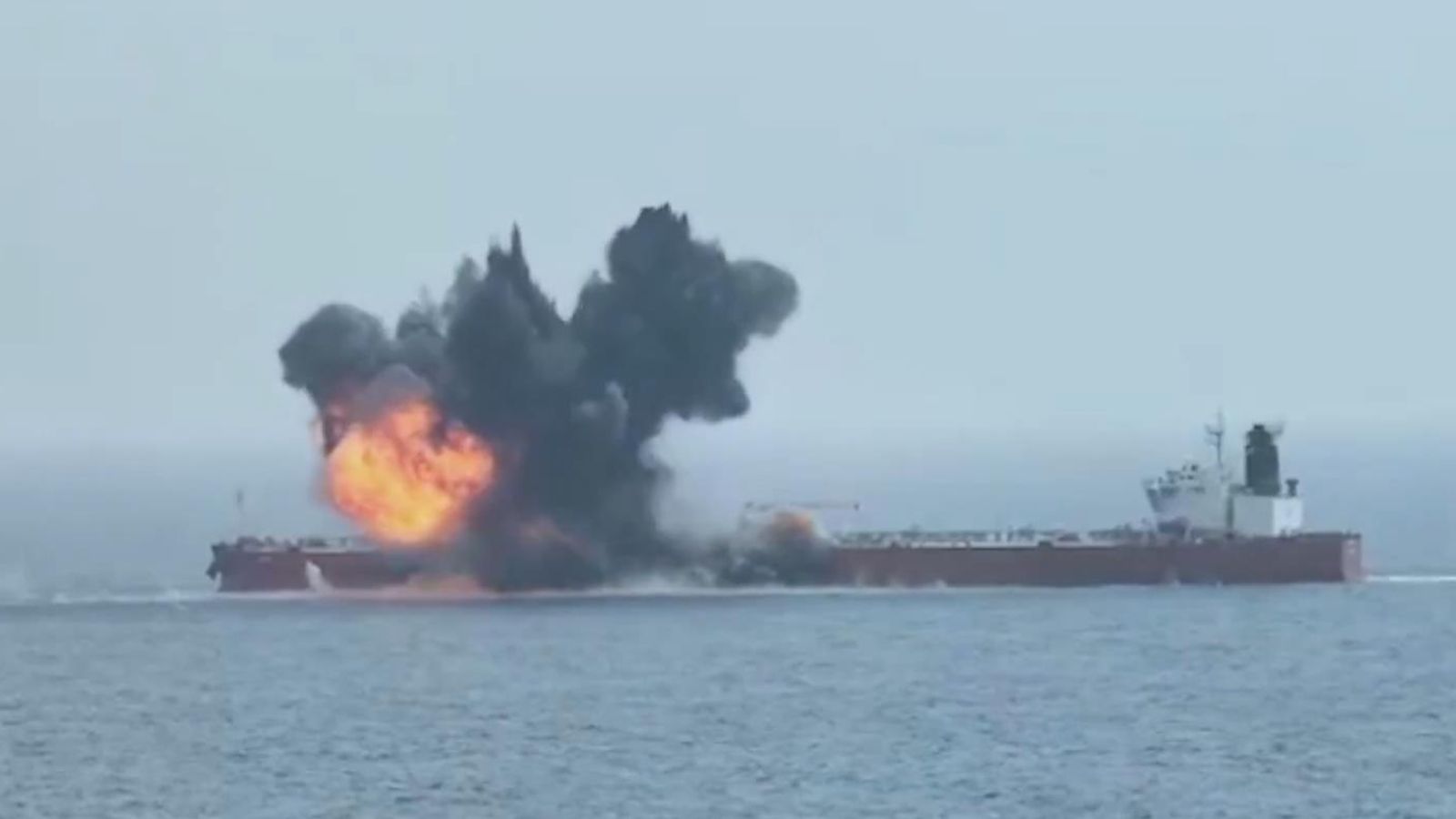
U.S. President Donald Trump threatened Iran and Yemen’s Houthi movement with severe military retaliation on Thursday after attacks on two Saudi oil tankers in the Red Sea raised fears that the Middle East conflict could disrupt a second major global shipping route.
Oil prices surged as the risk to maritime traffic expanded beyond the Strait of Hormuz. Brent crude climbed more than 6%, crossing $100 a barrel for the first time since May.
The escalation came two weeks after the collapse of an interim truce intended to halt the conflict. U.S. forces carried out another round of overnight strikes against Iran, while Tehran launched attacks toward neighbouring Arab states hosting American military facilities.
The Houthis said they had targeted the Saudi tankers Encelia and Layla with missiles and drones as part of a newly declared naval blockade against Saudi Arabia.
Trump said Washington would treat further Houthi attacks as Iranian actions, describing the Yemeni group as a proxy of Tehran.
“If they do this again, the U.S. will hold Iran responsible,” Trump wrote on Truth Social, warning that both Iran and the Houthis would face “major military punishment.”
Saudi Arabia has increasingly relied on pipelines to move oil toward Red Sea ports as Iranian actions disrupt tanker traffic through the Strait of Hormuz, the main maritime exit from the Gulf.
U.S. Secretary of State Marco Rubio said Iran would face growing pressure until it accepted a durable peace agreement.
“The price they pay will get higher every night,” Rubio told diplomats during a gathering in Southeast Asia, adding that Tehran had repeatedly failed to honour previous agreements.
Tanker struck near Jizan
A maritime security source said the Encelia issued a distress signal after being hit by a missile near the Saudi port of Jizan, just north of Yemen, late on Wednesday.
Saudi Arabia’s official news agency said the strike caused a fire in the vessel’s bow.
The reported attack on the Layla could not immediately be independently verified, although Trump referred to strikes against two Saudi tankers.
The attacks have intensified concerns over the Bab el-Mandeb Strait, the narrow waterway linking the Red Sea with the Gulf of Aden and Indian Ocean.
The route, whose name translates as the “Gate of Tears,” is one of the world’s most important passages for energy supplies and commercial shipping, second only to the Strait of Hormuz for oil transit.
Any prolonged disruption could force vessels to take longer and more expensive routes around southern Africa.
Iran attacks targets in Jordan and Kuwait
Iran, meanwhile, said it had struck U.S. missile systems, weapons depots and fuel facilities in Jordan, as well as American military positions in Kuwait.
Jordan’s armed forces said they had confronted four Iranian missiles and six drones during the previous 24 hours. All but one missile were intercepted, with the remaining projectile landing in an uninhabited area.
Iranian military spokesperson Brigadier General Mohammad Akraminia said Tehran would continue retaliating as long as the United States targeted Iranian infrastructure and coastal areas.
Since the United States and Israel launched the war in February, Iran has demonstrated its ability to strike American interests across the region despite earlier claims by Trump that Iranian military capabilities had been largely destroyed.
Four people familiar with U.S. intelligence assessments said Iranian attacks on CIA-linked targets earlier in the conflict had prompted an investigation into whether Russia had provided Tehran with targeting intelligence or drone-related assistance.
Shipping disruption fuels inflation fears
The surge in oil prices is adding to global inflation concerns and increasing political pressure on Trump’s Republican allies ahead of congressional elections in November.
Several tankers have altered course since the Houthis announced their blockade, avoiding the Bab el-Mandeb and changing planned routes.
Some vessels may now face significantly longer journeys around Africa to reach Asian markets, increasing shipping costs and delaying deliveries.
Shipping data showed that two Chinese supertankers carrying a combined 4 million barrels of Saudi oil were attempting to pass through the Bab el-Mandeb Strait on Thursday.
Current and former U.S. officials warned that a sustained Houthi campaign against Saudi shipping could widen the conflict and place further strain on American military resources in the region.
Threats against Iranian infrastructure
The latest confrontation follows the collapse of last month’s temporary agreement to halt fighting.
The deal unravelled amid tensions over the Strait of Hormuz, where Iran has sought to control the movement of Gulf energy exports by directing vessels closer to its coast and proposing future transit charges.
Iran has fired on ships using an alternative channel farther from its coastline that was promoted by Washington.
Trump said on Wednesday that the United States would destroy an Iranian bridge or power station each time Tehran attacked a vessel in the Strait of Hormuz.
Iran’s joint military command responded by threatening regional oil, gas, electricity and economic infrastructure, while warning that it could halt all petroleum exports from the region.