
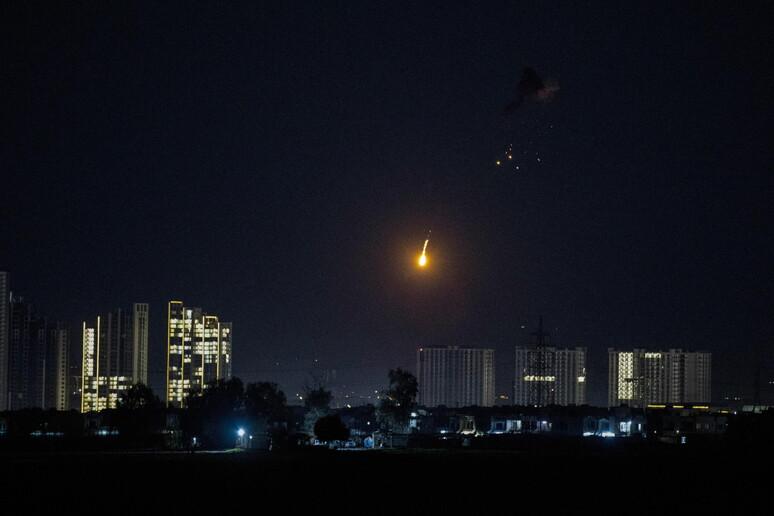
Drone attacks were reported across Saudi Arabia, Jordan and northern Iraq on Monday, two days after US President Donald Trump abruptly suspended a two-week bombing campaign against Iran, raising fears that Tehran and its regional allies are testing Washington’s latest military pause.
Saudi Arabia said its air defences intercepted drones targeting petroleum facilities, including sites in the capital, Riyadh. Saudi authorities said the aircraft were launched from Iraq by Iran-backed armed groups and warned that the kingdom reserved the right to respond.
In a separate development, Yemen’s Houthi movement said it had targeted oil transport infrastructure linking eastern Saudi Arabia to the Red Sea export hub of Yanbu. The group said the operation was carried out in retaliation for alleged Saudi drone incursions into Yemeni airspace.
Jordanian authorities also reported shooting down two drones, while Iraqi security sources said several drone attacks had taken place in the north of the country. Officials did not identify who was responsible for those incidents.
Jordan and northern Iraq were among the locations where four US service members were killed during Iran’s retaliatory attacks on American bases amid the recent two-week air campaign.
Trump suspended the bombing operation over the weekend after senior military commanders advised that the campaign had largely exhausted its available targets, according to a US official.
The president said on Monday that Washington remained engaged in what he described as “very deep talks” with Iran, but warned that the United States was prepared to take strong military action if diplomacy failed.
“Not much time. Either it goes fast or not at all,” Trump told Axios when asked how long he would allow negotiations to continue.
Iran has denied seeking the resumption of direct peace talks with Washington, although it has indicated that it would pause its own attacks for as long as the US suspension remains in place.
Tehran has also insisted that it remains in control of the Strait of Hormuz, the strategic waterway through which a significant share of global energy supplies passes. Trump has demanded that commercial vessels be allowed to use the strait without Iranian interference.
Oil prices fall after US bombing pause
Trump’s decision to halt the air campaign came without prior public warning after 13 consecutive nights of increasingly intense US strikes on Iran.
The suspension pushed global oil prices sharply lower. Brent crude fell by around 6.5% on Monday to slightly above $90 a barrel after briefly exceeding $100 last week for the first time since May. Prices fell as low as $87.55 during trading.
A US official told Reuters that military commanders had advised Trump they were running out of viable targets. General Dan Caine, chairman of the Joint Chiefs of Staff, had also raised concerns about the depletion of US air-defence munitions, the official said.
US Ambassador to the United Nations Mike Waltz said Trump had paused the campaign to create space for diplomacy. Trump, Secretary of State Marco Rubio and other senior officials have claimed that Iran was seeking an agreement.
Iranian Foreign Ministry spokesperson Esmail Baghaei rejected that account on Monday, saying reports that Tehran had requested renewed negotiations were false.
Messages were continuing to pass between the two sides through intermediaries, and Iran had not abandoned diplomacy, Baghaei said. However, he insisted Tehran had not asked Washington to restart talks.
Iran says six ships turned back in Hormuz
Iranian state media reported that six ships were prevented from crossing the Strait of Hormuz on Monday after allegedly attempting to pass without Tehran’s permission.
Citing an unidentified informed source, the reports described the vessels as “offending ships” and said one of them had been involved in an unspecified accident.
The United States has advised commercial vessels to travel through a route closer to the coast of Oman. Iran, however, maintains that ships should use a channel closer to the Iranian coast, where Tehran says it has the authority to regulate traffic and impose transit fees.
The latest US bombing campaign was launched after Iranian forces attacked vessels using the American-backed route through the strait.
Two weeks of US strikes killed scores of people in Iran and damaged bridges, tunnels and military installations in the country’s south. Iran responded by attacking US bases in neighbouring Arab states, killing four American service members.
Tehran also struck civilian infrastructure in Gulf countries, saying the attacks were retaliation for US strikes that had hit civilian areas inside Iran.
The suspension of the American campaign has left uncertainty over how Washington intends to pressure Tehran into loosening its control over the Strait of Hormuz.
The United States and Iran reached a preliminary framework in June for talks expected to take place by the end of August, covering Iran’s nuclear programme and other major disputes.
However, the two sides remain divided over the framework’s language on Hormuz. Washington says the agreement requires unrestricted commercial navigation, while Tehran argues that it retains the right to supervise and regulate maritime traffic.