
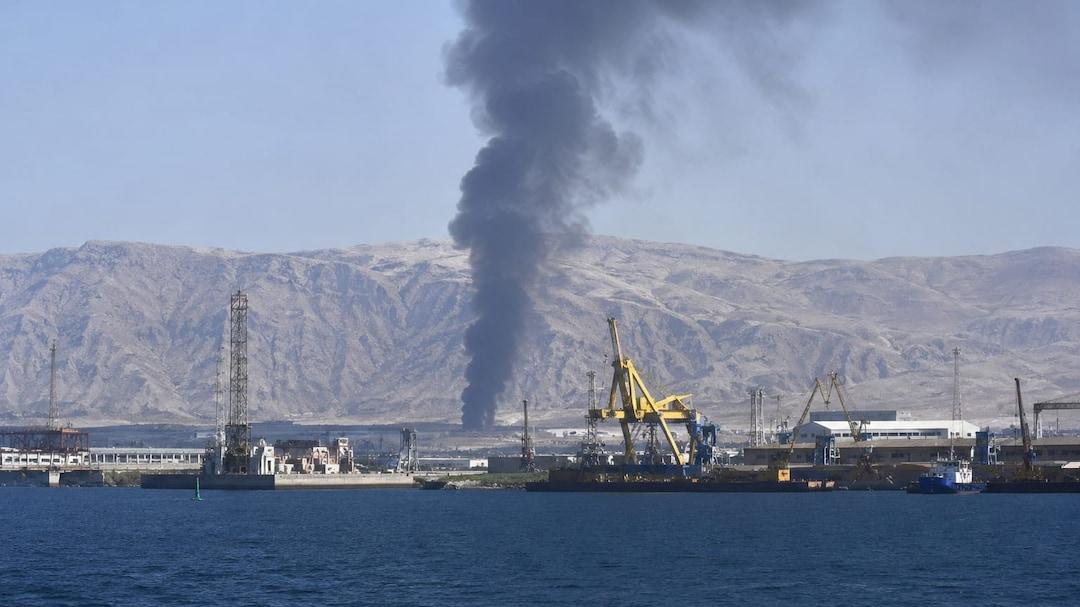
The United States launched a major new wave of airstrikes against Iran early Thursday, targeting dozens of Islamic Revolutionary Guard Corps command centres, drone facilities and maritime capabilities after Tehran fired ballistic missiles at American forces in the region.
US Central Command said the operation began at midnight GMT and continued for two hours, describing it as a “heavy wave of strikes” intended to weaken Iran’s ability to threaten US troops, commercial shipping and neighbouring Gulf states.
Iranian state media said at least three people were killed in strikes on Qeshm Island, a strategically located island near the Strait of Hormuz that hosts military and maritime infrastructure.
The attack marked the latest and most direct escalation in a rapidly widening regional conflict that has already spread into Jordan, Iraq, Saudi Arabia, Egypt and the waters surrounding the Arabian Peninsula.
Jordan intercepts five Iranian missiles
Jordan’s armed forces said Thursday that they had intercepted five Iranian missiles in what they described as an attempt to target the kingdom.
Iran confirmed a day earlier that it had fired ballistic missiles toward US forces stationed in Jordan. CENTCOM said all incoming missiles had been intercepted.
American military installations in Jordan have increasingly emerged as targets for Tehran as Iran seeks to retaliate against US attacks while expanding pressure on Washington’s regional allies.
US President Donald Trump had pledged a powerful response to the Iranian missile launches, while insisting that Washington remained open to negotiations aimed at ending the five-month conflict.
US and Saudi Arabia strike Iran-backed groups in Iraq
The strikes inside Iran came less than a day after US and Saudi forces jointly attacked Iran-aligned armed groups in eastern Iraq.
The operation, launched in retaliation for drone attacks against Saudi oil infrastructure that Washington and Riyadh said originated from Iraqi territory, marked the first publicly acknowledged Saudi participation in strikes alongside the United States.
Iraq’s Popular Mobilisation Forces said at least 20 of its members were killed and 32 wounded in attacks on several bases.
During funerals for the dead, Iraqi mourners carried body bags through the streets while chanting “Death to America.”
The Iraqi presidency condemned the operation as an unacceptable violation of the country’s sovereignty, but also called for armed factions to stop using Iraqi territory to launch attacks against neighbouring countries.
Iran has denied directing attacks from Iraq. However, the Iranian newspaper Hamshahri reported that four Revolutionary Guard advisers were killed in the US-Saudi strikes.
Following the operation, Saudi Defence Minister Khalid bin Salman met US Vice President JD Vance in Washington and urged the Trump administration to avoid further escalation against Iran-backed militias in Iraq or Yemen’s Houthi movement, according to two sources familiar with the talks.
One source warned that further military expansion could expose the region to “major unknown risks.”
Drone strike hits gas tanker in Egypt
The conflict also appeared to move closer to Egypt after a drone struck a US-owned gas storage tanker at the Mediterranean port of Damietta on Wednesday, according to British maritime security company Ambrey.
Egypt’s Petroleum Ministry confirmed that a fire had broken out at the port but did not mention a drone attack or identify the cause.
No group immediately claimed responsibility.
The incident raised fears that Egypt, which has so far sought to limit its direct involvement in the war, could become another front in a conflict increasingly targeting ports, energy facilities and commercial shipping routes.
The escalation comes after Yemen’s Iran-aligned Houthis announced a naval blockade against Saudi Arabia last week, further widening the maritime dimension of the war.
Strait of Hormuz remains central flashpoint
The conflict began in February, when the United States and Israel launched a bombing campaign against Iran that Trump initially said would last only several weeks.
A temporary ceasefire reached in June later collapsed as hostilities resumed over control of the Strait of Hormuz.
The narrow waterway, which connects the Gulf with the Gulf of Oman and the Arabian Sea, carried roughly one-fifth of global oil and liquefied natural gas supplies before the war.
Iran says it now controls passage through the strait and has repeatedly targeted vessels attempting to cross without authorisation.
Tehran said Wednesday that it had struck three tankers accused of travelling through an unauthorised route.
The strait has become the principal obstacle in peace negotiations and the most dangerous flashpoint in the conflict, with repeated attacks threatening global energy markets and international shipping.
Oman recently presented Tehran with a Gulf-backed proposal for joint management of the waterway, including a system of voluntary transit fees.
Iran rejected the proposal.
Oil prices surge as fighting expands
Oil prices jumped sharply on Wednesday as markets reacted to the renewed fighting and continued restrictions on traffic through Hormuz.
Brent crude climbed more than 8%, rising above $90 a barrel and reversing much of the decline recorded earlier in the week after Trump unexpectedly paused US strikes.
Prices eased slightly on Thursday but remained elevated amid fears that further attacks on Gulf infrastructure or shipping could cause another major supply shock.
Despite the expanding military campaign, Trump said Washington was still seeking a peace agreement with Tehran.
However, with US aircraft again striking targets inside Iran, missiles flying toward Jordan and Saudi forces entering the conflict in Iraq, the war is moving further away from containment and closer to a broader regional confrontation.