
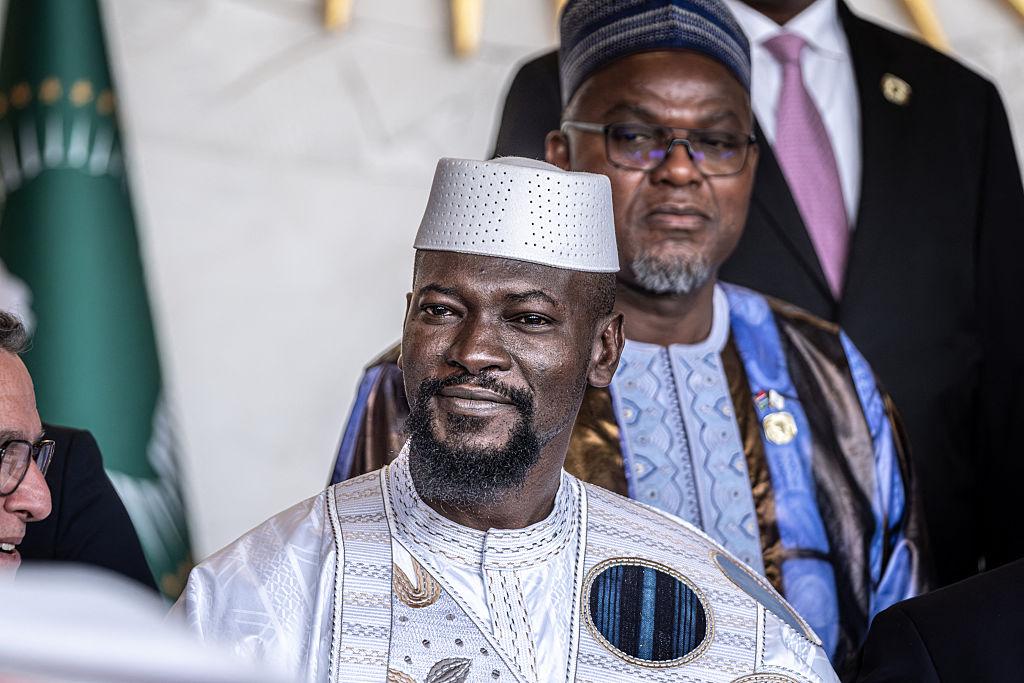
Guinean President Mamadi Doumbouya’s prolonged periods away from public view and his latest overseas holiday have fuelled fresh speculation over his health and political stability in the West African country.
Guinean authorities have sought to reassure the public that Doumbouya is in good health, as rumours surrounding the former special forces commander continue to circulate.
The latest controversy followed his departure from Conakry in early August for what the presidency described as a family holiday in Greece. Officials presented the trip as a rare, officially announced period of annual leave after several years of intensive government duties.
The presidency subsequently released photographs showing Doumbouya with his wife and family aboard a yacht, apparently seeking to counter mounting speculation over his condition.
But questions surrounding the president’s health predate the latest trip.
Doumbouya left Guinea on February 13 to attend an African Union summit in Addis Ababa and remained outside the country for several weeks afterwards. As speculation grew, officials insisted he was in “good health” and said he would return to Conakry.
His prolonged absence came only weeks after a presidential election in which his image dominated streets and campaign material across Guinea, despite the president himself making only limited public appearances.
Doumbouya later re-emerged, but observers again raised questions about his appearance when he attended a regional summit in Sierra Leone in July.
Holiday renews health speculation
The latest overseas trip has revived those concerns.
Guinean media outlets operating from exile have claimed that Greece was only one stop on Doumbouya’s journey and that he subsequently travelled to Cyprus for medical examinations.
Those claims have not been officially confirmed.
Other reports have attempted to reconstruct the movements of the presidential aircraft and suggested further travel outside Europe, but there has been no authoritative confirmation of the president undergoing treatment abroad.
Doumbouya himself appeared to address the controversy through a social media post accompanied by photographs of his family holiday, saying that wherever he was, he remained focused on serving Guinea.
The uncertainty has nevertheless created an increasingly tense political atmosphere.
Restrictions on access to social media and disruptions to internet services have added to concerns among opposition activists and journalists about the government’s handling of the speculation.
The authorities have not publicly linked the restrictions to rumours surrounding Doumbouya.
Fears of instability
Guinea’s history of military takeovers has ensured that any prolonged uncertainty over the president’s whereabouts quickly generates speculation about the stability of his government.
Opposition groups grouped under the Forces Vives de Guinée coalition have continued to challenge the legitimacy of the political system built under Doumbouya and have called for an end to what they describe as authoritarian rule.
Some opposition figures and commentators have raised the possibility of another military transition if the president became unable to govern, although there has been no confirmed evidence of an active coup attempt.
The armed forces have moved to publicly demonstrate unity around the president.
Chief of Staff General Ibrahima Sory Bangoura issued a televised statement reaffirming the military’s loyalty to Doumbouya and urging Guineans not to be drawn in by what he described as misinformation.
The unusual intervention underscored the sensitivity of the rumours in a country where the military remains a central political force.
From coup leader to elected president
Doumbouya seized power on September 5, 2021, when soldiers under his command overthrew President Alpha Condé.
He initially ruled Guinea as the head of a military transition before changes to the political framework allowed him to contest the December 2025 presidential election.
Doumbouya won the election and was sworn in as president in January 2026, formally transforming himself from military ruler into an elected head of state.
His critics, however, argue that the transition consolidated rather than dismantled the political system established after the 2021 coup, pointing to restrictions on opposition parties, civil society and independent media.
For now, the presidency maintains that Doumbouya is simply taking a period of rest and remains fully capable of governing.
But in a country shaped by repeated coups and military interventions, the lack of clarity surrounding his movements has been enough to keep rumours of ill health — and questions over what might follow — firmly alive.