
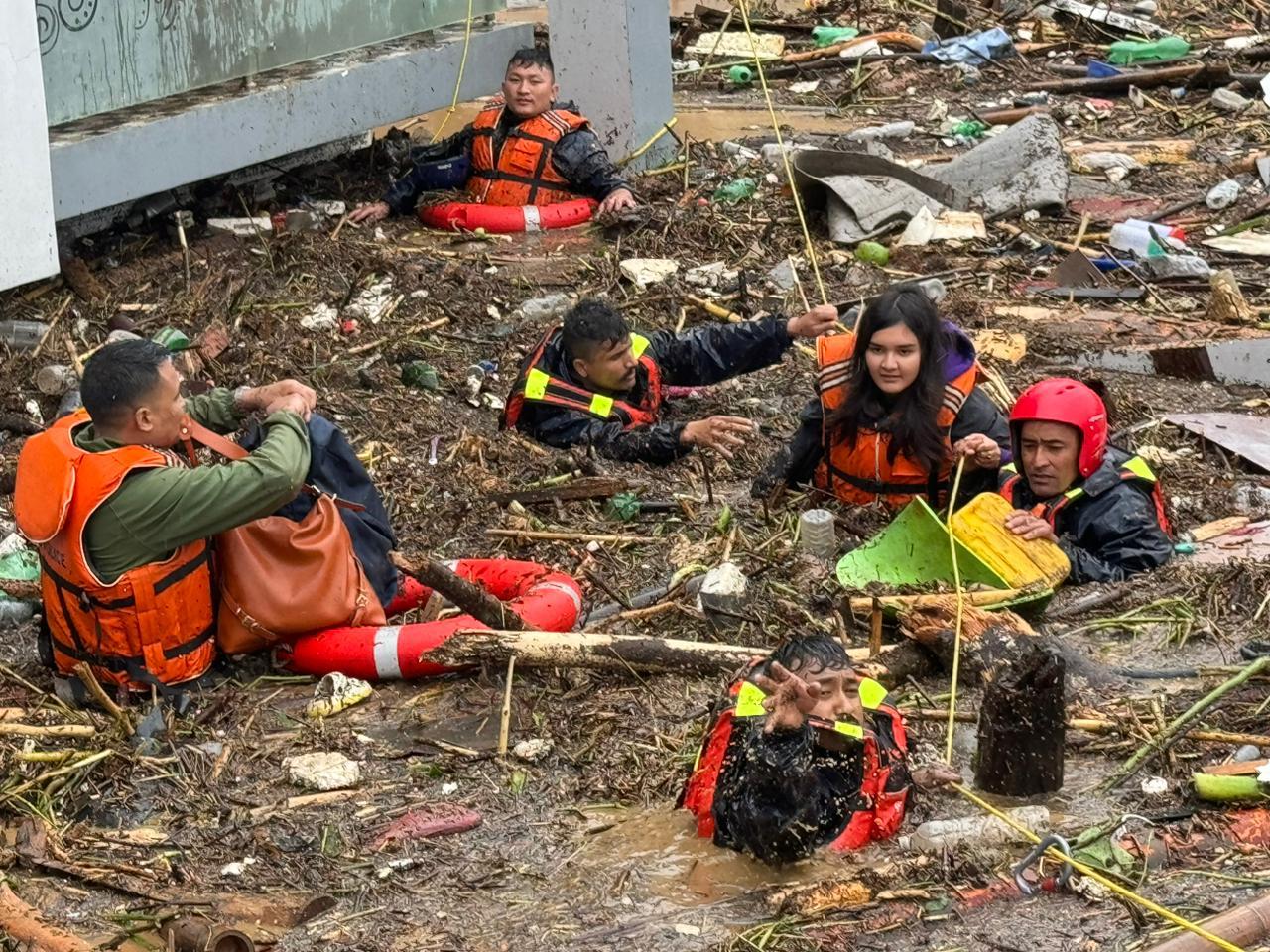
Rescue teams are racing to find survivors after the Nepal-China floods killed more than 1,270 people and left thousands missing across the Himalayan region.
Nepal’s National Disaster Risk Reduction and Management Authority said on Thursday that 1,252 bodies had been recovered in Nepal, while at least 4,216 people remained unaccounted for. Authorities in Tibet have reported another 21 deaths and 541 missing.
The disaster struck on August 26 after a massive surge of rock, ice, mud and water swept through communities near the Nepal-China border.
Scientists believe a glacier collapse in the Himalayas triggered the devastating flooding.
Nepal-China floods leave thousands missing
Search teams continue to work across some of Nepal’s hardest-hit areas, including Rasuwa and Nuwakot.
A major focus of the operation is the country’s hydropower facilities. Hundreds of workers remain missing, and rescuers fear some could be trapped inside tunnels.
Nepali soldiers and international experts have deployed heavy machinery to reach areas buried under mud and debris. Teams from India, China and South Korea are also supporting tunnel rescue operations, according to Nepal’s Ministry of Foreign Affairs.
Authorities are also using helicopters and other methods to reach communities cut off after roads and bridges were destroyed.
Despite the scale of the destruction, rescue teams continue to search for possible survivors.
Thousands of homes need rebuilding
The Nepal-China floods have also created a major reconstruction challenge.
Around 20,000 homes will need to be rebuilt, including approximately 7,500 that were completely destroyed, according to Nepalese disaster officials cited by Reuters.
Authorities are considering relocating some communities instead of rebuilding homes in areas vulnerable to future flooding.
Thousands of displaced residents are already staying in temporary shelters as humanitarian organisations work to provide food, clean water and other essential supplies.
The disaster has also affected schools, electricity infrastructure and hydropower projects across the region.
Families wait for news of missing relatives
For thousands of families, the search has become a painful wait for information.
In Kathmandu, forensic teams are working to identify recovered bodies. The scale of the disaster and condition of some remains have made identification difficult.
Official figures released Thursday showed that only 95 of the 1,252 bodies recovered in Nepal had been identified and handed over to their families.
Meanwhile, hundreds of foreign nationals are also among those still unaccounted for.
Climate concerns grow after Himalayan disaster
The catastrophe has renewed concern about the vulnerability of Himalayan communities to climate-related disasters.
Nepalese officials have pointed to rising temperatures and glacier instability while calling for greater international support.
Prime Minister Balendra Shah has said the government will continue rescue operations while beginning rehabilitation and reconstruction efforts.
With thousands of people still missing, authorities say the immediate priority remains finding survivors and reaching isolated communities.
The full human and economic impact of the Nepal-China floods is likely to become clearer as rescuers gain access to more of the devastated region.