
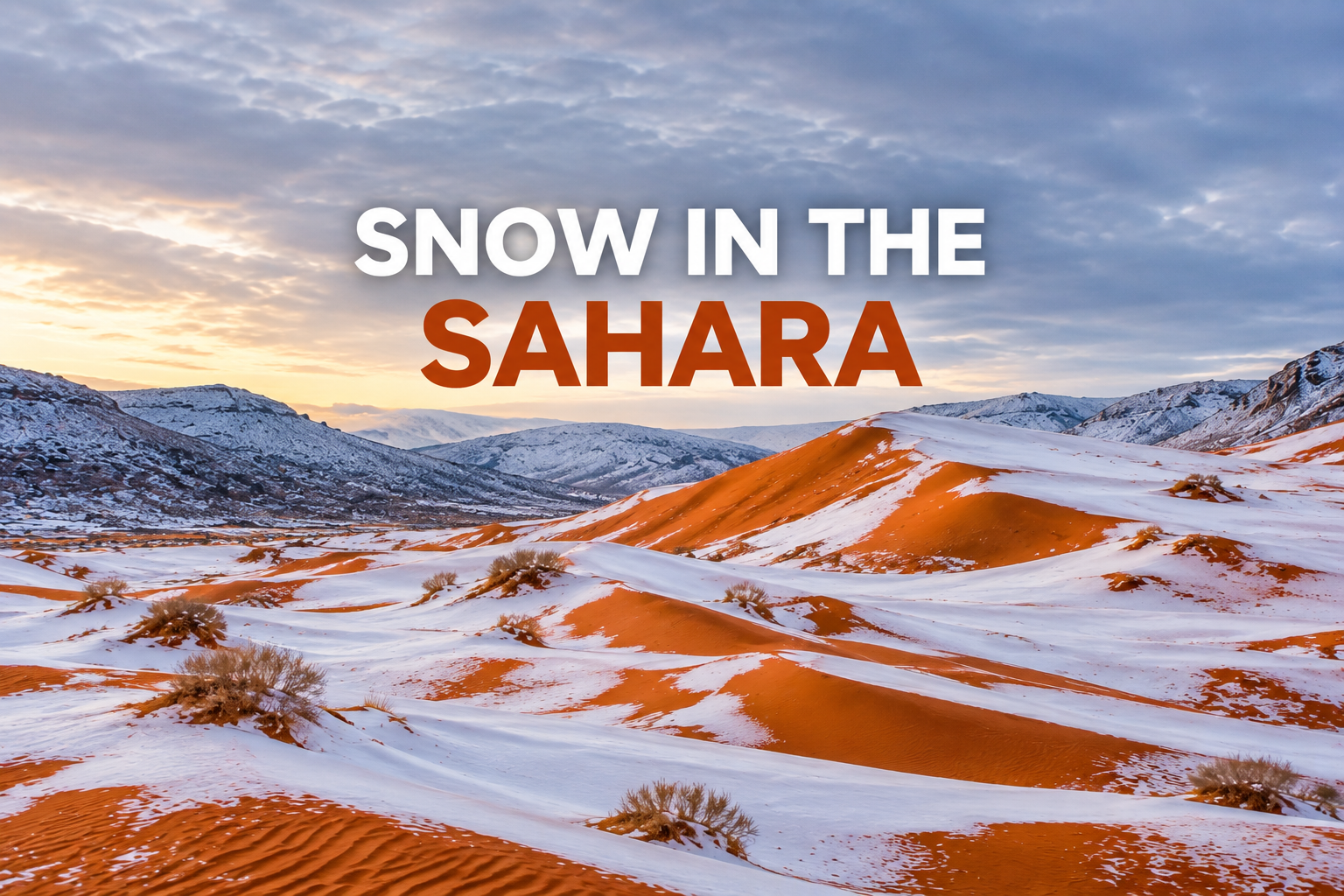
Illustration: AI-generated with OpenAI
The Sahara is famous for scorching temperatures, endless sand dunes and some of the driest landscapes on Earth.
But every now and then, something unexpected happens.
It snows.
Snowfall has been recorded in parts of the Sahara, including around the Algerian town of Ain Sefra, where white snow has covered normally golden and red desert landscapes.
It is rare, but there is nothing impossible about snow falling in the world’s largest hot desert.
Why does it snow in the Sahara?
The Sahara is extremely hot during much of the year, but being a desert does not mean it is always hot.
Deserts are primarily defined by their lack of precipitation, not by temperature.
During winter, parts of the northern Sahara can become surprisingly cold, especially at night.
Ain Sefra also sits at an elevation of roughly 1,060 metres above sea level, helping temperatures fall much lower than people might expect from a Saharan location.
When sufficiently cold air arrives at the same time as moisture, snow can form.
The result is one of Africa’s most unusual sights: snow-covered desert dunes.
The Sahara turned white in 2016 and 2017
One particularly famous snowfall occurred in December 2016.
According to Britain’s Met Office, it was reported as the first snow in that part of the Sahara for 37 years.
Then it happened again.
In January 2017, snow covered parts of the desert, with some areas experiencing substantial drifts. The event was significant enough to be visible from space using NASA’s Terra satellite.
Images of orange desert dunes covered by white snow quickly attracted attention around the world.
Deserts can actually get very cold
It may seem strange because deserts are usually associated with extreme heat.
However, dry desert air contains relatively little water vapour. Without much moisture and cloud cover to retain heat, temperatures can fall sharply after sunset.
Altitude can make conditions even colder.
That means a winter day in the Sahara can be very different from the extreme summer temperatures usually associated with the desert.
Snow is still unusual because cold temperatures alone aren’t enough. Moisture and suitable atmospheric conditions also need to arrive at the same time.
When they do, parts of the Sahara can briefly look more like a winter landscape than one of the world’s great deserts.
Africa is more climatically diverse than many realise
The Sahara snowfall is also a reminder of Africa’s enormous climatic diversity.
The continent contains tropical rainforests, Mediterranean coastlines, high mountains, savannas and vast deserts.
Some African mountains even have permanent or long-lasting ice and snow at sufficiently high elevations, although these ice fields have been shrinking.
So while seeing snow covering Saharan sand might look impossible, the science behind it is relatively straightforward.
Even the Sahara can have a snow day.