
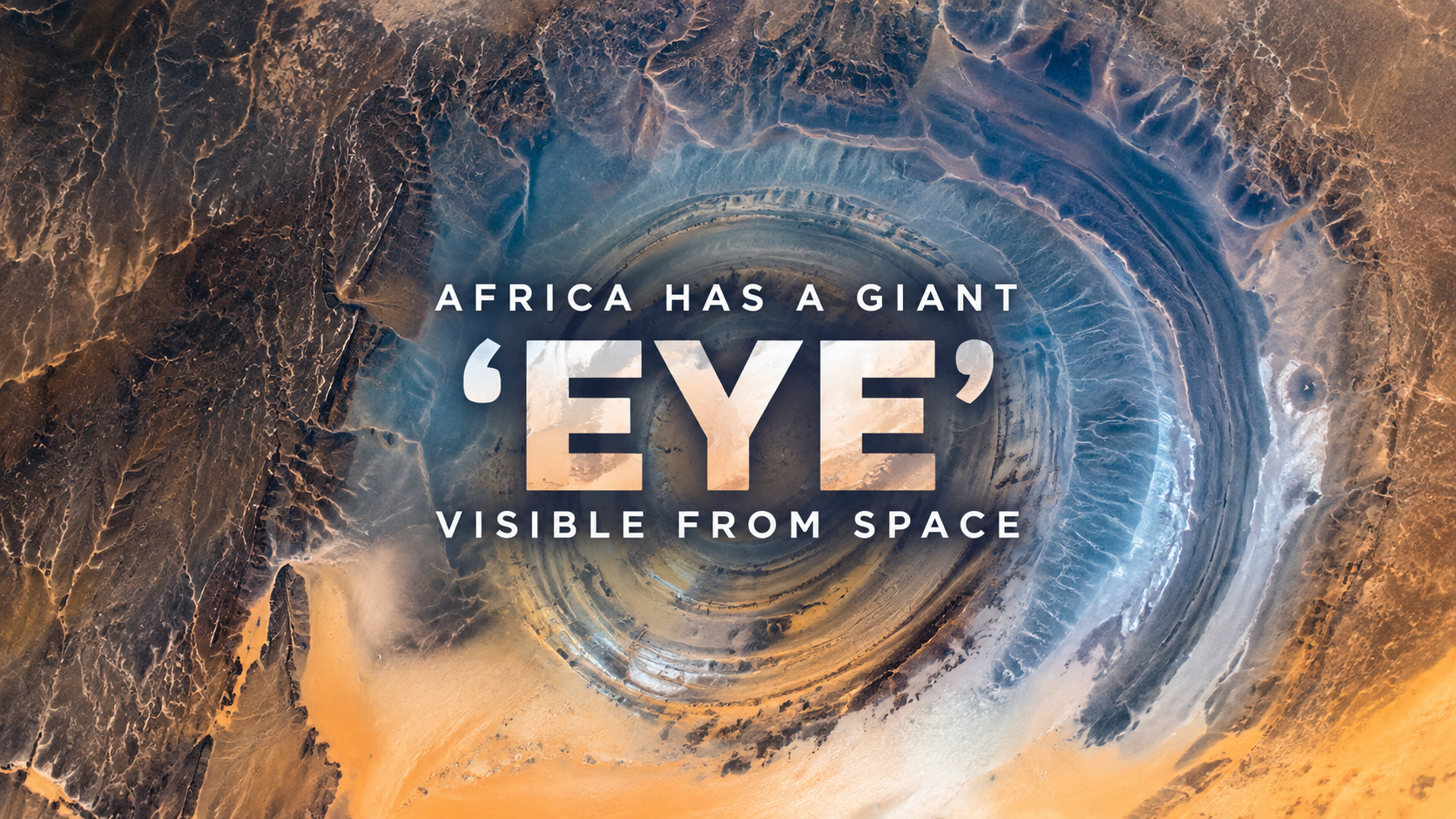
Deep in the Sahara Desert lies a huge natural formation that looks remarkably like an eye when viewed from space.
Known as the Richat Structure, the circular formation sits in Mauritania in northwest Africa.
It stretches about 40 kilometres across and is surrounded by the vast landscape of the Sahara.
Its unusual appearance has earned it the nickname “Eye of the Sahara.”
What is the Eye of the Sahara?
The Richat Structure consists of enormous rings of rock.
From the ground, its overall shape can be difficult to recognise.
However, the pattern becomes much clearer when viewed from above.
NASA satellite images show the rings forming a giant bull’s-eye across Mauritania’s Adrar Plateau.
The structure is so distinctive that astronauts helped bring wider attention to it after photographing the area during early space missions.
Is it a giant meteor crater?
For years, researchers considered whether the Richat Structure could have been created by a meteorite impact.
Its nearly circular shape made that explanation seem possible.
However, geological research later showed that it is not an impact crater.
Instead, scientists describe it as a deeply eroded geological dome.
Rock beneath the area was pushed upwards. Over long periods, erosion gradually exposed different layers of rock.
Because those rocks eroded at different rates, they formed the striking circular ridges visible today.
Why does it look like an eye?
The effect comes from the structure’s concentric rings.
Different sedimentary and igneous rocks also create changes in colour across the landscape.
Together, the rings and contrasting rock formations create the eye-like appearance seen in satellite and astronaut photographs.
NASA says the feature measures around 40 kilometres, or 25 miles, across.
That makes the “Eye of the Sahara” far larger than its appearance in photographs might suggest.
A landmark visible from space
The Richat Structure has attracted the attention of astronauts for decades.
Today, modern satellite imagery provides detailed views of its rings, surrounding dunes and ancient landscape.
It is not really an eye, of course.
Instead, the Eye of the Sahara is an extraordinary example of how geological forces and erosion can create patterns large enough to stand out from space.