
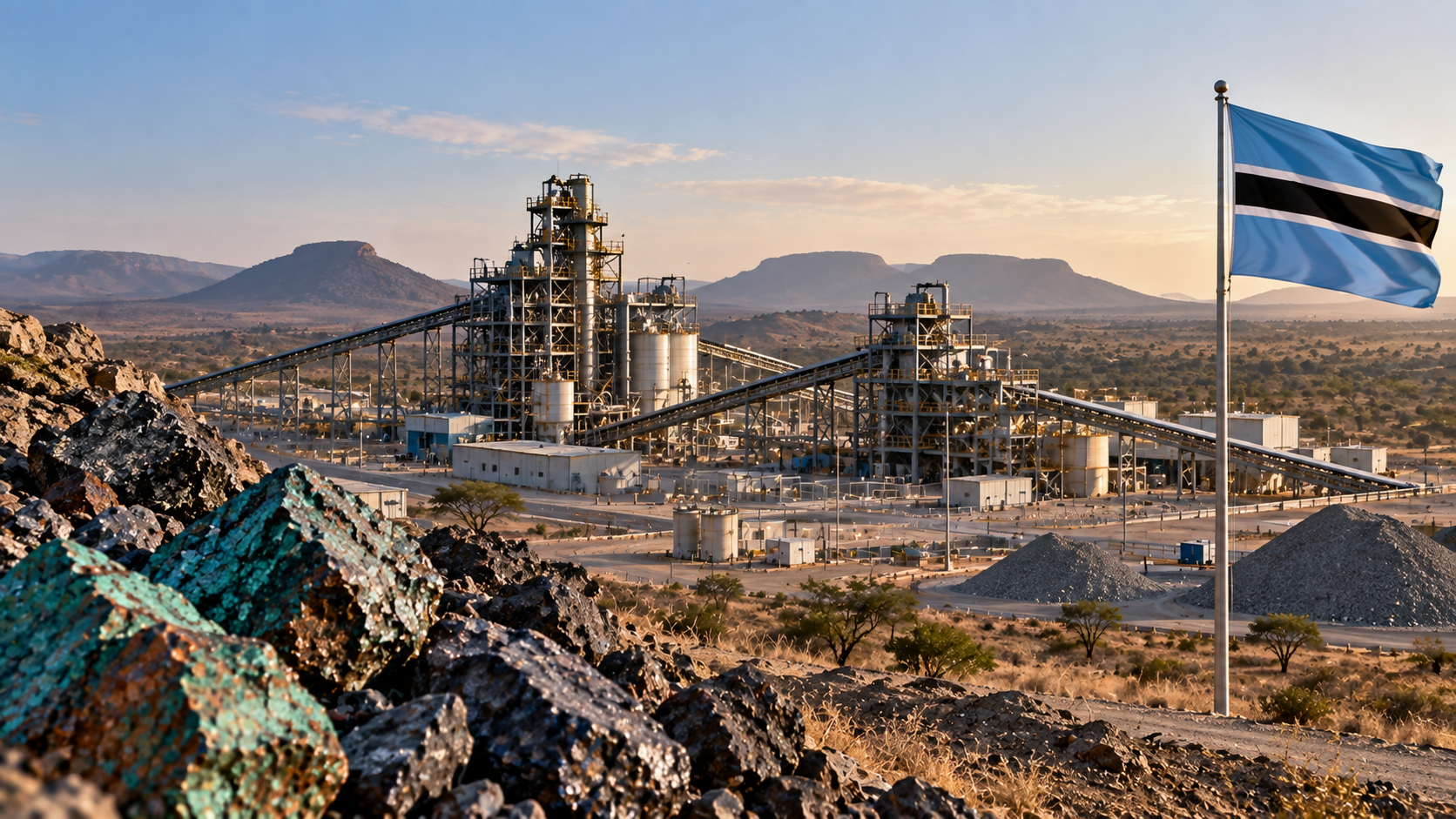
Botswana has cleared plans for a $140 million battery minerals plant.
Mining chemicals company Kemcore has received environmental approval for the project.
The planned facility will produce chemicals used by copper and cobalt mines. It will mainly supply operations in Zambia and the Democratic Republic of Congo (DRC).
Botswana battery minerals plant moves forward
The environmental clearance marks an important step for the project.
However, construction has not started yet.
Kemcore aims to secure financing by December 2026. Construction is then expected to begin in 2027.
Meanwhile, initial production is planned for the first half of 2028.
Plant will support copper and cobalt mining
The plant will produce chemicals used to process minerals.
These include sodium metabisulphite, sodium hydrosulphide and sodium isobutyl xanthate.
Once fully operational, the plant could produce around 150,000 metric tons of mining chemicals each year.
The products will mainly serve copper and cobalt mines in Zambia and the DRC.
As a result, the project could support mineral processing across the region.
Botswana to use local raw materials
The project will also use raw materials available in Botswana.
These include gas, soda ash and salt.
Kemcore is in talks to secure gas from Botala Energy’s coal-bed methane project.
In addition, soda ash and salt are expected to come from the Botash mine.
The mine is about 300 kilometres from the planned facility.
New industrial hub planned
The plant will be located at the planned Leupane Energy Hub and Industrial Park in central Botswana.
Botala Energy also plans to develop up to 700 megawatts of hybrid gas and solar power at the site.
Kemcore says the facility would become Southern Africa’s first integrated battery minerals chemical complex.
Therefore, the project could give Botswana a larger role in the regional mineral supply chain.
However, the project must still secure financing before construction can begin.