
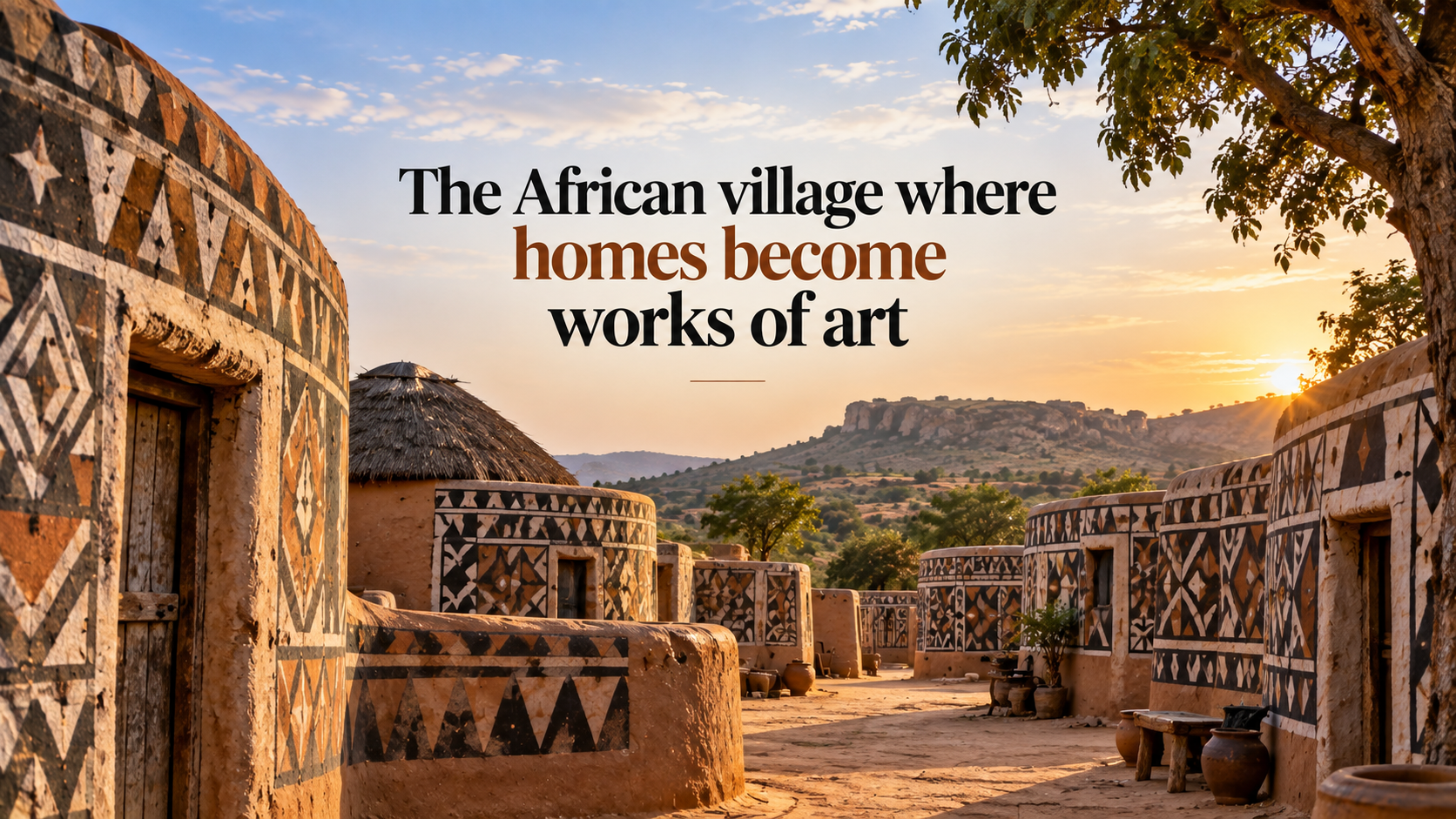
In southern Burkina Faso, an extraordinary village turns the walls of its homes into striking works of art.
Tiébélé, near the border with Ghana, is known for the decorated homes of the Kassena people.
The buildings feature bold geometric patterns painted across their exterior walls.
But the designs are more than decoration. They are part of a building and artistic tradition passed down through generations.
The painted houses of Tiébélé
Tiébélé is home to the royal court of the Kassena community.
Traditional compounds are built using local materials such as earth, wood and straw.
Many walls are then decorated with geometric designs in contrasting natural tones.
The result gives Tiébélé its distinctive appearance.
Circles, lines, triangles and other patterns can cover entire walls.
Women play a central role
Women traditionally play an important role in decorating the buildings.
They create patterns on the walls using locally available materials and pigments.
The designs can carry cultural and symbolic meanings. However, their interpretation can vary depending on the pattern and local tradition.
The decorated surfaces also have a practical purpose.
Traditional finishing techniques can help protect earthen walls from rain and weather.
Architecture shaped by local life
The shape of the buildings is just as distinctive as their decoration.
Traditional Kassena compounds include different types of structures designed for family and community life.
Thick earthen walls also help regulate temperatures inside the buildings.
This makes the architecture closely connected to the local environment.
A tradition preserved across generations
The painted homes of Tiébélé show how architecture, craftsmanship and community traditions can come together.
The designs are maintained and renewed over time rather than simply preserved as static artworks.
That means the village’s appearance continues through the skills of new generations.
In Tiébélé, a wall can be much more than part of a building.
It can also become a canvas for one of Burkina Faso’s most distinctive architectural traditions. in culpa qui officia deserunt mollit anim id est laborum.