
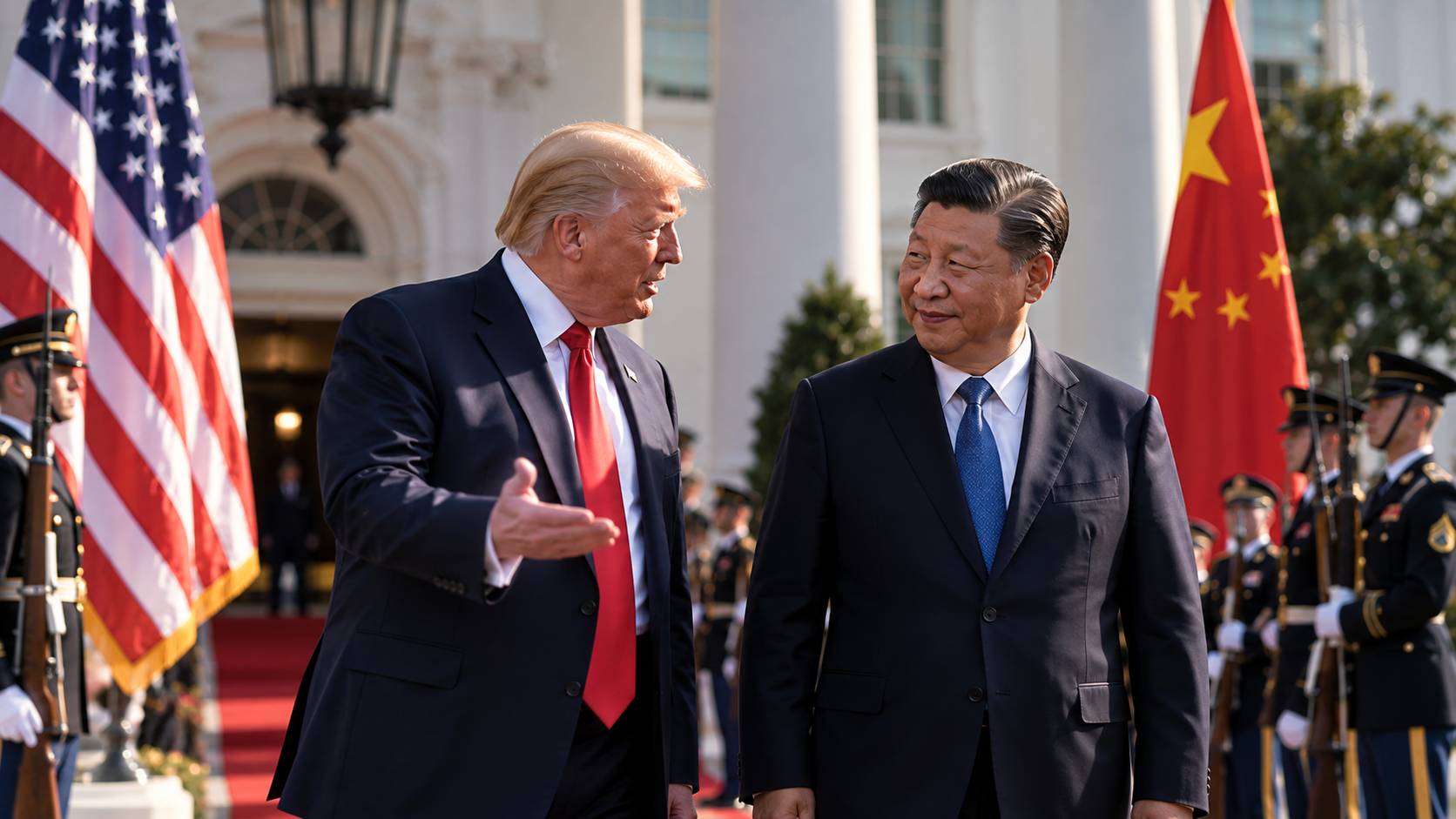
US President Donald Trump and Chinese President Xi Jinping have sought to project stability in relations between Washington and Beijing following high-level talks at the White House.
Trump described Thursday’s meeting as “great”, while Xi called for competition between the world’s two largest economies to remain controlled.
However, major differences over Iran, Taiwan, trade and technology remained unresolved following the talks.
Trump and Xi emphasise stable relations
Trump welcomed Xi during the Chinese president’s three-day state visit to the United States.
The US president highlighted his personal relationship with Xi and said it was based on mutual respect and the interests of both countries.
The meeting followed a period of significant economic tension between Washington and Beijing.
Trump’s tariffs on Chinese goods had triggered a wider trade dispute before the two governments moved to reduce tensions.
Xi, meanwhile, said the two countries should avoid allowing their rivalry to develop into conflict.
“It should be a race of catching up with one another, not a wrestle in which one either wins or loses,” Xi said.
He called for what he described as “healthy” competition between the two powers.
Iran remains a major point of disagreement
The war involving the United States, Israel and Iran was also discussed during the summit.
Trump has called on China to support Washington’s efforts to increase economic pressure on Tehran.
China is Iran’s largest trading partner and has been reluctant to adopt Washington’s approach, according to the Al Jazeera report.
No breakthrough on Iran was reported following Thursday’s talks.
Xi instead expressed support for the United States and Iran returning to negotiations and an interim agreement intended to lead towards a broader peace deal.
Xi raises Taiwan with Trump
Taiwan remained another major source of disagreement.
China considers Taiwan part of its territory, while Taiwan’s government rejects Beijing’s sovereignty claims.
Chinese state news agency Xinhua said Xi urged Trump during the meeting to oppose Taiwanese independence and approach the issue “prudently”.
The White House had not released its own detailed account of the Taiwan discussion at the time of the report.
The United States does not maintain formal diplomatic relations with Taiwan but is required under US law to provide the island with the means to defend itself. Reuters reported ahead of the summit that Beijing was expected to press Washington over US arms sales to Taiwan.
Trade and technology remain on the agenda
Economic relations remain central to the US-China relationship.
Both governments have sought to prevent their trade dispute from escalating while disagreements continue over tariffs, technology and export restrictions.
Artificial intelligence was also among the issues surrounding the summit.
Despite those differences, both leaders used the meeting to emphasise dialogue and stability rather than confrontation.
Reuters reported that the summit produced no clear breakthroughs on the major disputes dividing Washington and Beijing.
US lawmakers divided over Xi visit
Xi’s reception in Washington also generated debate among US lawmakers.
Republican Senator Roger Wicker criticised the decision to give the Chinese president an elaborate welcome.
Democratic Senator Chris Van Hollen also criticised Trump’s approach towards Xi.
However, Republican Senator Rand Paul welcomed the talks and argued that continued diplomacy could reduce the risk of conflict between the two powers.
The summit therefore ended with both leaders publicly supporting more stable relations, while the most difficult disputes between their governments remained unresolved.