
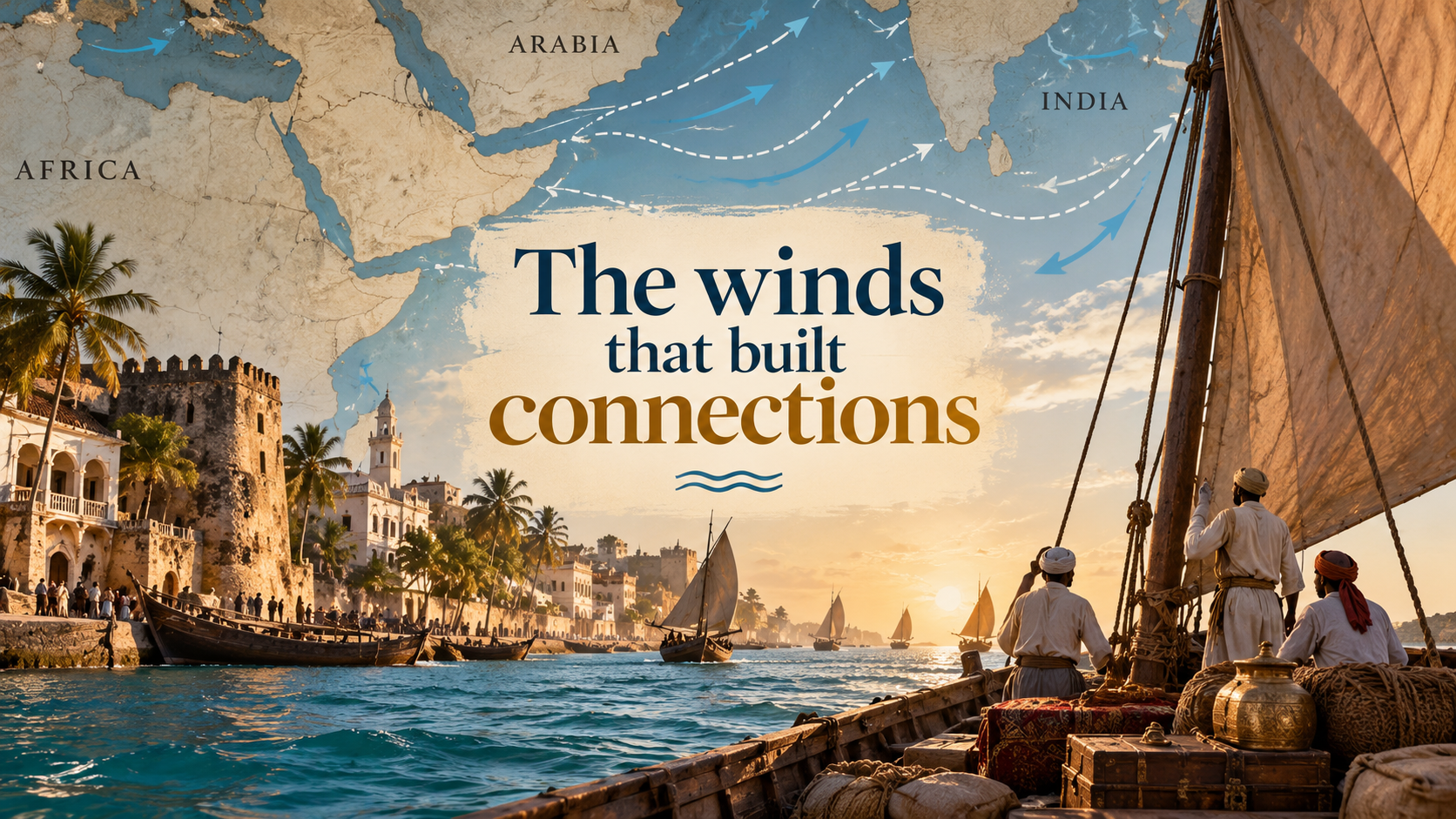
Long before engines powered ships across the Indian Ocean, sailors had another source of power: the wind.
For centuries, merchants travelling between East Africa, Arabia and India learned to use the Indian Ocean’s seasonal monsoon winds.
These winds changed direction during different parts of the year. That made long-distance voyages more predictable.
The result was one of the world’s great maritime trading networks.
A natural timetable across the ocean
Monsoon winds follow a seasonal pattern across the Indian Ocean.
Sailors learned when the winds would carry ships in one direction and when changing conditions could help bring them back.
UNESCO notes that regular and predictable monsoon winds connected the East African coast with Arabia and the Indian subcontinent. UNESCO World Heritage Centre
Instead of fighting against the weather, sailors planned journeys around it.
That helped turn the Indian Ocean into a major route for trade and travel.
East Africa became part of a huge trade network
The East African coast was ideally placed to benefit.
Over time, coastal trading centres developed links stretching across the Indian Ocean.
Cities including Mombasa, Malindi and Kilwa became part of networks connecting Africa with Arabia, India and areas farther east. UNESCO World Heritage Centre
Ships carried African products such as gold and ivory overseas. Imported goods included cloth, glass beads, ceramics and other products from across the Indian Ocean world. UNESCO World Heritage Centre
The connections were not limited to goods.
People, languages, beliefs and cultural practices also travelled along these maritime routes.
Monsoon winds helped shape the Swahili Coast
These connections became an important part of the history of the Swahili Coast.
UNESCO describes Swahili communities as long-distance seafarers who mastered the monsoon wind system to trade across the Indian Ocean. UNESCO World Heritage Centre
The Metropolitan Museum of Art also notes that monsoon-driven currents helped connect coastal Africa with the Persian Gulf and regions farther east. The Metropolitan Museum of Art
Over centuries, these connections contributed to the development of prosperous coastal communities and a distinctive Swahili culture.
The ocean was a connection, not a barrier
Today, looking at a map, the Indian Ocean may appear to separate East Africa from Arabia and India.
Historically, it often did the opposite.
Predictable seasonal winds gave sailors a way to cross enormous distances.
Long before modern cargo ships and aircraft, the monsoon helped connect East Africa to a trading world stretching across the Indian Ocean.