
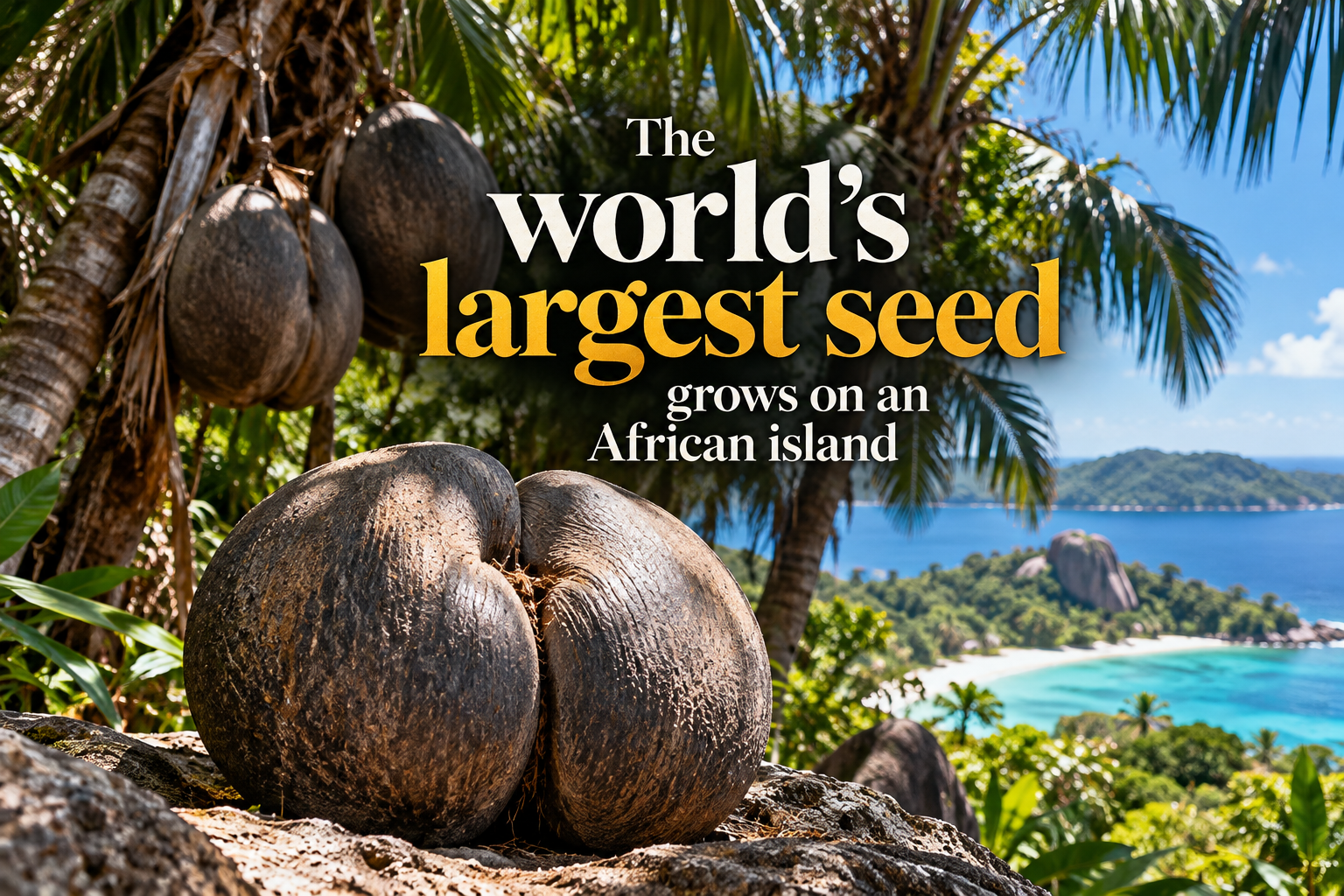
The coco de mer is a rare palm tree in Seychelles that produces the world’s largest seed. Some seeds weigh more than 15 kilograms, making them among the most remarkable botanical wonders on Earth.
This unusual palm grows naturally on just two islands in the Indian Ocean. Its enormous seeds, distinctive shape and slow growth make it one of Africa’s most fascinating plants.
However, the species is endangered, and conservation efforts are essential to protect it.
What is the coco de mer?
The coco de mer is a palm tree scientifically known as Lodoicea maldivica.
It produces the world’s largest seed, which has a distinctive double-lobed shape.
Some seeds weigh more than 15 kilograms. This makes them much heavier than ordinary coconuts.
In addition, the palm produces exceptionally large leaves.
Its unusual appearance has attracted the attention of scientists and visitors for generations.
Today, the species is one of Seychelles’ best-known natural treasures.
Where does the coco de mer grow?
The coco de mer grows naturally on two islands in Seychelles: Praslin and Curieuse.
These islands provide the conditions needed for the rare palm to survive.
One of its most famous habitats is the Vallée de Mai Nature Reserve on Praslin.
UNESCO recognises the reserve as a World Heritage Site.
The protected forest contains an important population of these unusual palm trees.
Visitors can see them growing naturally in the reserve.
However, the species has a very limited natural distribution.
As a result, protecting its remaining habitats is especially important.
Why does the coco de mer take so long to grow?
The coco de mer grows much more slowly than many familiar plants.
Its palms can take many years to reach maturity.
After pollination, the fruit may take six to seven years to develop fully.
This long development period makes reproduction particularly slow.
Furthermore, male and female flowers grow on separate trees.
Male palms produce long flowering structures. Meanwhile, female palms produce the enormous fruits.
Because the species grows slowly, replacing mature trees can take decades.
Therefore, conservation efforts must focus on protecting existing populations.
Why is the world’s largest seed so unusual?
The coco de mer is famous for its enormous size and unusual shape.
Unlike ordinary coconuts, its seeds have two rounded lobes.
For centuries, these seeds attracted curiosity across the Indian Ocean.
Some washed ashore far from Seychelles, creating confusion about their origins.
Today, scientists understand where the seeds come from.
Unlike ordinary coconuts, mature coco de mer seeds are not adapted to float across oceans and establish new populations.
Consequently, the palm remains naturally restricted to a small number of islands.
Its limited distribution makes the species particularly vulnerable to environmental changes.
Is the coco de mer endangered?
The International Union for Conservation of Nature classifies the coco de mer as Endangered.
The species faces several threats, including illegal harvesting, habitat damage and wildfires.
Its slow reproduction creates additional challenges.
Furthermore, its small natural range makes it vulnerable to environmental disturbances.
Seychelles has introduced measures to protect the species.
These include protected habitats and restrictions on seed collection and trade.
The Vallée de Mai Nature Reserve plays an important role in conservation.
However, continued protection remains necessary.
A unique natural wonder of Seychelles
The coco de mer is one of Africa’s most extraordinary plants.
Its enormous seeds can weigh more than 15 kilograms, while its fruits take years to mature.
The palm also grows naturally in only a small part of Seychelles.
These characteristics make it a remarkable example of island biodiversity.
Today, conservation efforts aim to ensure that future generations can continue to see the world’s largest seed growing in its natural habitat.