
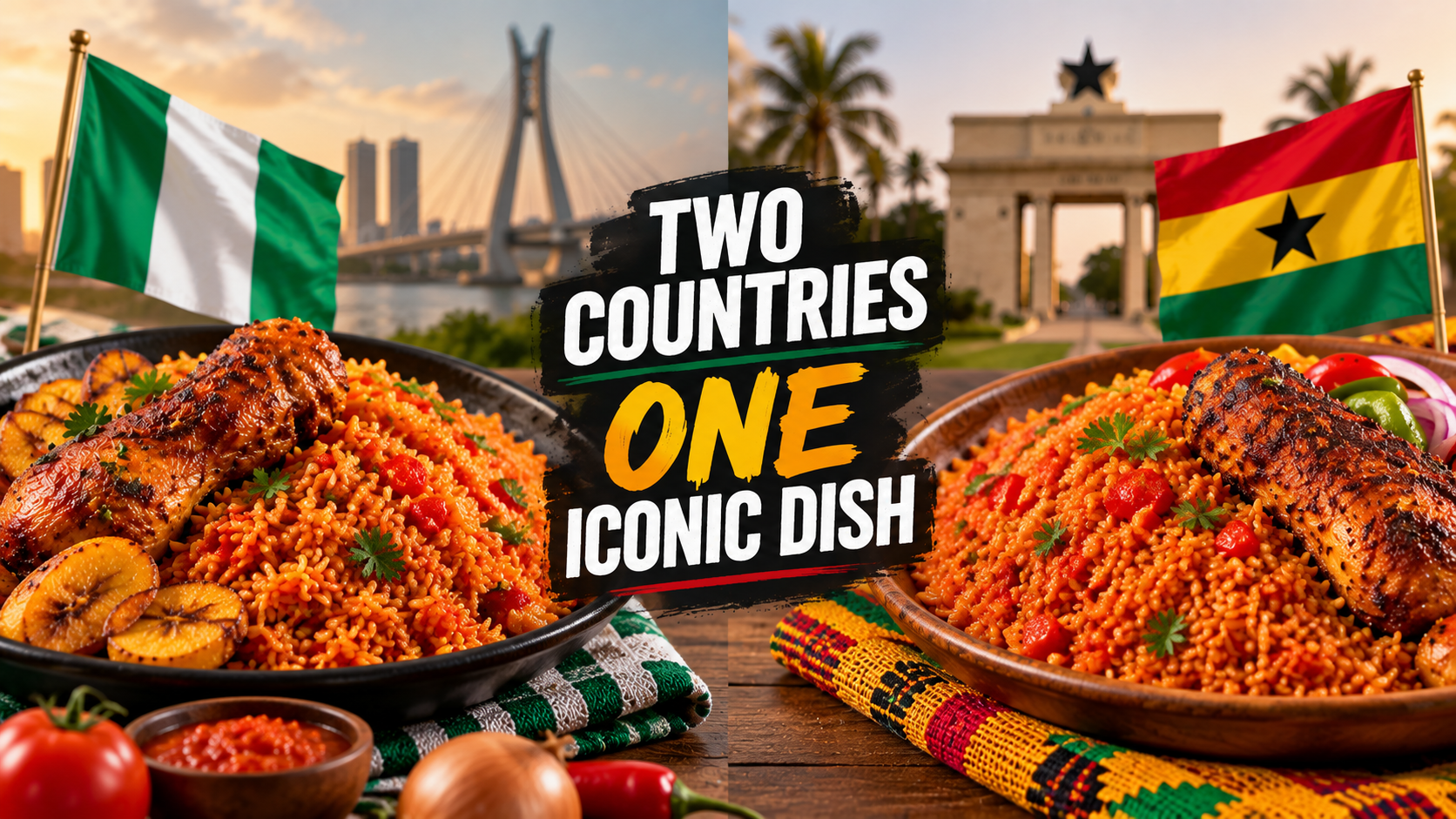
Few food debates in West Africa inspire as much passion as one simple question: Who makes the best Jollof rice, Nigeria or Ghana?
For years, Nigerians and Ghanaians have defended their versions of the popular rice dish, turning a friendly culinary rivalry into a conversation that reaches far beyond West Africa.
From family gatherings and weddings to restaurants and social media, Jollof rice has become more than a meal. It is a symbol of cultural pride, hospitality and shared African heritage.
But what makes Nigerian and Ghanaian Jollof different? And can either country really claim the title of best Jollof rice?
What is Jollof rice?
Jollof rice is a popular West African dish made by cooking rice in a seasoned tomato-based sauce.
Common ingredients include tomatoes, onions, peppers, spices and stock. Depending on the recipe, cooks may serve it with chicken, fish, vegetables or other accompaniments.
Although Jollof is especially associated with Nigeria and Ghana, many other West African countries have their own versions.
The dish is widely linked to the historical Wolof region of Senegambia, particularly the area that includes modern-day Senegal and The Gambia.
Over generations, different communities adapted the recipe to local ingredients, cooking methods and tastes.
Today, Jollof rice remains one of the region’s most recognisable dishes.
Nigerian Jollof rice: Bold flavour and smoky aromas
Nigerian Jollof rice is often celebrated for its rich tomato flavour, generous seasoning and distinctive smoky aroma.
Many recipes use long-grain parboiled rice, which helps the grains remain separate during cooking.
The rice absorbs a sauce typically prepared with blended tomatoes, peppers, onions and spices.
One particularly popular variation is Nigerian party Jollof.
Often prepared in large pots for celebrations, party Jollof is prized for the slightly smoky flavour that can develop during cooking.
For many Nigerians, that aroma is an essential part of the experience.
The dish is commonly served at weddings, birthdays and other family celebrations.
It also appears alongside fried plantains, salads and a variety of meat or fish dishes.
However, recipes differ between households and regions, meaning there is no single Nigerian method.
Ghanaian Jollof rice: Fragrant rice and rich seasoning
Ghanaian Jollof rice has an equally devoted following.
One notable difference is the frequent use of fragrant rice varieties, particularly jasmine rice.
This can give Ghanaian Jollof a distinctive aroma and softer texture.
The dish is usually prepared with a seasoned tomato stew, often including onions, peppers, ginger, garlic and spices.
Some recipes also use herbs or additional seasonings to develop the flavour.
Like its Nigerian counterpart, Ghanaian Jollof is a favourite at celebrations, social gatherings and family meals.
It is commonly served with chicken, fish, fried plantains or salad.
Ghanaian cooks take pride in balancing the rice, sauce and seasonings to create a flavourful dish.
Still, cooking styles vary considerably, and not every Ghanaian household prepares Jollof in the same way.
Nigerian vs Ghanaian Jollof: What is the difference?
The biggest differences generally involve rice varieties, seasoning choices and cooking techniques.
Nigerian Jollof often uses parboiled long-grain rice, while Ghanaian versions frequently feature jasmine rice.
Nigerian party Jollof is particularly associated with a smoky flavour.
Meanwhile, Ghanaian Jollof is often recognised for its fragrant rice and richly seasoned tomato stew.
However, these are broad tendencies rather than strict national rules.
Cooks in both countries experiment with different ingredients and methods.
As a result, two plates of Jollof from the same country can taste surprisingly different.
Ultimately, the cook’s skill and personal recipe may matter more than nationality.
Why do Nigerians and Ghanaians argue about Jollof rice?
The rivalry reflects the close cultural relationship between Nigeria and Ghana.
Both countries share a passion for food, football, entertainment and friendly competition.
Jollof rice has become one of the most entertaining expressions of that relationship.
On social media, people regularly defend their country’s recipe, share cooking videos and challenge others to taste tests.
Restaurants and food enthusiasts have also embraced the debate through cooking competitions and tasting events.
Yet the rivalry is generally rooted in humour and national pride rather than serious disagreement.
For many people, discussing Jollof is simply another way to celebrate West African culture.
Is Jollof rice originally Nigerian or Ghanaian?
Neither Nigeria nor Ghana is generally regarded as the original birthplace of Jollof rice.
The dish’s history is commonly traced to the Senegambian region and the culinary traditions of the Wolof people.
A related Senegalese dish, ceebu jën, combines rice, fish and vegetables and is an important part of the region’s food heritage.
In 2021, UNESCO recognised Senegal’s ceebu jën as part of the Intangible Cultural Heritage of Humanity.
Although modern Jollof recipes differ from ceebu jën, the broader history highlights the deep connections between West African food traditions.
Over time, Jollof spread across the region, where communities developed their own interpretations.
That shared history makes the Nigeria-Ghana rivalry even more interesting.
So, who really makes the best Jollof rice?
There is no universally accepted winner.
Some people prefer the smoky, richly seasoned character associated with Nigerian party Jollof.
Others enjoy the fragrant rice and distinctive flavours found in many Ghanaian recipes.
Taste depends on personal preference, ingredients and the person preparing the meal.
What is clear, however, is that both countries have helped make Jollof rice internationally popular.
The dish has become a favourite in African communities around the world, introducing new audiences to West African cuisine.
And while Nigerians and Ghanaians may never agree on who makes the best version, their friendly rivalry has achieved something remarkable.
It has turned a simple plate of rice into one of Africa’s most recognisable cultural conversations.
So, which team are you on: Nigerian Jollof or Ghanaian Jollof?