
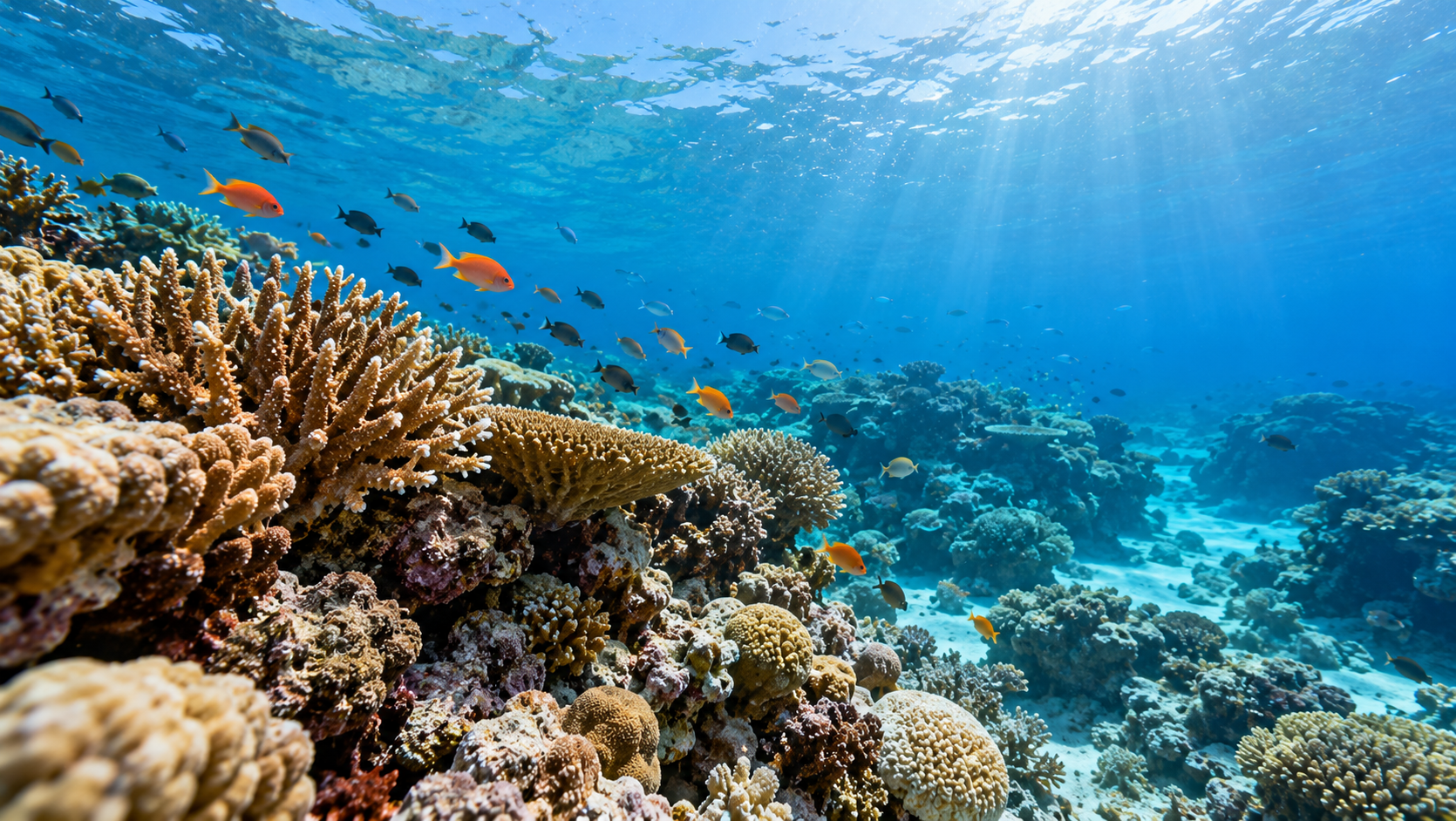
Nearly all of the world’s shallow-water coral reefs face a critical risk of collapse within the next 50 years, according to a new assessment by the International Union for Conservation of Nature (IUCN).
The conservation organisation has classified 96% of the world’s assessed coral reef ecosystems as critically endangered, its highest risk category.
The findings, released on Thursday, warn that climate change and rising ocean temperatures could cause widespread reef collapse by 2075.
However, scientists stress that many coral reefs can still recover if urgent action is taken to protect them.
Climate change threatens coral reefs
The IUCN assessment identifies global warming as the biggest long-term threat to coral reef ecosystems.
Corals are highly sensitive to changes in ocean temperatures. Prolonged marine heatwaves can trigger coral bleaching, weakening reefs and increasing the risk of death.
Mishal Gudka, scientific lead of the IUCN Red List of Coral Reef Ecosystems assessment, warned that climate change poses a severe threat to their survival.
The assessment examined 127 tropical and subtropical coral reef systems covering approximately 188,362 square kilometres.
Researchers used a climate scenario projecting global temperatures to rise by around 2.7°C above pre-industrial levels by 2100.
Under those conditions, scientists warned that widespread ecological collapse could occur over the coming decades.
What happens when coral reefs collapse?
Healthy coral reefs support some of the most diverse marine ecosystems on Earth.
Although reefs occupy only a small proportion of the ocean, they provide habitats for approximately one-quarter of marine species.
They support fish, shellfish and other organisms that depend on their complex structures for food and shelter.
When reefs collapse, living hard corals can disappear and be replaced by algae, rubble and sponges.
This transformation reduces the reef’s ability to support marine biodiversity.
It can also affect fishing communities, tourism businesses and coastal populations that depend on healthy reefs.
Coral reefs help protect coastlines by reducing the force of waves and limiting erosion during storms.
Their disappearance could therefore have significant environmental and economic consequences.
African coral reefs also face growing threats
Africa’s coastal and island communities are among those potentially affected by coral reef degradation.
Reefs in the Red Sea and the western Indian Ocean support marine biodiversity, fishing activities and tourism.
Countries including Kenya, Tanzania, Mozambique, Madagascar, Mauritius and Seychelles have coastal ecosystems that depend on healthy coral habitats.
Rising ocean temperatures threaten these ecosystems through increasingly frequent bleaching events.
Damage to reefs can reduce fish habitats and affect communities that rely on marine resources for their livelihoods.
Tourism destinations that depend on coral reefs for diving and other marine activities may also face economic losses.
The IUCN assessment identifies Red Sea coral reefs among the major reef systems classified as critically endangered.
Major reef systems at risk
The assessment found that several internationally recognised coral reef systems face serious threats.
These include Australia’s Great Barrier Reef, the Coral Triangle in Southeast Asia and the western Pacific, and the Mesoamerican Barrier Reef System.
The Red Sea’s coral reefs are also included among the critically endangered ecosystems.
The warning follows earlier research documenting the scale of coral bleaching worldwide.
A previous global survey found that bleaching had affected approximately 84% of the world’s coral reef area during the latest widespread bleaching event.
Another IUCN study found that nearly 44% of reef-building coral species face an elevated risk of extinction.
These findings measure different threats: the latest assessment examines the risk of entire reef ecosystems collapsing, while the species assessment evaluates the extinction risk of individual coral species.
El Niño could worsen ocean warming
Scientists also warn that the emergence of a strong El Niño event could place additional pressure on coral reefs.
El Niño is a natural climate pattern associated with unusually warm waters in parts of the Pacific Ocean.
It can contribute to higher ocean temperatures and intensify marine heat stress in some regions.
Gudka raised concerns about the phenomenon during a news conference at the UN COP17 biodiversity summit in Yerevan, Armenia.
Combined with long-term human-driven climate change, such warming events can make it harder for damaged reefs to recover.
Scientists say coral reefs can still recover
Despite the alarming findings, the IUCN emphasised that the future of coral reefs is not entirely determined.
Some reef ecosystems have demonstrated an ability to recover after severe bleaching events.
Scientists believe that protecting surviving coral populations and reducing other environmental pressures could improve their chances of survival.
Efforts to limit global warming remain central to protecting reefs over the long term.
Reducing pollution, improving coastal management and protecting marine habitats can also support reef resilience.
The IUCN stressed that many reefs have not yet been lost.
Its findings serve as a warning that the coming decades will be crucial for the survival of coral reef ecosystems and the communities that depend on them.