
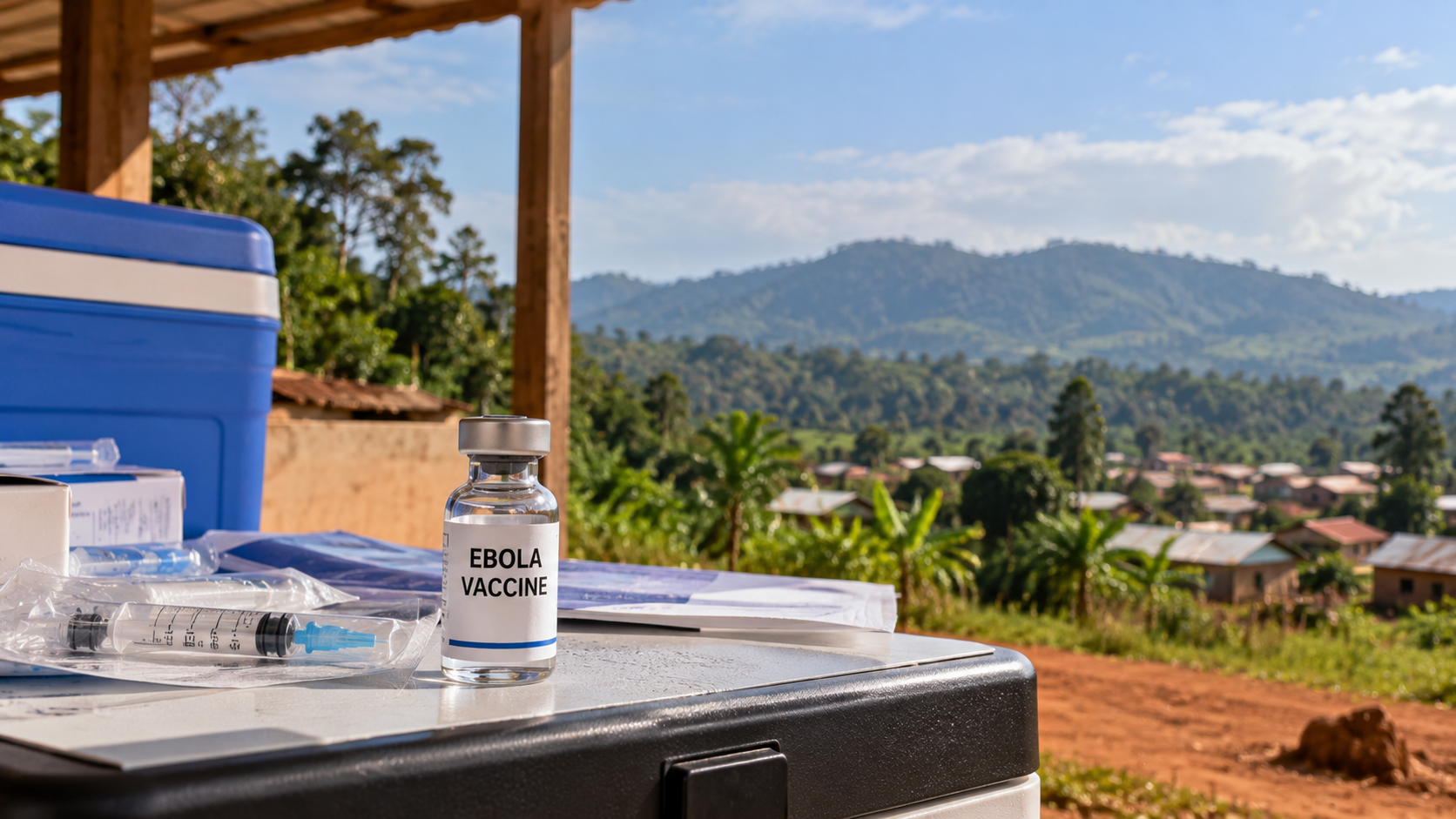
The World Health Organization (WHO) has announced the start of a new Ebola vaccine trial in the Democratic Republic of Congo (DRC), as the country battles a major outbreak.
Health workers began vaccinating participants in Bunia, the capital of northeastern Ituri province, on Friday.
The clinical trial aims to determine whether existing and experimental vaccines can protect people against the Bundibugyo strain of Ebola.
The announcement comes as the outbreak continues to spread across parts of Africa, raising concerns among health authorities.
Ebola vaccine trial begins in Bunia
WHO Director-General Tedros Adhanom Ghebreyesus confirmed the launch of the trial on Friday.
In a social media statement, he said the programme would help researchers understand which vaccines could offer protection against the virus.
The trial, known as Tumaini, is taking place in Bunia, the centre of the current outbreak.
Researchers will examine the safety and effectiveness of several vaccines. They will also study how the immune system responds to each candidate.
The programme is led by Congolese health authorities, with support from the WHO and international partners.
According to Tedros, the initiative aims to provide scientific evidence that could help protect vulnerable communities.
Scientists test protection against Ebola strain
The trial will initially assess Ervebo, an Ebola vaccine already approved for use against the Zaire strain of the virus.
However, the current outbreak involves the Bundibugyo strain.
Researchers therefore want to establish whether Ervebo can provide any protection against this different form of Ebola.
The trial will also examine two experimental vaccines designed specifically for Bundibugyo.
One candidate uses technology developed by the University of Oxford. The other uses messenger RNA technology developed by Moderna.
Both vaccines have received support from the Coalition for Epidemic Preparedness Innovations (CEPI).
According to CEPI, the experimental vaccines are expected to join the trial soon.
Trial will include high-risk communities
The Tumaini programme will use a method known as ring vaccination.
Under this approach, health workers vaccinate people who have been in contact with infected individuals.
They may also vaccinate others considered at high risk of exposure.
This strategy aims to protect vulnerable groups while helping researchers assess vaccine performance.
Importantly, the trial will include pregnant women and children aged 12 and older.
These groups are often excluded from early vaccine research.
Their participation could provide valuable information about vaccine safety and immune responses across different populations.
Ebola outbreak spreads beyond DR Congo
The DRC declared its latest Ebola outbreak in May 2026.
Since then, authorities have reported more than 9,700 cases and over 4,600 deaths, according to figures cited in the report.
The outbreak has become the country’s 17th and its deadliest on record.
Furthermore, infections have now been reported in four African countries.
The geographic spread has increased concerns about cross-border transmission.
In response, the WHO declared a public health emergency of international concern.
The designation allows health authorities to strengthen international coordination and emergency measures.
Meanwhile, governments and health organisations continue working to contain infections through surveillance, testing and contact tracing.
WHO hopes trial will improve Ebola response
WHO emergencies director Chikwe Ihekweazu said the trial aims to produce reliable scientific evidence about vaccine protection.
Researchers hope the results will help determine which vaccines can reduce the risk of infection.
The findings could also guide future vaccination campaigns against the Bundibugyo strain.
However, scientists must first establish whether the vaccines are safe and effective.
For now, health authorities continue to focus on detecting cases, supporting affected communities and preventing further transmission.
The Tumaini trial represents an important step towards developing stronger protection against Ebola as the outbreak continues.