
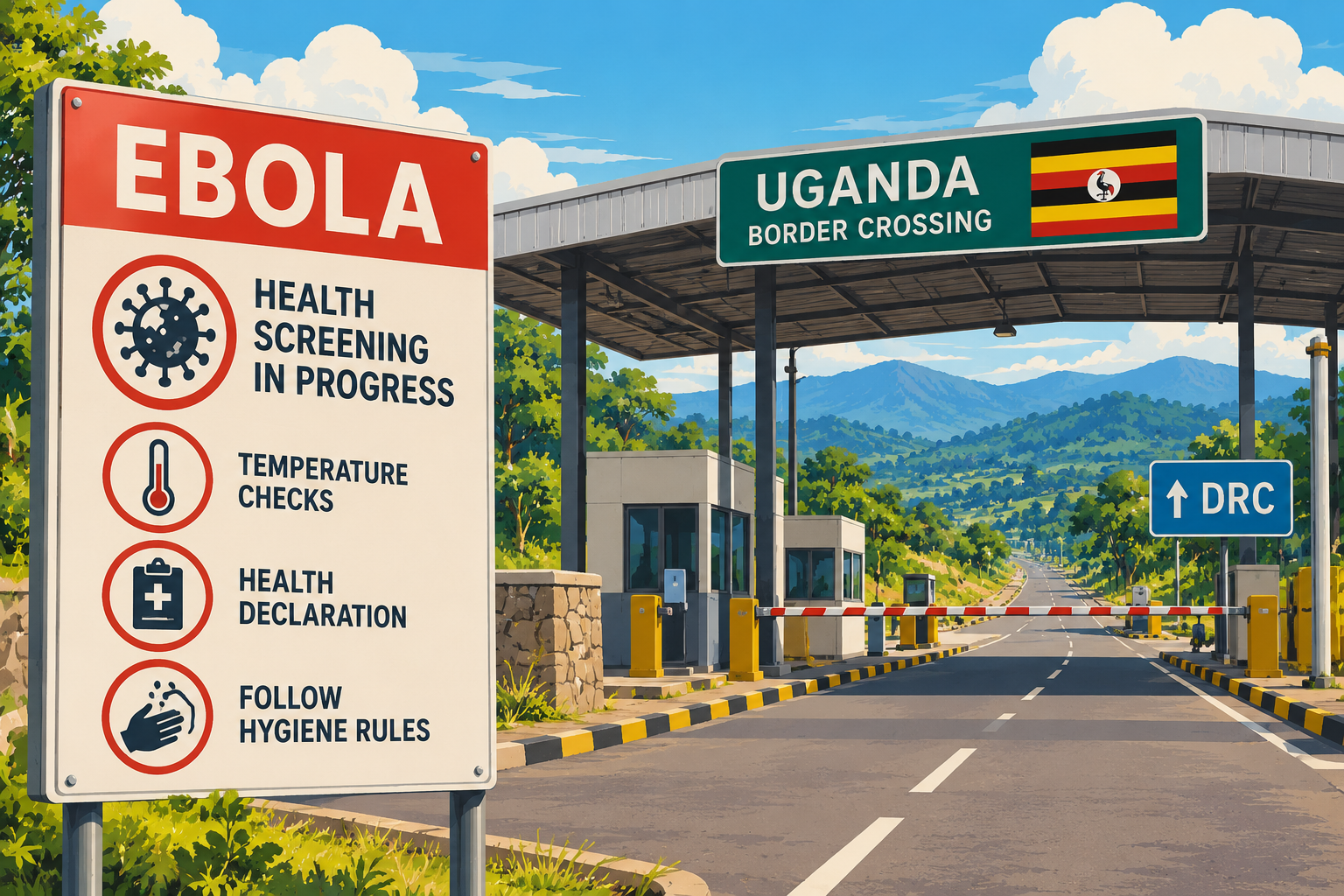
Uganda has introduced a mandatory 21-day quarantine for returning citizens who have travelled to the Democratic Republic of Congo (DRC), as authorities tighten border controls to prevent the spread of Ebola.
The new measures come as the DRC battles a major Ebola outbreak that has claimed more than 4,600 lives since May 2026.
Uganda’s Ministry of Health announced the restrictions on Sunday, October 25, amid growing concerns about the virus spreading across international borders.
According to AFP, returning Ugandan citizens with a recent travel history to the DRC must complete the quarantine period at their own expense.
The government has also strengthened health screening at airports, land borders and designated road checkpoints.
Uganda tightens Ebola prevention measures
Ugandan authorities say the new quarantine requirements are intended to prevent further infections within the country.
Citizens returning from the DRC will be required to isolate for 21 days, the maximum incubation period commonly used for Ebola monitoring.
The Ministry of Health has intensified screening at Entebbe International Airport and all official land border crossings.
Additional screening measures have been introduced at designated checkpoints along major roads.
The restrictions follow a period of heightened concern over Ebola transmission in East and Central Africa.
Uganda shares a long border with the DRC, making cross-border movement a significant consideration for health authorities.
DR Congo faces major Ebola outbreak
The DRC has recorded more than 4,600 Ebola-related deaths since declaring its 17th outbreak in May 2026, according to figures reported by AFP.
The outbreak has raised concerns among neighbouring countries and international health organisations.
The current outbreak involves the Bundibugyo strain of the Ebola virus.
Unlike some other Ebola strains, Bundibugyo does not have a widely approved vaccine or specific treatment.
Ebola spreads through direct contact with the blood or other bodily fluids of infected people.
Symptoms can include fever, weakness, vomiting and diarrhoea. Severe cases can involve internal or external bleeding.
The disease can be fatal, particularly when patients do not receive timely medical care.
Over the past five decades, Ebola outbreaks have claimed more than 15,000 lives across Africa, according to figures cited in the report.
Uganda declared Ebola-free in August
Uganda’s latest restrictions come just two months after the World Health Organization declared the country free of Ebola.
That announcement followed an outbreak involving 20 confirmed cases and two deaths.
According to the report, most infections were linked to people who had travelled to the DRC.
Ugandan authorities say the country currently has no confirmed Ebola cases.
However, officials remain concerned about the possibility of infected travellers entering the country.
The new quarantine measures are intended to reduce that risk.
Kenya and Nigeria report Ebola cases
Concerns about regional transmission have increased following the detection of Ebola cases in other African countries.
Kenya has reported two deaths linked to the virus.
Nigeria also confirmed its first case in October.
According to AFP, the Nigerian case involved a woman who arrived in Abuja on a flight from Uganda.
However, Ugandan authorities rejected suggestions that she necessarily contracted the virus while visiting their country.
Government spokesperson Alan Kasujja said Uganda had no active Ebola cases and disputed attempts to link the Nigerian infection to her stay there.
The source of the infection has not been established in the information released.
Regional health authorities remain on alert
The latest developments highlight the challenges of containing infectious diseases across countries with busy international borders.
Uganda’s decision to introduce mandatory quarantine adds another layer of protection alongside existing health screening measures.
However, the requirement for returning citizens to cover their own quarantine expenses could place an additional financial burden on travellers.
Health authorities across the region continue to monitor the situation as the DRC struggles to contain its outbreak.
For Uganda, the immediate priority is preventing new infections after its recent declaration of Ebola-free status.
The government has not announced when the quarantine restrictions will be lifted.