
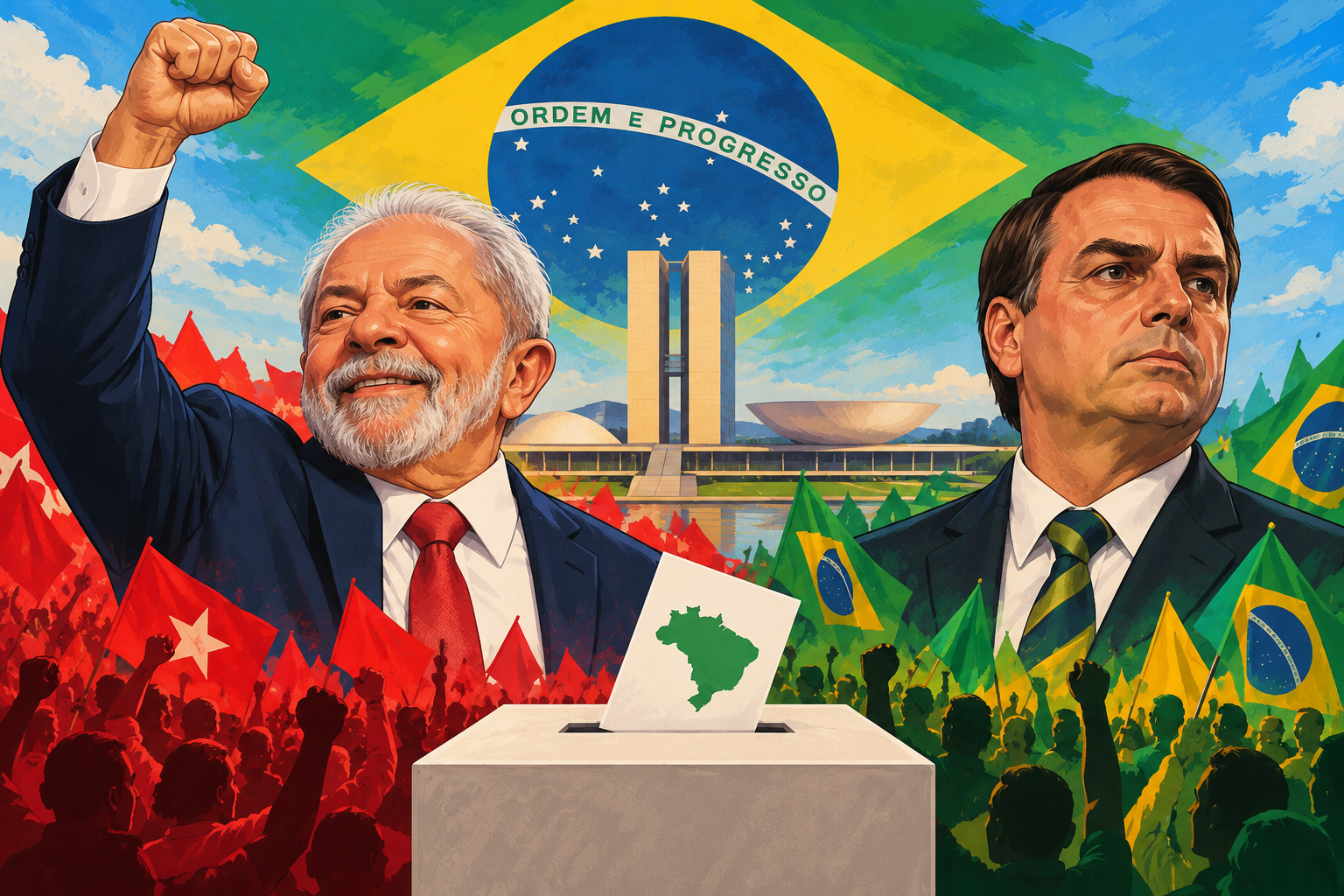
Brazilian President Luiz Inácio Lula da Silva has secured a historic fourth term after winning a closely contested presidential election, but his rival Flávio Bolsonaro has refused to accept the result and called for the vote to be annulled.
Lula won 51.8% of the vote against Bolsonaro’s 48.2% in Sunday’s runoff, according to official results reported by AFP.
The margin amounted to approximately 4.4 million votes, bringing an end to one of Brazil’s most closely watched presidential contests.
However, the result has deepened political tensions after Bolsonaro questioned the legitimacy of the election.
The senator, son of former President Jair Bolsonaro, announced that he would seek to overturn the outcome.
Lula secures historic fourth term
Lula’s victory marks a remarkable political comeback for the veteran left-wing leader.
The Brazilian president, who turns 81 on Tuesday, overcame a narrow first-round defeat to win another term in office.
He previously served as president from 2003 to 2010 before returning to power following the 2022 election.
His latest victory makes him the first Brazilian president to win four terms.
Speaking after the results were announced, Lula credited voter participation and mobilisation for his victory.
He said his campaign had convinced Brazilians of the importance of voting to protect democracy.
Thousands of supporters celebrated in cities including São Paulo and Rio de Janeiro.
Many wore red, the traditional colour of Lula’s Workers’ Party, as fireworks and celebrations filled the streets.
Bolsonaro refuses to recognise election results
Flávio Bolsonaro rejected the election outcome shortly after Lula’s victory became clear.
Speaking in Brasília, the senator announced plans to request the annulment of the vote.
His objections followed a Supreme Court decision to extend voting by two hours on election day.
The extension came after concerns that transport disruptions and heavy rainfall had prevented some voters from reaching polling stations.
Lula’s campaign had complained that buses were withdrawn from service in several cities, potentially limiting access to voting.
Bolsonaro also requested additional voting time in some regions affected by heavy rain.
However, he later criticised the court’s decision, describing it as unacceptable.
The senator has not accepted the official result, raising concerns about further political uncertainty.
Brazil remains deeply divided
The election highlighted the political divisions that have shaped Brazil for more than a decade.
Lula campaigned on his government’s economic record, social programmes and the protection of democratic institutions.
During his third term, Brazil experienced improvements in inflation and unemployment, while government initiatives helped reduce hunger.
However, many voters remained concerned about living costs, crime and economic opportunities.
Bolsonaro sought to appeal to conservative voters and Brazilians dissatisfied with the country’s direction.
Although he presented himself as more moderate than his father, he retained strong support among conservative groups.
His father, Jair Bolsonaro, is serving a 27-year prison sentence following his conviction over an attempted coup after the 2022 election.
The younger Bolsonaro’s strong showing demonstrated the continued influence of the country’s conservative movement.
Nearly half of participating voters supported him, leaving Lula with the challenge of governing a politically divided nation.
Lula’s victory carries international significance
The result also has implications beyond Brazil.
Lula’s victory comes as several Latin American countries have elected conservative leaders in recent years.
His re-election breaks with that regional trend and preserves Brazil’s current foreign policy direction.
During the campaign, Lula emphasised national sovereignty and criticised economic and diplomatic pressure from the United States.
US President Donald Trump has maintained close political ties with the Bolsonaro family.
Lula, meanwhile, has promoted stronger cooperation with developing economies and international partners.
Brazil is a founding member of BRICS, alongside Russia, India, China and South Africa.
The group has since expanded to include additional countries, including Egypt and Ethiopia.
Lula’s continued leadership is therefore significant for Brazil’s relations with Africa and other emerging economies.
Following his victory, Lula received congratulations from several regional leaders, including Mexico’s President Claudia Sheinbaum.
What happens next in Brazil?
Despite his victory, Lula faces significant challenges as he prepares for another four years in office.
Brazil’s Congress remains dominated by right-wing parties, potentially complicating his legislative agenda.
Economic concerns, public security and political polarisation are also expected to remain major issues.
Meanwhile, Bolsonaro’s decision to challenge the election result could prolong political tensions.
Although the senator has announced plans to seek annulment, no court decision overturning the result has been reported.
Lula’s fourth term is scheduled to run until 2030, when he will be 85 years old.
His immediate challenge will be governing a country where the presidential election exposed deep political divisions.
The result represents a major victory for Brazil’s left, but Bolsonaro’s strong performance suggests that the country’s political rivalry is far from over.