
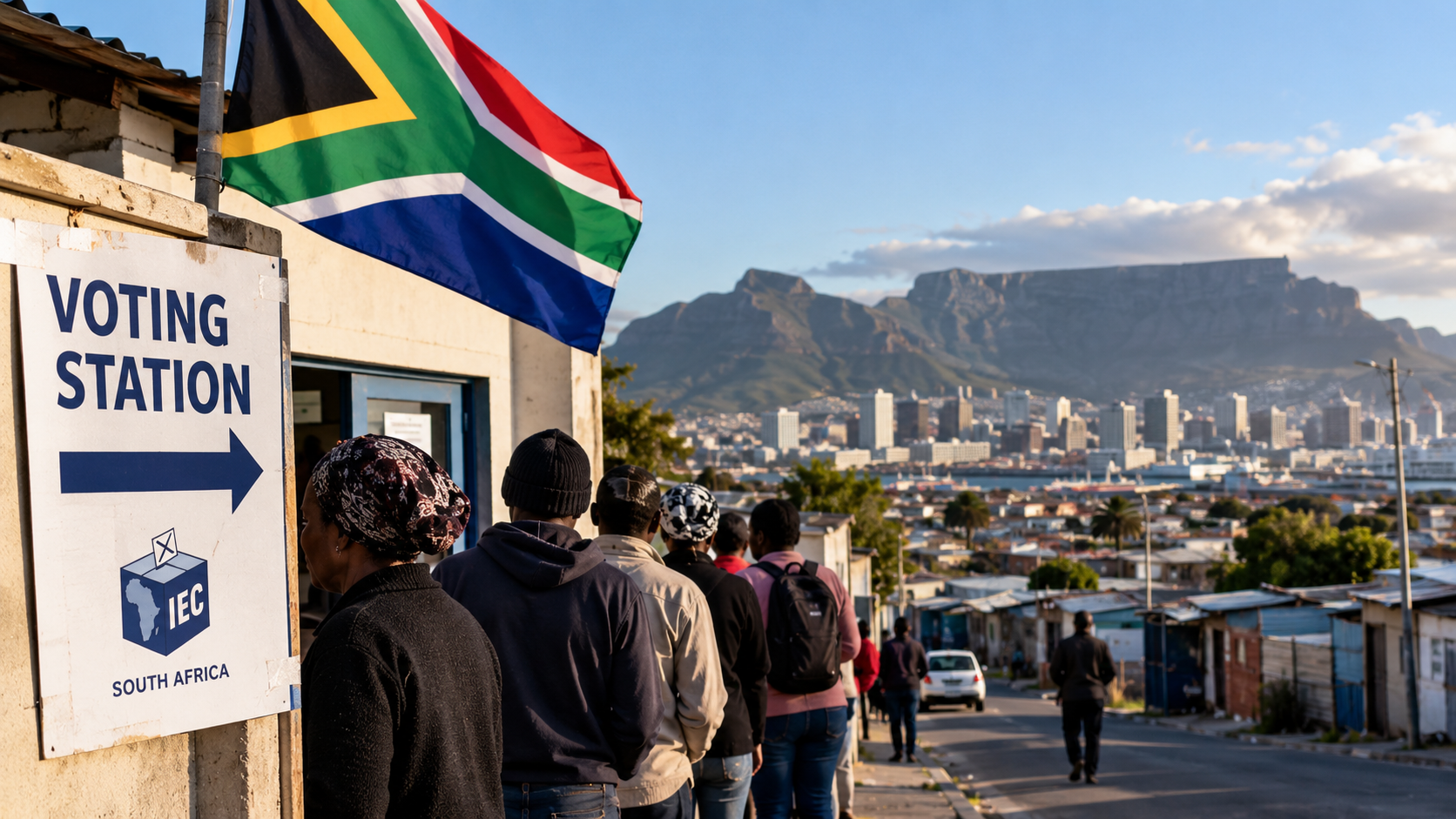
South Africa’s local elections are approaching as growing frustration over crime, unemployment and poor public services threatens support for established political parties.
More than 29 million South Africans are registered to vote on November 4. However, many remain disappointed with local government performance.
Water shortages, unreliable electricity and inadequate sanitation have become major election issues.
According to Africanews, citing AFP reporting, voters are increasingly questioning whether political parties can deliver meaningful improvements.
The elections will also test support for the African National Congress (ANC), which has dominated South African politics since the end of apartheid.
Poor services dominate South Africa elections
In Cape Town’s Khayelitsha township, many residents still lack access to adequate sanitation.
Ntombekhaya Makeleni, 53, stopped using communal toilets after men reportedly tried to enter while she was inside.
She now relies on a bucket at home.
Despite her experience, Makeleni plans to vote. She hopes the elections will bring improvements to her community.
Meanwhile, residents in Durban face similar problems.
Nikesh Nunkoo, 27, said water shortages in his Shallcross neighbourhood sometimes last up to two weeks.
He remains uncertain about voting because he has lost confidence in local government.
Another Durban resident, Nkanyiso Hadebe, 24, said he would not vote because he believes elections have failed to improve living conditions.
These experiences highlight the frustration facing South Africa’s political leaders.
Unemployment adds to voter frustration
South Africa’s unemployment rate stands at approximately 33%, according to the figures cited in the report.
Young people are particularly affected by limited job opportunities.
For many, the lack of employment has weakened confidence in political promises.
Ntokozo Mthethwa, a 21-year-old IT student from Durban, expressed doubts about his future in the country.
He questioned whether any political party could deliver meaningful change.
However, economic concerns are not the only factors influencing voters.
Crime, housing conditions and access to essential services are also shaping political attitudes.
ANC faces growing political pressure
The ANC has experienced a significant decline in electoral support.
In the 2021 local elections, the party received less than 50% of the vote for the first time since South Africa became a democracy in 1994.
It also lost its parliamentary majority in the 2024 national elections.
Meanwhile, the Democratic Alliance (DA) is campaigning to expand its influence.
The party governs Cape Town and hopes to gain control of Johannesburg.
However, inequalities remain visible in Cape Town, particularly between wealthy neighbourhoods and poorer townships.
Political commentator Kuhle Zwakala said residents mainly want reliable water, electricity and sanitation.
He argued that the continued absence of basic services reflects deeper governance problems.
Smaller parties challenge traditional rivals
South Africa’s political landscape has become increasingly fragmented.
More than 500 political parties are registered with the electoral commission.
Former President Jacob Zuma’s MK party is also entering the local election contest after finishing third in the 2024 national elections.
An Ipsos survey published in March found that nearly half of South Africans believed no political party represented their views.
Furthermore, only 38% said their municipality was performing well.
However, political loyalties remain important.
Researcher Oscar van Heerden said historical identities still influence support for the ANC and DA.
As a result, dissatisfaction with services may not automatically translate into votes for opposition parties.
Coalition governments face another test
Voter turnout could play a decisive role in the South Africa elections.
Only 46% of registered voters participated in the 2021 local elections. By comparison, turnout reached 58.6% in the 2024 national elections.
The results could also produce more coalition governments.
Research by the Mapungubwe Institute for Strategic Reflection found that no party secured a majority in nearly one-third of South Africa’s 257 municipal councils after the previous elections.
By February 2026, 74 municipalities were governed by coalitions or minority administrations.
Such arrangements have become increasingly important as support for major parties declines.
However, their ability to provide stable local government remains under scrutiny.
South Africa prepares for November vote
The November 4 elections will provide an important measure of public confidence in local government.
They will also offer an early indication of changing political loyalties ahead of the 2029 general election.
For many voters, the immediate concerns remain unchanged.
Reliable water, electricity, sanitation, safer communities and employment opportunities are among their priorities.
Whether the elections produce meaningful improvements will depend on the performance of the councils that emerge from the vote.