
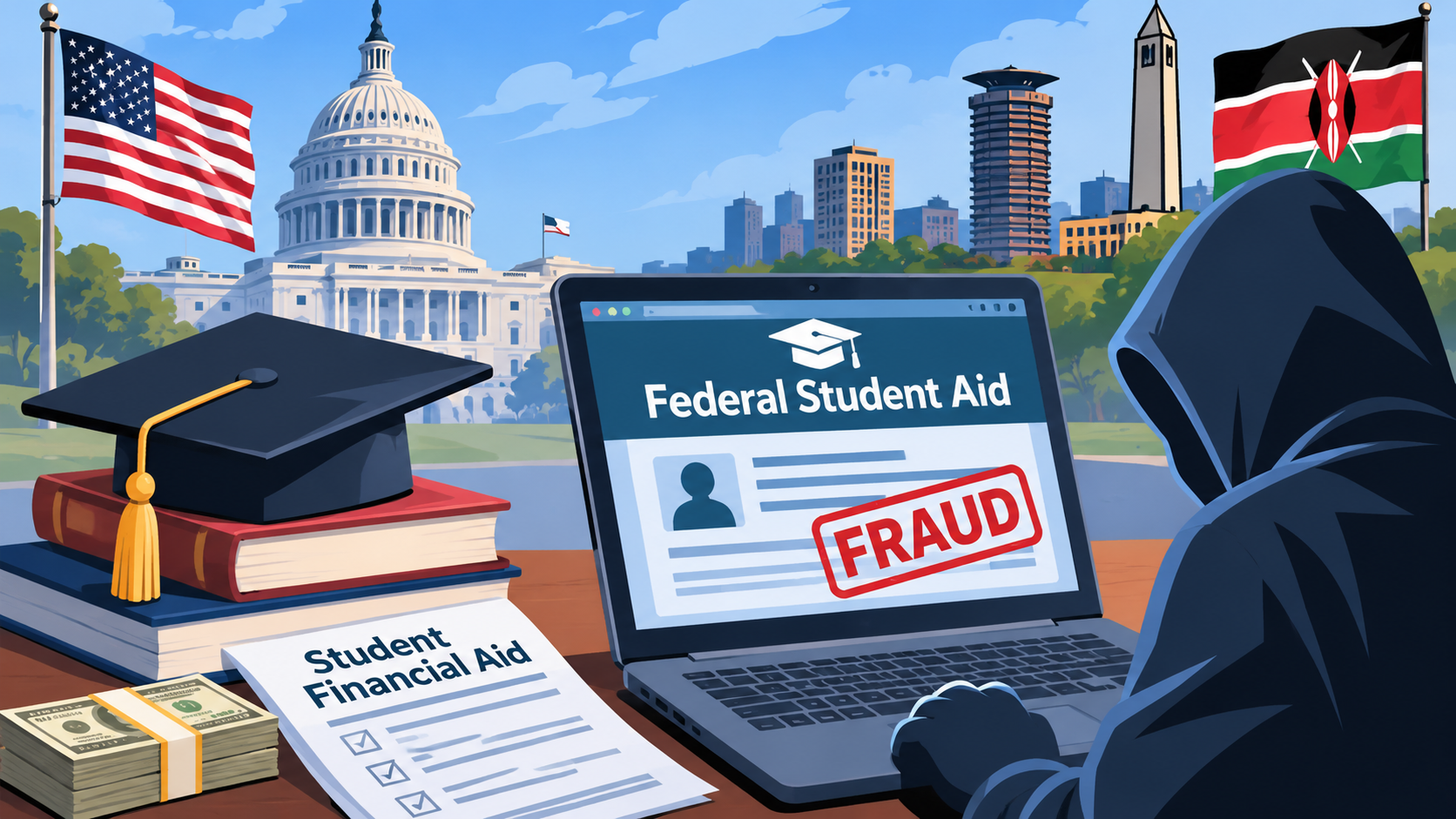
US authorities have charged several Kenyan nationals in an investigation into a student aid fraud scheme involving nearly $130 million in potentially fraudulent federal financial assistance.
The investigation, known as Operation Ghostbusters, has uncovered allegations that criminals used stolen identities to enrol fictitious students in American colleges.
Investigators believe the suspects then collected financial aid payments intended for genuine students.
According to the BBC, US prosecutors have announced five indictments involving Kenyan nationals. Another 40 investigations remain open.
However, authorities have clarified that the $130 million figure represents financial aid linked to potentially fraudulent accounts, not confirmed financial losses.
Kenyan national charged in US student aid fraud case
One of the suspects is Francis Mogambi, a Kenyan national who moved to the United States in May 2024 through the Diversity Visa programme.
On October 19, 2026, a federal grand jury in Nebraska indicted Mogambi on five counts of theft of government money and five counts of aggravated identity theft.
Prosecutors allege that he worked with associates in Kenya between November 2025 and May 2026.
The group allegedly stole the identities of American citizens and used their personal information to register fictitious students at US colleges.
Once the applications were approved, financial aid payments were allegedly redirected to the suspects.
According to prosecutors, Mogambi kept 30% of the proceeds and transferred the remaining money to associates in Kenya.
The intended loss in his individual case was approximately $20,000.
Court documents also allege that Mogambi received $2,000 weekly and attempted to recruit another participant.
He was arrested following the indictment and remains in custody pending trial.
Mogambi has not publicly responded to the allegations. The charges against him have not been proven in court.
How the $130m student aid fraud scheme allegedly worked
US investigators say the wider scheme relied on stolen personal information.
Fraudsters allegedly obtained the identities of American citizens, sometimes purchasing personal details online for as little as $4 to $8.
They then used the information to create fraudulent student applications.
The fake students were enrolled in colleges and became eligible for federal financial assistance.
Authorities also allege that some suspects used advanced technology to complete coursework and maintain the appearance of genuine student attendance.
This allowed fraudulent accounts to remain active across multiple semesters.
At a news conference on October 29, Assistant Attorney General Colin M. McDonald warned that the scheme exploited programmes designed to help students.
“If you steal taxpayers’ dollars, if you exploit a programme meant to help students, we are resolved to find you and prosecute you,” McDonald said.
The investigation identified 830,840 potentially fraudulent Federal Student Aid identification numbers during September and October 2026.
These accounts were associated with nearly $130 million in financial aid.
Investigators recommended that the US Department of Education disable the suspicious accounts.
However, the total value of confirmed losses remains separate from the amount associated with potentially fraudulent applications.
Identity theft leaves Americans facing unexpected debts
The alleged fraud has also affected people whose identities were stolen.
Some victims discovered that student loans had been registered in their names despite never attending college.
As a result, they could face unexpected debts and damage to their credit records.
Authorities say the suspects often targeted people from low-income backgrounds.
Some victims had never previously enrolled in higher education.
McDonald described how one victim’s stolen identity placed his financial reputation at risk.
The investigation has therefore raised concerns about both taxpayer losses and the protection of personal information.
US officials have also warned about the scale of fraudulent applications in community colleges.
According to McDonald, nearly one-third of community college applicants in California in 2024 were identified as fraudulent.
US and Kenya cooperate in fraud investigation
The investigation has prompted cooperation between American and Kenyan law enforcement agencies.
In September, US officials travelled to Kenya to discuss extraditions, prosecutions and the recovery of allegedly stolen funds.
Working with Kenyan investigators, American authorities seized more than $750,000 from a cryptocurrency account belonging to a Kenyan national linked to the wider investigation.
The US Justice Department described the operation as its first international seizure of this kind in Kenya.
However, the cryptocurrency seizure was not connected to Mogambi’s individual case.
The investigation has also uncovered other alleged financial networks involving transfers between the two countries.
Separate cases involve millions in student aid
In Virginia, prosecutors allege that another Kenyan national received more than 700 fraudulent student aid refunds.
The payments totalled approximately $1.44 million.
Investigators say at least $1.3 million was subsequently transferred through thousands of transactions involving accounts in the United States and Kenya.
Meanwhile, three people have been charged in New Jersey over a separate alleged scheme involving more than $1 million in federal student aid.
Prosecutors claim the suspects acted as money mules.
They allegedly received payments through American bank accounts, retained a portion and transferred the remainder to associates in Kenya.
Some transfers were reportedly linked to a purported safari company.
These cases form part of the wider investigation but involve separate allegations and defendants.
US authorities promise further prosecutions
American prosecutors say Operation Ghostbusters remains active.
With dozens of investigations still open, additional charges could follow.
Authorities are also working to recover funds and identify more victims of identity theft.
If convicted, Mogambi faces a mandatory prison sentence of at least 10 years, according to the Justice Department.
Other defendants could face prison sentences, asset forfeiture and restitution orders if found guilty.
For investigators, the case highlights the growing use of stolen identities and technology to exploit public financial assistance programmes.
It also demonstrates the international nature of financial crime, with alleged operations extending across the United States and Kenya.
US authorities say their investigation will continue as they seek to identify those responsible and recover misappropriated funds.