
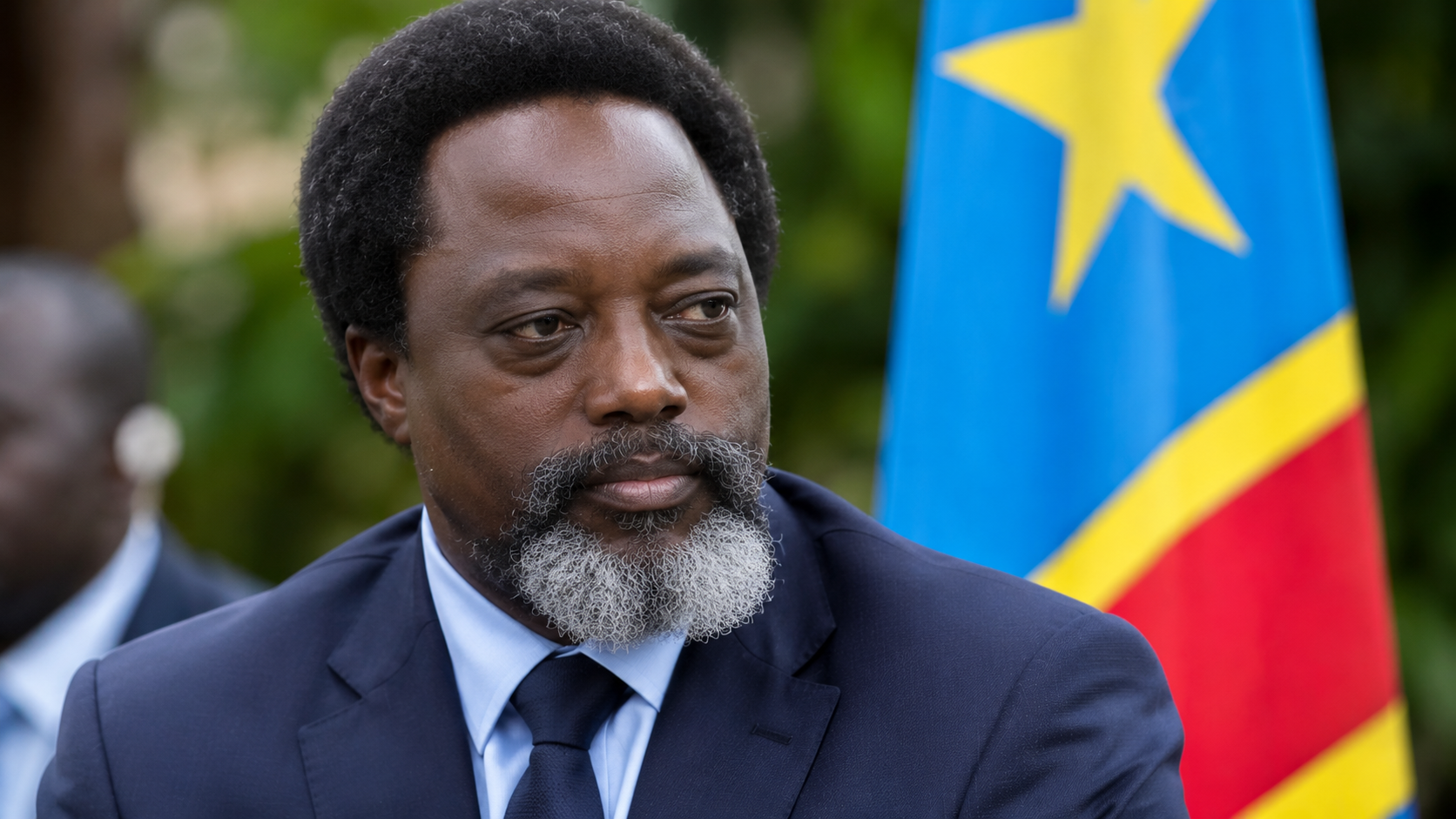
Former DR Congo President Joseph Kabila has emerged as the leader of a rebel alliance seeking to remove President Félix Tshisekedi from power, marking a dramatic return to armed opposition.
Kabila, who governed the Democratic Republic of Congo for 18 years, was recently named leader of the Front for the Refoundation of the Nation (FRN).
The coalition includes the M23 rebel movement, which controls significant territory in eastern DR Congo, including the cities of Goma and Bukavu.
According to the BBC, the development represents a major shift in Congolese politics. Kabila previously fought M23 while serving as president.
Now, he has joined forces with the movement against the man who succeeded him in 2019.
Joseph Kabila returns to rebel politics
Joseph Kabila’s political career began within the armed movement that brought his father, Laurent-Désiré Kabila, to power.
Following his father’s assassination in 2001, Kabila became president.
He remained in office until January 2019, when Félix Tshisekedi succeeded him after a disputed election.
However, their political relationship gradually deteriorated.
Kabila later moved into self-imposed exile in South Africa before returning to DR Congo in 2025.
He subsequently appeared in rebel-held Goma, raising questions about his relationship with M23.
His appointment as FRN leader has now confirmed his political alignment with the rebel coalition.
The alliance offers Kabila a potential route back to national political influence.
However, it remains unclear whether the movement can challenge Tshisekedi’s government beyond eastern Congo.
Why Joseph Kabila joined the M23 alliance
M23 has made significant territorial gains in eastern DR Congo.
However, military advances have not translated into broad political support across the country.
Kabila’s involvement could give the movement access to political networks and experience at the national level.
Meanwhile, the former president could benefit from the rebels’ military strength.
Political analyst Henry-Pacifique Mayala told the BBC that Kabila had limited options for regaining influence.
He suggested the former president may have received assurances before joining the coalition.
Nevertheless, the partnership carries considerable political and security risks.
Kabila faces a death sentence following his conviction in absentia by a Congolese military court in September 2025.
The charges included treason and financing violence in eastern Congo.
He has rejected the accusations.
The United States has also imposed sanctions on Kabila over his alleged support for M23.
Tshisekedi condemns former president
President Félix Tshisekedi has strongly criticised Kabila’s decision to lead the rebel alliance.
He accused his predecessor of acting against the interests of the Congolese people.
The two leaders were once political partners.
Following the disputed 2018 presidential election, Kabila’s coalition retained significant influence in parliament.
The arrangement allowed Tshisekedi to assume the presidency while Kabila’s allies maintained substantial political power.
However, the coalition collapsed in December 2020.
Tshisekedi subsequently established a new parliamentary majority, weakening Kabila’s influence.
Their political rivalry has intensified since then.
Kabila now accuses Tshisekedi of authoritarianism and violating democratic principles.
He has also criticised the government’s use of the death penalty.
Tshisekedi, meanwhile, rejects Kabila’s political position and continues to lead the internationally recognised government.
DR Congo opposition rejects military solution
Despite Kabila’s criticism of Tshisekedi, not all opposition groups support his rebellion.
The C64 opposition coalition has refused to endorse the FRN’s armed campaign.
Instead, it has called for direct discussions involving both Kabila and Tshisekedi.
The coalition believes DR Congo’s political and security crises require an inclusive national dialogue.
Its position highlights divisions among political groups opposed to the president.
Kabila has invoked Article 64 of the Congolese constitution, which addresses resistance to unconstitutional exercises of power.
However, opposition to constitutional changes does not automatically translate into support for armed rebellion.
There is speculation that Tshisekedi could seek constitutional amendments allowing another presidential term.
No such outcome has been established.
The next presidential election is scheduled for 2028, although Tshisekedi has warned that insecurity could disrupt the timetable.
Rwanda’s role complicates DR Congo conflict
Kabila’s alliance with M23 also raises questions about relations with Rwanda.
The Congolese government accuses Rwanda of supporting the rebel movement.
Rwanda has denied the allegations.
However, international investigations and evidence cited by the BBC have linked Rwanda to M23’s operations.
Relations between Kabila and Rwandan President Paul Kagame have changed considerably over the years.
During Kabila’s presidency, Congolese forces fought M23.
At other times, Kinshasa and Kigali cooperated against armed groups operating near their shared border.
Alex Adams, Africa programme director at the European Council on Foreign Relations, told the BBC that Kabila and Kagame may now have overlapping interests.
However, he suggested their objectives remain different.
Kabila is seeking renewed national political influence, while Rwanda’s priorities centre on its security and strategic position in eastern Congo.
Therefore, the relationship may be driven by immediate political interests rather than lasting trust.
Can Joseph Kabila challenge Tshisekedi?
Despite the rebel alliance’s territorial gains, removing Tshisekedi from power would be difficult.
M23’s strongest military presence remains in eastern DR Congo, far from the capital, Kinshasa.
Kabila’s political networks could potentially broaden the coalition’s influence.
However, there is no clear evidence that the FRN has the military capacity to extend its campaign across the country.
Richard Moncrieff, an analyst with the International Crisis Group, told the BBC that Tshisekedi retains significant advantages.
These include international backing, financial resources and control over state institutions.
The United States has also imposed sanctions on Rwandan officials and institutions accused of contributing to instability in eastern Congo.
Meanwhile, fighting has continued despite international peace efforts.
What Joseph Kabila’s return means for DR Congo
Kabila’s return to rebel politics adds another layer of uncertainty to DR Congo’s prolonged conflict.
The former president has questioned whether elections alone can resolve the country’s political crisis.
He has instead called for fundamental changes to the country’s political institutions.
However, critics argue that neither Kabila nor Tshisekedi has presented a convincing plan to address the country’s wider economic challenges.
International security analyst Ovigwe Eguegu told the BBC that ordinary Congolese citizens risk losing out as the two leaders compete for power.
DR Congo holds major reserves of gold, diamonds and minerals used in modern technology.
Yet decades of conflict have prevented many communities from benefiting from that wealth.
For now, Kabila’s new alliance has increased pressure on Tshisekedi.
Whether it leads to negotiations, further political instability or an expansion of the conflict remains uncertain.