
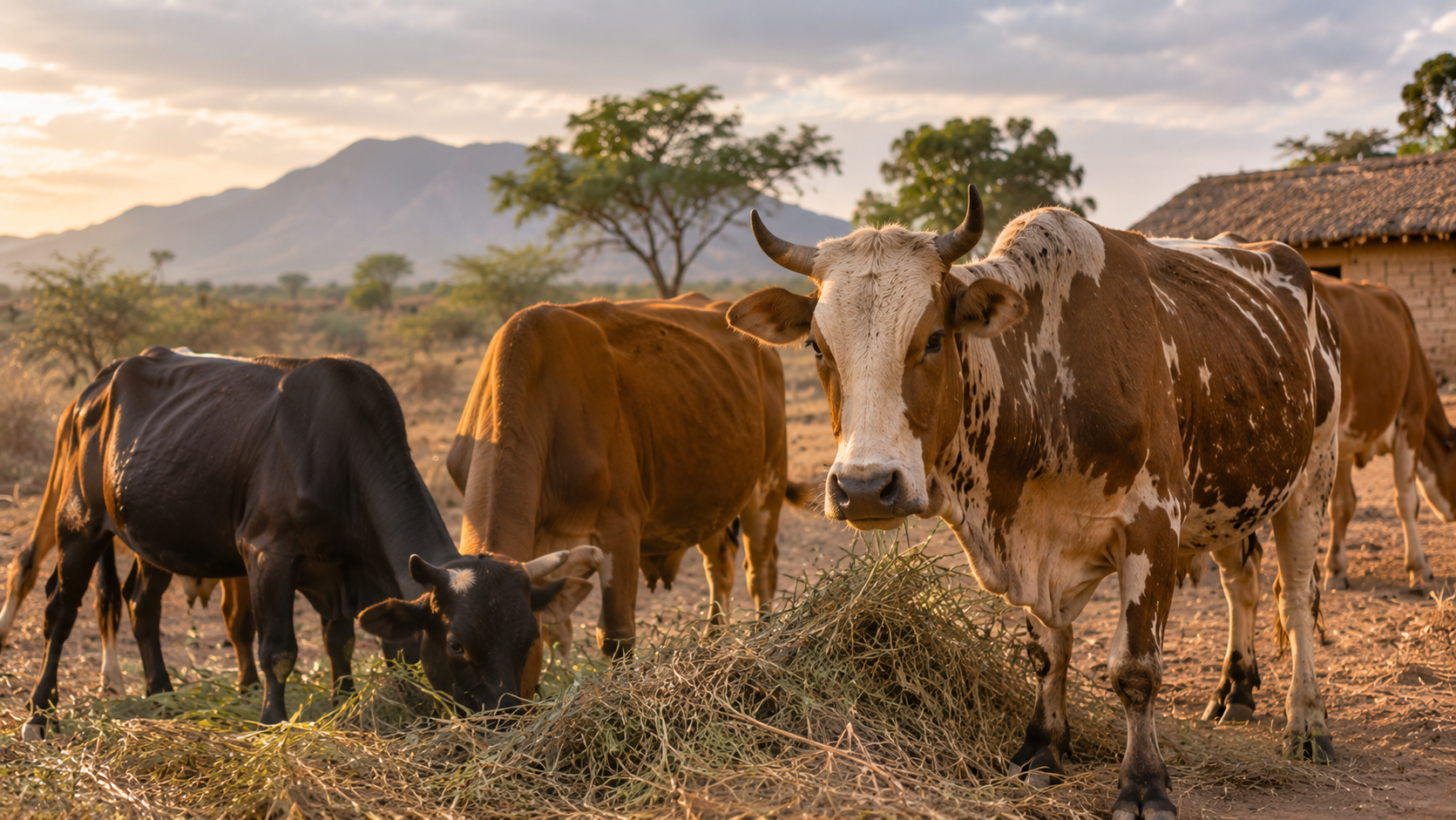
Malawi cattle farmers are travelling longer distances to find animal feed as dry conditions, rising costs and shrinking vegetation threaten their livelihoods.
In southern Malawi’s Mulanje district, farmers say grass has become increasingly difficult to find. As a result, some now travel more than 25 kilometres to collect enough fodder for their animals.
The shortages have also affected milk production and increased the cost of keeping cattle.
According to Al Jazeera, farmers are struggling with the effects of changing rainfall patterns, environmental degradation and pressure on riverside vegetation.
Malawi cattle farmers travel farther for grass
In Nsanjama, 25-year-old Lawrence Abison regularly travels to the Likhubula River to collect grass for cattle.
On one recent trip, he and three friends travelled 27 kilometres before beginning their work.
They spent two hours cutting Napier grass and reeds. However, the amount they collected was only enough to feed 10 cattle for one day.
Abison said finding suitable grass had become increasingly difficult.
He explained that workers now travel farther because nearby sources can no longer meet demand.
Other farmers in Mulanje face similar problems.
Many depend on grass growing near rivers, especially during the dry season.
However, vegetation has become scarce in areas where farmers previously collected fodder.
Dry conditions put pressure on livestock farming
Malawi experienced prolonged dry spells and high temperatures during parts of the 2023–2024 rainy season.
El Niño also disrupted rainfall patterns across southern Africa.
At the time, Malawi’s Department of Climate Change and Meteorological Services warned of below-normal rainfall in some regions.
Southern Malawi was among the areas facing an increased drought risk.
Although rainfall varies between seasons, farmers say the effects of previous dry periods continue to affect their operations.
Meanwhile, reduced vegetation has made it harder to feed livestock.
Farmers must now spend more time and money collecting grass.
Rising feed costs reduce farmers’ earnings
Macdonald Khandalawo, a 54-year-old cattle farmer in Nsanjama, has kept livestock since 2014.
He currently owns 10 cattle.
However, finding enough food for them has become an expensive challenge.
Khandalawo sends workers to rivers to collect grass because nearby supplies are insufficient.
Sometimes, the journey takes an entire day.
He said the shortage has also affected milk production because his cows receive less feed.
Farmers usually supplement grass with maize bran. Yet that has also become more expensive and difficult to obtain.
Lower maize harvests have reduced the availability of bran, adding another financial burden.
Khandalawo normally earns more than one million Malawian kwacha, approximately $577, from monthly milk sales.
Recently, however, much of that income has gone towards buying feed and paying workers.
He is now uncertain how long he can maintain his herd under these conditions.
Malawi dairy cooperative searches for solutions
Khandalawo serves as treasurer of the New Thuchira Milk Bulking Group.
The cooperative brings together as many as 400 farmers in Mulanje district.
It collects milk from members, stores it and sells it to commercial processors.
The organisation also allows farmers to exchange ideas about managing feed shortages.
Some members collect maize stalks after harvesting and store them for the dry season.
Others use leftover pea and rice plants to supplement cattle feed.
These methods help reduce dependence on fresh grass.
However, they have not eliminated the shortage.
As feed becomes more expensive, farmers face increasing pressure on their earnings.
Riverbank farming adds to vegetation loss
Farmers also blame changes along riverbanks for the declining availability of grass.
Khandalawo said vegetable cultivation has expanded into areas where reeds and other vegetation once grew.
As a result, fewer plants remain available for livestock feed.
He called for stronger protection of riverbanks to help restore vegetation.
Other residents have noticed similar environmental changes.
Batson Kweluza, 57, lives near the Likhubula River in Supuni Village.
He said trees that once provided extensive shade along the river have disappeared from many areas.
He has also observed that the river has become shallower.
These observations highlight local concerns about deforestation, land use and declining water availability.
However, the extent to which each factor contributes to the changes has not been established in the report.
Farmers fear for the future of their cattle
The shortage is also affecting smaller livestock farmers.
In Nkando, 25-year-old Alefa Saulo raises bulls for sale.
She said her three cows have become thinner because of insufficient feed.
Saulo employs workers to help manage her farm, but finding enough food for the animals remains difficult.
She hopes the coming rains will allow grass to grow again.
Until then, maintaining healthy cattle will remain a challenge.
For farmers who depend on livestock for income, the consequences extend beyond animal health.
Lower milk production, higher costs and weaker animals can reduce household earnings.
Malawi farmers wait for rainfall
The difficulties facing Malawi cattle farmers show how changing environmental conditions can affect rural livelihoods.
In Mulanje, families depend on livestock for milk, income and financial security.
However, scarce fodder and rising expenses are making cattle farming increasingly difficult.
Farmers are adapting by travelling farther, storing crop residues and purchasing alternative feed.
Yet these measures come at a cost.
For now, many are waiting for sufficient rainfall to restore grass supplies and ease pressure on their animals.
Without reliable access to affordable feed, farmers fear their livestock businesses will become increasingly difficult to sustain.