
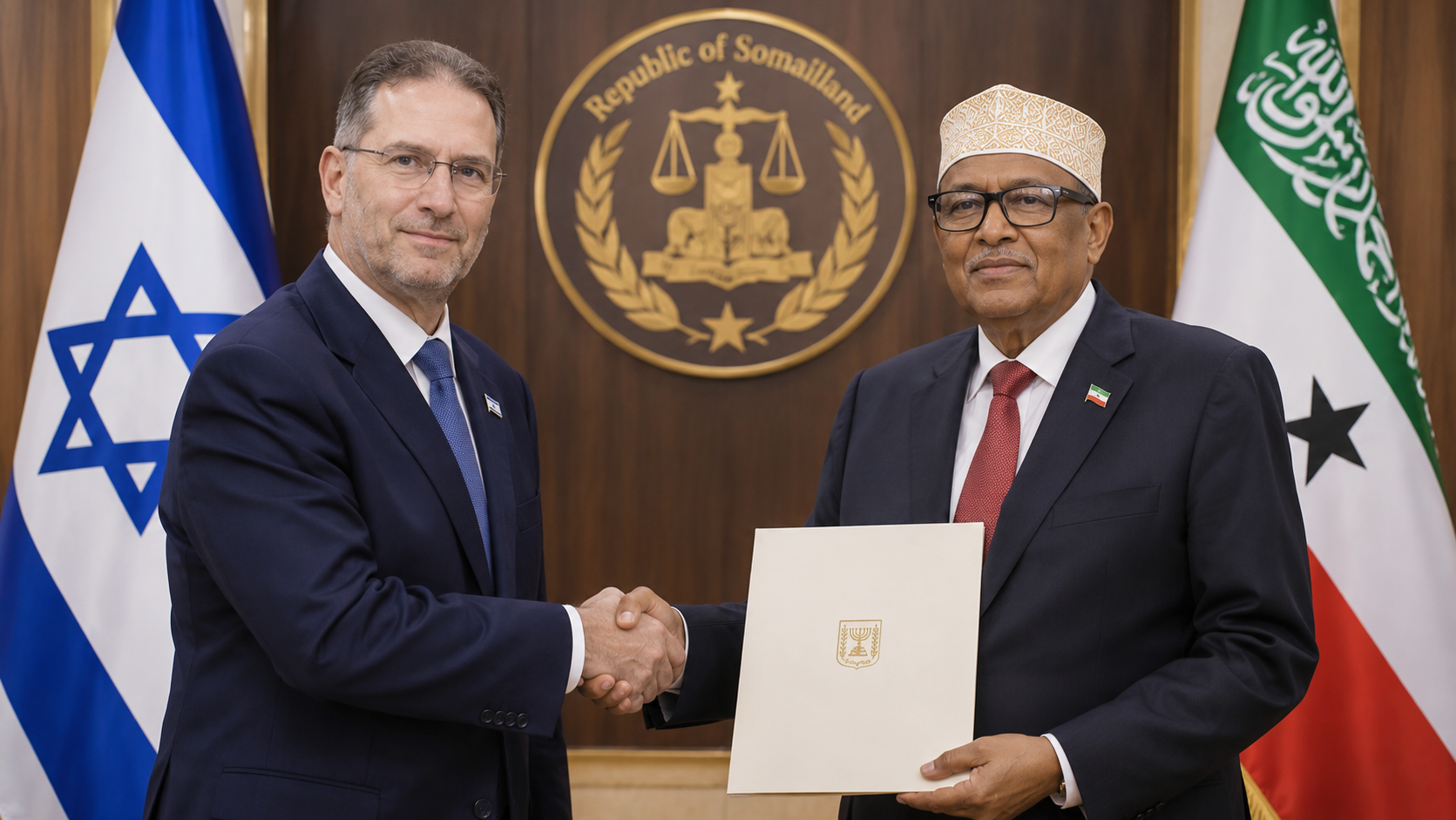
Israel’s first ambassador to Somaliland has officially presented his credentials to President Abdirahman Mohamed Abdullahi, marking a new stage in diplomatic relations between the two sides.
Ambassador Michael Lotem attended a ceremony in Hargeisa, where Somaliland’s president formally accepted his credentials.
Officials also laid the foundation stone for a future Israeli embassy in the territory.
Israel’s Foreign Ministry announced the developments on November 1, 2026. According to Al Jazeera, the ceremonies took place during the previous week.
The move follows Israel’s decision to recognise Somaliland’s independence in December 2025, a decision strongly opposed by Somalia.
Israel’s first ambassador to Somaliland begins diplomatic mission
The ceremony in Hargeisa marked a significant development in relations between Israel and Somaliland.
President Abdullahi, widely known as Cirro, described the occasion as historic.
He said it was the first time Somaliland had received the credentials of an ambassador representing a United Nations member state that recognises its independence.
Ambassador Michael Lotem also highlighted the significance of the relationship.
He said Israel’s recognition acknowledged Somaliland’s political development over the previous 35 years.
Meanwhile, Israeli Foreign Minister Gideon Sa’ar said the exchange of ambassadors fulfilled commitments made when diplomatic relations were established.
The two sides have expanded their contacts throughout 2026.
Sa’ar visited Somaliland in January, while Somaliland opened an embassy in West Jerusalem during Cirro’s visit to Israel in June.
Why did Israel recognise Somaliland?
Israel formally recognised Somaliland on December 26, 2025.
It became the first UN member state to recognise the territory as an independent country.
Somaliland declared independence from Somalia in 1991 following the collapse of Somalia’s central government.
Since then, it has developed its own political institutions, security structures and administrative system.
However, Somalia continues to regard Somaliland as part of its sovereign territory.
The African Union and most international governments have maintained support for Somalia’s territorial integrity.
Israel’s recognition therefore represents a major diplomatic development for Somaliland.
Nevertheless, the decision has also created tensions with Somalia and several regional organisations.
Somaliland’s strategic position near the Red Sea
Somaliland occupies an important geographical position along the Gulf of Aden.
The territory lies opposite Yemen and near the Bab al-Mandeb strait.
This narrow maritime passage connects the Red Sea with the Gulf of Aden and the Indian Ocean.
It is also a major route for international shipping.
During the diplomatic ceremony, President Cirro emphasised Somaliland’s strategic location.
He said cooperation with Israel carried regional and international significance because of the territory’s position near important maritime routes.
The relationship comes amid renewed fighting in Yemen.
On October 9, UN envoy Hans Grundberg warned that Yemen had returned to full-scale war.
The fighting involves the Houthi movement and forces aligned with Yemen’s internationally recognised government.
Consequently, security around the Red Sea and Gulf of Aden remains a major regional concern.
Somalia questions Israel’s intentions
Somalia has strongly opposed Israel’s recognition of Somaliland.
President Hassan Sheikh Mohamud recently questioned the reasons behind Israel’s growing relationship with the territory.
In an interview with Sky News, Mohamud argued that Israel was primarily interested in gaining access to the Red Sea.
He also alleged that Israel wanted to establish a naval base in Somaliland.
However, no agreement to establish such a base has been confirmed.
Somaliland officials have previously expressed openness to the possibility of hosting an Israeli military facility.
Nevertheless, President Cirro recently said that no discussions about establishing a base had taken place.
The competing statements highlight continuing disagreements over the strategic implications of the relationship.
Israel and Somaliland discuss security cooperation
Security cooperation has become another important aspect of relations between Israel and Somaliland.
During Cirro’s visit to Israel in June, Israeli Defence Minister Israel Katz said the two sides had cooperated on secret operations for years.
He also expressed interest in expanding their security relationship.
However, the details of those activities have not been publicly disclosed.
The location of Somaliland near the Gulf of Aden has increased attention on the potential security implications of the partnership.
Meanwhile, the conflict in Yemen has added further importance to regional maritime security.
Despite speculation about a possible Israeli military presence, no confirmed agreement to establish a naval base has been announced.
African Union and regional organisations oppose recognition
Israel’s decision to recognise Somaliland has faced criticism from several international organisations.
The African Union condemned the move, reflecting its longstanding support for Somalia’s sovereignty and territorial integrity.
The Arab League and Organisation of Islamic Cooperation also opposed the decision.
Somalia described Israel’s recognition as a violation of its sovereignty.
The dispute reflects wider disagreements over Somaliland’s political status.
Somaliland considers itself an independent state and has sought international recognition for decades.
However, Somalia maintains that the territory remains part of the country.
These competing positions continue to shape diplomatic relations across the Horn of Africa.
What happens next for Israel and Somaliland?
The arrival of Israel’s first ambassador represents another step in formalising relations with Somaliland.
The planned Israeli embassy in Hargeisa could further expand diplomatic cooperation.
Meanwhile, the two sides have expressed interest in strengthening political and security ties.
However, the relationship remains controversial because of Somalia’s objections and wider regional concerns.
Questions also remain about the future scope of security cooperation, particularly around the Red Sea.
For Somaliland, Israel’s recognition represents a significant development in its longstanding campaign for international recognition.
For Somalia, the issue remains a challenge to its territorial sovereignty.
As diplomatic engagement continues, the relationship is likely to attract further attention across the Horn of Africa and the wider Middle East.