
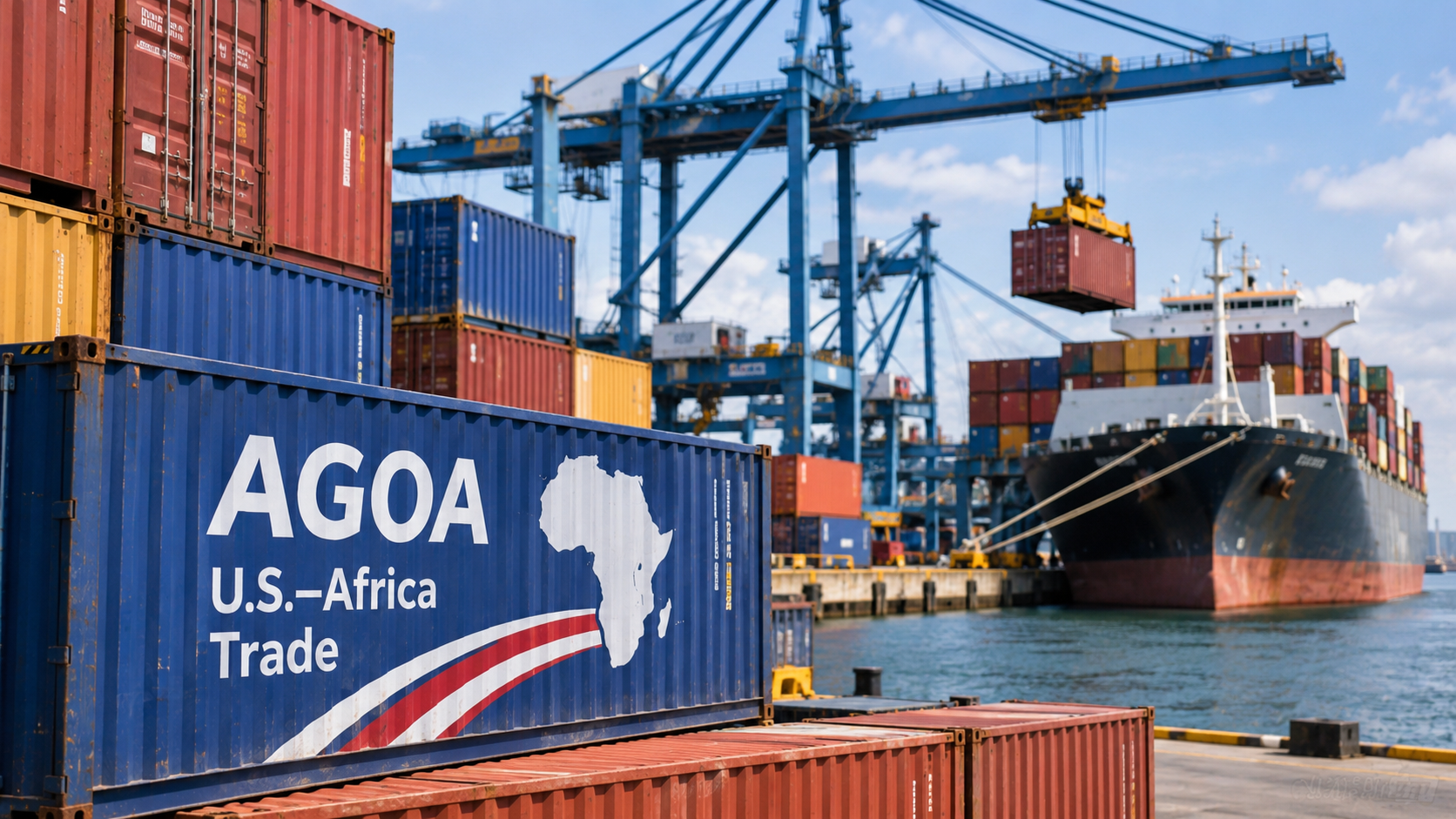
Nineteen African countries are expected to remain outside the US African Growth and Opportunity Act (AGOA) trade programme in 2027, raising concerns about market access and economic relations with Washington.
The countries include South Africa, Rwanda, Ethiopia, Uganda, Sudan and several other economies across the continent.
According to Business Insider Africa, the changes come as the United States reassesses its trade and diplomatic relationships with African nations.
The development could create additional challenges for exporters that depend on preferential access to the American market.
What is AGOA?
The African Growth and Opportunity Act was introduced in 2000 to strengthen trade between the United States and eligible sub-Saharan African countries.
The programme allows qualifying products to enter the American market without certain import duties.
This arrangement has helped African businesses compete internationally, particularly in manufacturing, agriculture and textiles.
However, eligibility depends on criteria established by US authorities.
These include trade policies, labour rights, human rights and other economic and political considerations.
Countries that lose eligibility may face higher tariffs on products previously covered by the programme.
South Africa faces trade uncertainty
South Africa is among the countries facing changes to its AGOA eligibility from January 1, 2027.
The country maintains one of Africa’s largest commercial relationships with the United States.
In 2025, bilateral trade in goods and services reached approximately $28.8 billion, up 10.1% from the previous year.
US exports to South Africa totalled $10.3 billion, while imports reached $18.5 billion.
As a result, Washington recorded an estimated trade deficit of $8.3 billion.
Industry and labour representatives have warned that the loss of preferential access could threaten as many as 10,000 jobs.
The citrus industry is among the sectors facing uncertainty over future export costs.
Rwanda also affected
Rwanda is another country facing the loss of AGOA eligibility.
Its trade relationship with the United States is considerably smaller than South Africa’s.
In 2025, bilateral trade reached $333.4 million, representing an 8.1% decline from 2024.
US exports to Rwanda stood at $195.1 million, while imports totalled $138.3 million.
Washington maintained a trade surplus of approximately $56.8 million.
The eligibility change could affect Rwandan exporters seeking to expand their presence in the American market.
Which countries are affected?
Business Insider Africa identified the following 19 countries as ineligible for AGOA benefits in 2027.
- South Africa
- Rwanda
- Burkina Faso
- Cameroon
- Burundi
- Uganda
- Zimbabwe
- Gabon
- Central African Republic
- Sudan
- Guinea
- Equatorial Guinea
- Eritrea
- Seychelles
- Ethiopia
- Somalia
- Niger
- South Sudan
- Mali
The countries have different trade relationships with Washington. Therefore, the potential economic impact will vary considerably.
Ethiopia and Uganda trade figures
Ethiopia recorded approximately $4.5 billion in trade with the United States in 2025.
That represented an increase of 3.5% compared with the previous year.
Ethiopian goods exports to the American market also rose sharply, reaching approximately $1 billion.
Meanwhile, US trade with Uganda declined by 2.3% to around $1.1 billion.
American goods imports from Uganda increased by 50.3% to $198.5 million.
However, US services exports to Uganda fell by 18.9% to $382 million.
These figures show how trade patterns differ across African economies.
Sudan and Somalia face challenges
Sudan’s trade with the United States declined by 7.8% in 2025, reaching approximately $211.1 million.
US goods exports to Sudan fell by 32.6% to $37.6 million.
Despite the decline, Washington maintained an estimated overall trade surplus of $56.1 million.
Meanwhile, US trade with Somalia dropped by 18.7% to approximately $170.4 million.
American goods exports to Somalia remained relatively stable at $49.7 million.
Both countries face broader economic challenges that could complicate efforts to expand international trade.
Trade impact varies across Africa
Several other countries experienced significant changes in trade volumes during 2025.
Gabon recorded a 96.3% increase in trade with the United States, reaching $835.6 million.
In contrast, Eritrea experienced a 50.7% decline, with bilateral trade falling to $31.8 million.
Niger’s trade dropped by 29.9% to $101.7 million.
South Sudan also recorded a decline of 33.6%, bringing its total trade with Washington to $132 million.
These differences highlight the varied economic circumstances of countries affected by AGOA eligibility decisions.
Importantly, losing AGOA benefits does not mean that all trade with the United States will stop.
Businesses may continue trading under other applicable tariff arrangements.
What happens next?
The expected AGOA eligibility changes could reshape commercial relationships between the United States and several African countries.
For exporters, the main concern is whether higher import duties will make their products less competitive.
Businesses may need to review pricing, supply chains and alternative export markets.
Governments could also seek negotiations with Washington to address eligibility concerns.
However, the consequences will depend on each country’s export profile and the specific products affected.
As 2027 approaches, African businesses and policymakers will be watching closely for further decisions on trade access.
The broader challenge will be maintaining investment, protecting jobs and expanding economic opportunities despite uncertainty over preferential trade arrangements.