
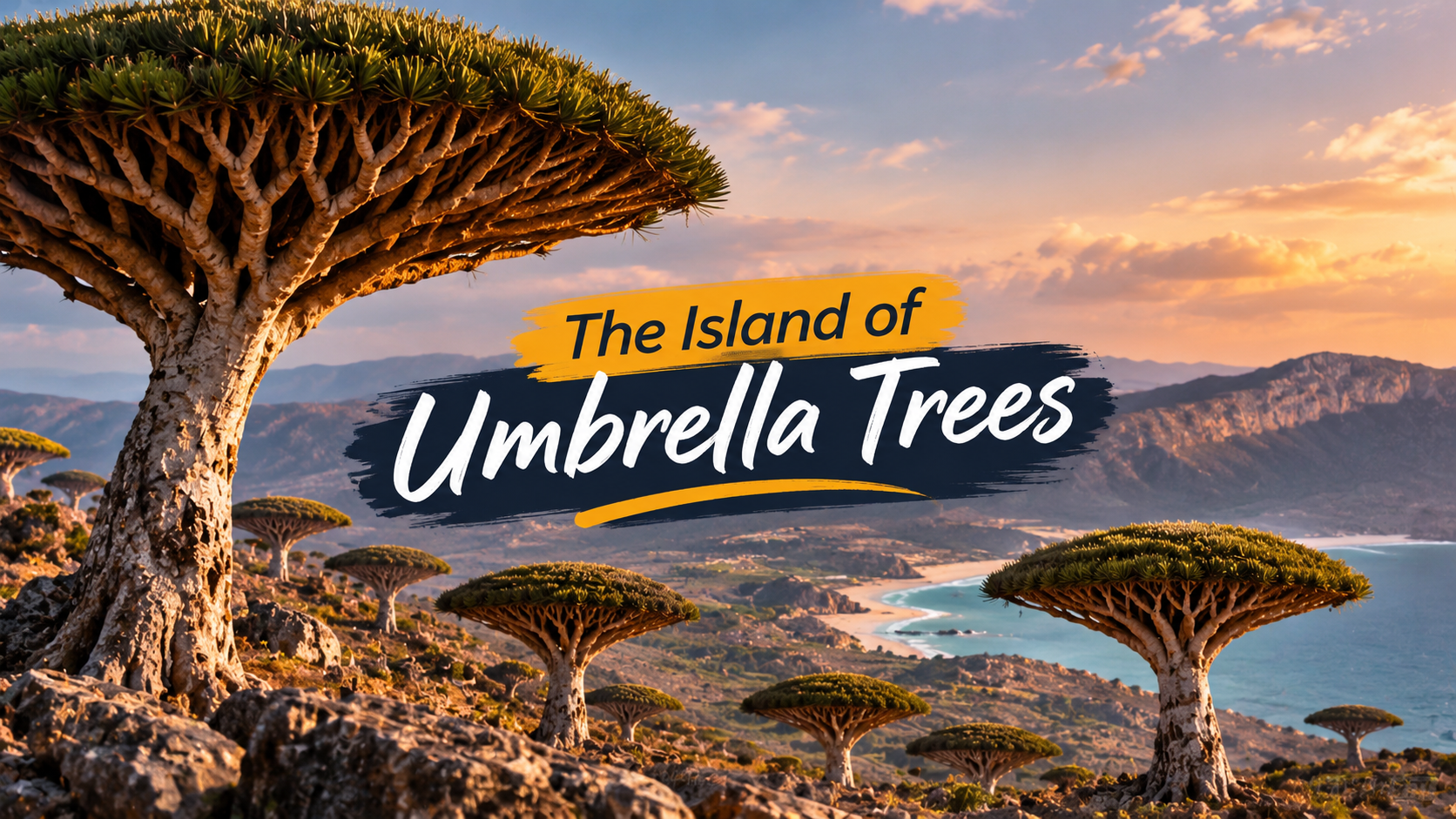
Imagine visiting an island where trees look like giant umbrellas rising from rocky mountains.
This extraordinary place is Socotra Island, located in the Arabian Sea near the Horn of Africa.
Socotra is famous for its unusual landscapes, rare wildlife and remarkable dragon’s blood trees.
Their wide, umbrella-shaped crowns make them some of the most recognisable trees in the world.
Although Socotra belongs to Yemen, its location near Africa and unique natural environment have attracted international attention.
Trees shaped like umbrellas
The dragon’s blood tree, scientifically known as Dracaena cinnabari, is native to Socotra.
Unlike ordinary trees, it grows with a thick trunk and a dense crown of branches that spread outward.
From a distance, its shape resembles an open umbrella.
This unusual structure helps the tree collect moisture from mist and fog while providing shade that reduces water loss from the surrounding soil.
These adaptations allow the trees to survive in Socotra’s challenging environment.
Some grow on rocky slopes where rainfall is limited and conditions can be harsh.
Why the unusual name?
Despite its dramatic name, the dragon’s blood tree has nothing to do with actual dragons.
The name comes from the dark red resin produced by the tree.
For centuries, people have collected this resin for traditional uses, including pigments and varnishes.
The striking colour gave rise to the name dragon’s blood.
However, the resin is simply a natural substance produced by the plant.
Its unusual appearance is one of the many fascinating features of Socotra’s plant life.
An island full of rare life
Socotra is often described as one of the world’s most distinctive islands for biodiversity.
Its long geographic isolation has allowed many plants and animals to develop characteristics rarely seen elsewhere.
A significant proportion of its plant species are found nowhere else on Earth.
Alongside dragon’s blood trees, the island is home to unusual desert plants, distinctive birds and rare reptiles.
UNESCO recognised the Socotra Archipelago as a World Heritage Site in 2008 because of its exceptional biodiversity.
The island offers an important example of how living things adapt to different environments.
Why these trees matter
Dragon’s blood trees play an important role in Socotra’s ecosystem.
Their broad crowns provide shade and help create conditions that support other living organisms.
However, the species faces several threats.
Climate change, grazing animals and changes in land use can affect young trees and their ability to survive.
Scientists and conservationists have also raised concerns about the limited regeneration of dragon’s blood tree populations.
Protecting these trees is important for preserving Socotra’s unique natural heritage.
A reminder of nature’s beauty
From vast deserts to tropical forests, the natural world contains an extraordinary variety of shapes, colours and living organisms.
Socotra’s umbrella-shaped trees are a remarkable example of that diversity.
For Muslims, observing the natural world can also be an opportunity to reflect on the beauty and wisdom of Allah’s creation.
The Quran encourages reflection on the signs found throughout the heavens and the earth.
Socotra’s unusual trees offer a fascinating reminder of how much there is to discover and appreciate in nature.
Fun fact: Although they look like giant umbrellas, dragon’s blood trees are real plants that have adapted to survive in one of the world’s most unusual island environments.