
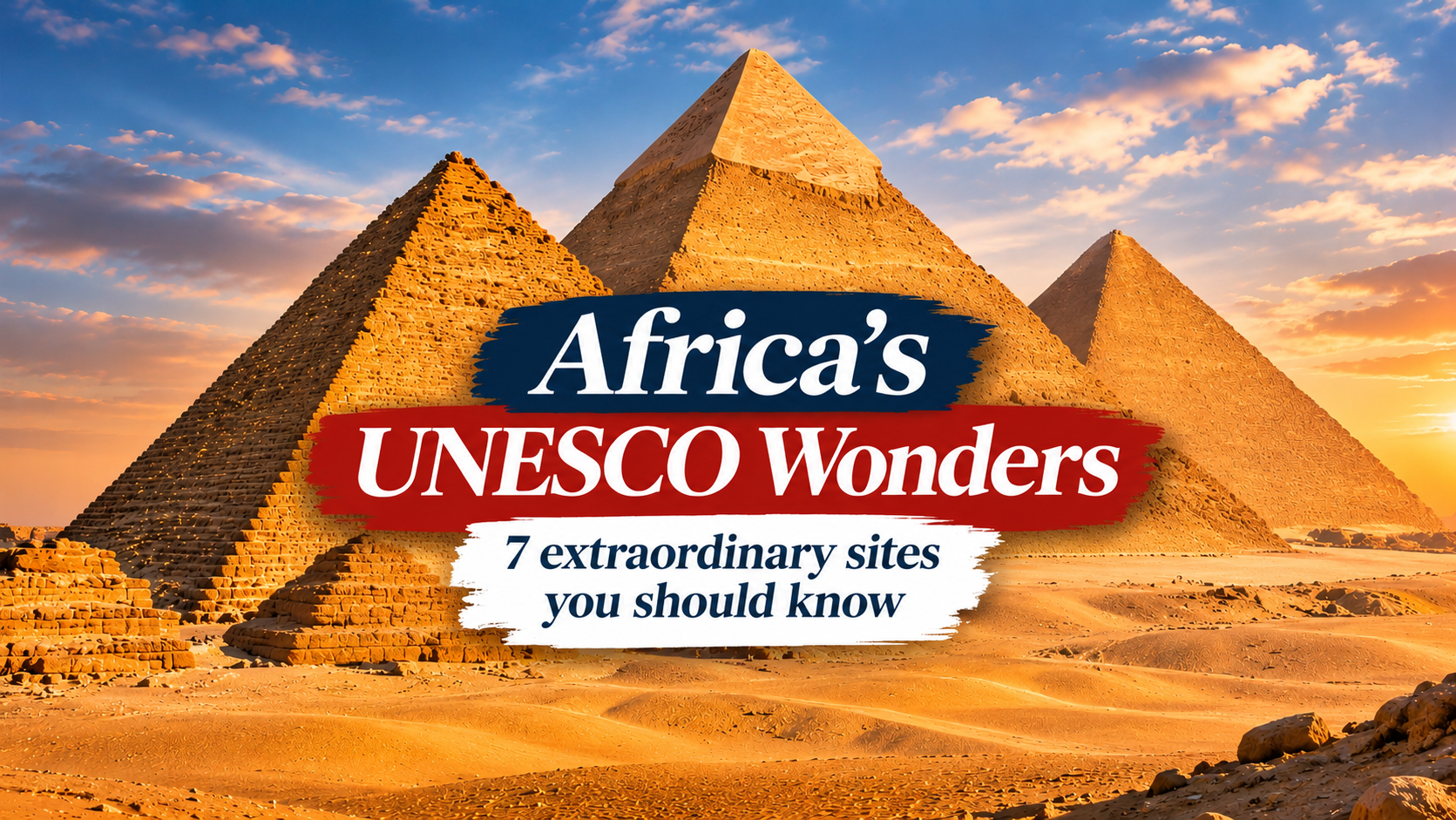
Did you know that Africa is home to some of the world’s most extraordinary UNESCO World Heritage Sites, including ancient pyramids, cities built without mortar and churches carved directly into rock?
Across the continent, these remarkable places preserve thousands of years of history, architecture and natural beauty.
Some reveal the achievements of ancient African civilisations. Others protect breathtaking landscapes and wildlife found in few other places on Earth.
Here are seven fascinating UNESCO World Heritage Sites in Africa that deserve global attention.
1. Egypt’s pyramids are more than 4,500 years old
The Pyramids of Giza are among the world’s most recognisable ancient monuments.
Built around 4,500 years ago, these enormous structures served as royal tombs for ancient Egyptian pharaohs.
The Great Pyramid of Khufu originally stood approximately 146 metres tall.
Remarkably, it remained the world’s tallest human-made structure for thousands of years.
Today, it is the only surviving Wonder of the Ancient World.
The pyramids form part of the UNESCO-listed Memphis and its Necropolis site, preserving an extraordinary chapter of African history.
2. Ethiopia has churches carved from solid rock
In the Ethiopian town of Lalibela, visitors can discover 11 extraordinary medieval churches carved directly into rock.
Unlike conventional buildings, these churches were created by excavating the surrounding stone.
Some stand below ground level, connected by narrow passages and trenches.
The churches date largely to the 12th and 13th centuries and remain important places of worship.
UNESCO recognises Lalibela for its exceptional architectural and cultural significance.
The site demonstrates the remarkable craftsmanship and engineering abilities of medieval Ethiopian builders.
3. Mali’s Timbuktu was once a famous centre of learning
Centuries ago, Timbuktu was one of Africa’s most important centres of trade and Islamic scholarship.
Located near the Sahara Desert, the city attracted merchants, scholars and students from different regions.
Its intellectual traditions included the study of Islamic law, theology, mathematics and astronomy.
Historic institutions associated with Sankore helped establish Timbuktu’s reputation as a centre of learning.
The city also became famous for its manuscripts, many of which preserve centuries of African scholarship.
Today, Timbuktu’s historic mosques and cultural heritage are recognised by UNESCO.
4. Tanzania hosts one of the world’s greatest animal migrations
The Serengeti National Park in Tanzania is famous for one of nature’s most spectacular annual events.
Huge herds of wildebeest, accompanied by zebras and other grazing animals, move across the wider Serengeti ecosystem in search of food and water.
Their journey follows seasonal rainfall and changing grazing conditions.
Along the way, the animals encounter rivers, predators and other natural challenges.
The Serengeti also supports lions, elephants, giraffes and an extraordinary variety of wildlife.
UNESCO recognises the park for its outstanding natural importance and ecological processes.
5. Zimbabwe has an ancient city built without mortar
Great Zimbabwe is one of southern Africa’s most impressive archaeological sites.
The historic settlement developed into a major political and trading centre between approximately the 11th and 15th centuries.
Its most remarkable features include enormous stone walls built from carefully arranged granite blocks.
The builders constructed these walls without using mortar to hold the stones together.
Some sections rise several metres high, demonstrating impressive architectural skill.
Great Zimbabwe also maintained trading connections extending towards the Indian Ocean.
Today, the UNESCO-listed ruins provide powerful evidence of the sophistication of medieval African societies.
6. Namibia has towering dunes beside the Atlantic Ocean
Namibia’s Namib Sand Sea is one of Africa’s most spectacular natural landscapes.
The UNESCO-listed area contains vast fields of sand dunes shaped by wind over immense periods.
Its dramatic scenery includes towering red-orange dunes, dry valleys and striking desert formations.
However, the landscape is more than a beautiful destination.
Despite extremely dry conditions, the desert supports specialised plants and animals.
Fog drifting inland from the Atlantic Ocean provides an important source of moisture for some species.
The Namib Sand Sea is recognised by UNESCO for its exceptional natural processes and desert environment.
7. Senegal’s Gorée Island preserves an important historical memory
Just off the coast of Dakar, Senegal’s Gorée Island is a UNESCO World Heritage Site associated with the history and remembrance of the Atlantic slave trade.
The island contains historic buildings, narrow streets and sites dedicated to remembering those affected by slavery.
Its House of Slaves has become an internationally recognised memorial, although historians debate the scale of the slave trade conducted through that particular building.
Today, Gorée Island welcomes visitors seeking to understand this difficult chapter of history.
The site reminds the world why preserving historical memory is essential.
Africa’s heritage is a treasure for future generations
From the engineering achievements of ancient Egypt and Zimbabwe to the intellectual traditions of Timbuktu, Africa’s UNESCO World Heritage Sites reveal an extraordinary legacy.
Meanwhile, natural wonders such as the Serengeti and Namib Sand Sea demonstrate the continent’s remarkable environmental diversity.
These landmarks offer more than beautiful scenery.
They preserve history, knowledge, craftsmanship and ecosystems that deserve protection.
Together, they remind us that Africa’s cultural and natural heritage is an invaluable part of humanity’s shared history.