
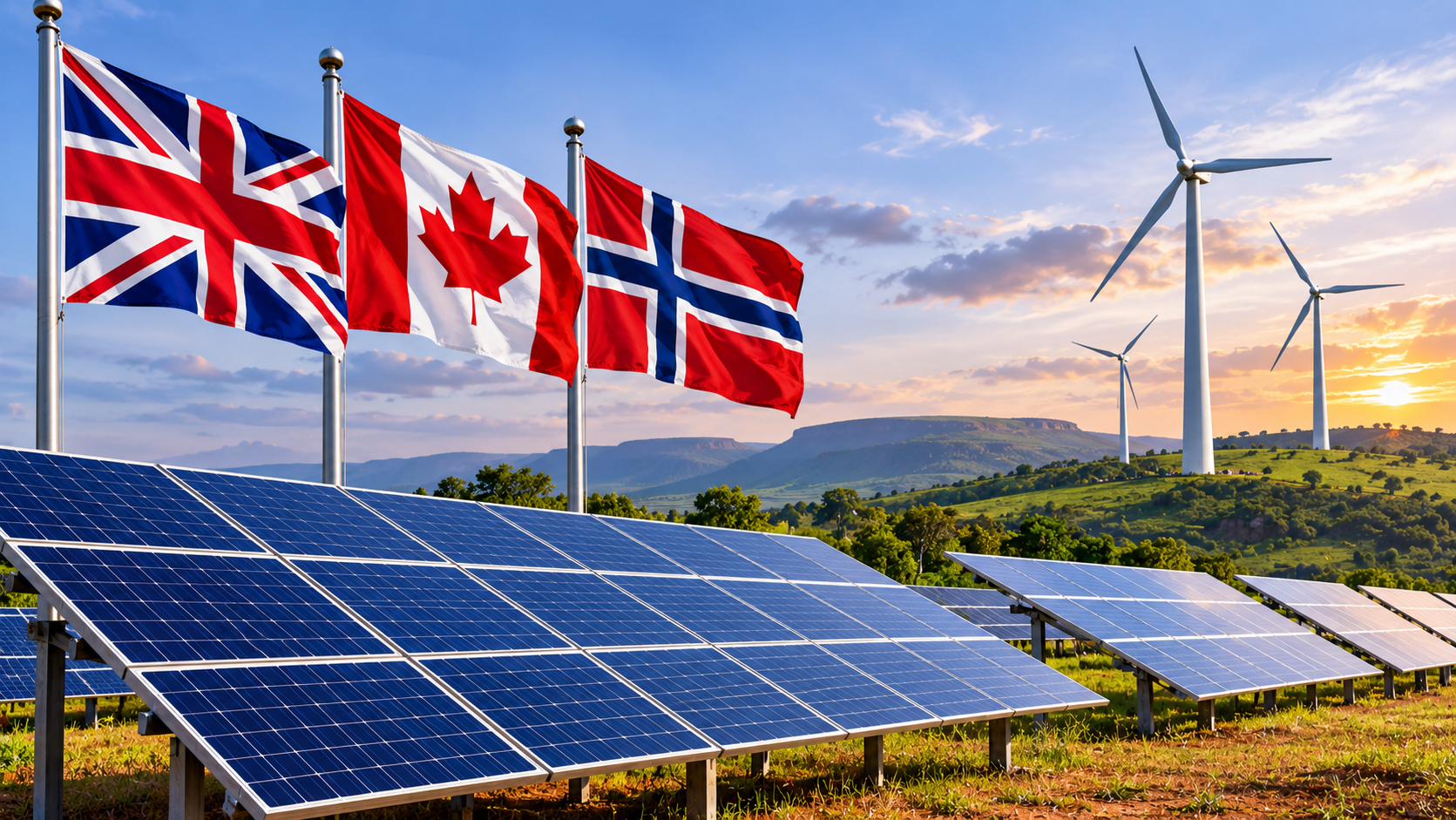
Britain, Canada and Norway have launched a $10 billion climate investment initiative that could support renewable energy and infrastructure projects across Africa.
The three countries announced the partnership during the COP31 climate summit in Antalya, Türkiye.
According to Business Insider Africa, citing Reuters, the initiative aims to mobilise at least $10 billion in climate-related investments by 2030.
However, the funding is not exclusively for Africa. The partners have not announced how much will reach the continent.
Three countries join forces at COP31
British International Investment, FinDev Canada and Norway’s Norfund signed an agreement to establish the initiative, known as 10by30.
The partnership will focus on renewable electricity, energy storage and power transmission.
In addition, it will support sustainable fuels and projects that reduce industrial emissions.
The institutions plan to share investment opportunities and coordinate project assessments.
They also hope to attract more private investors into major infrastructure projects.
However, the agreement does not establish a new investment fund or create binding financial commitments.
Instead, each institution will continue to approve investments independently.
What the $10 billion target means
The $10 billion figure represents a target for investment activity through 2030.
Importantly, it includes money the institutions hope to attract from private investors.
Therefore, the announcement does not mean governments have already committed $10 billion in new funding.
Furthermore, the partners have not identified the first projects or countries that will receive financing.
British International Investment chief executive Leslie Maasdorp welcomed the agreement.
He said the partnership could help attract private investment to markets where financing is urgently needed.
The institutions also expect cooperation to reduce delays when assessing major projects.
African energy projects could benefit
Africa is already an important investment market for all three institutions.
British International Investment committed approximately £1.07 billion to African investments in 2025.
That represented 59% of its new commitments during the year, according to Business Insider Africa.
Meanwhile, Norfund directed 71% of its new development investments to Africa in 2025.
Its climate investment priorities include South Africa, Egypt, Tunisia and Morocco.
FinDev Canada also finances projects across Africa.
Earlier in 2026, the Canadian institution committed $100 million to the Africa Finance Corporation.
That investment supports renewable energy and low-carbon railway projects.
These existing partnerships could help African developers access financing under the new initiative.
Nevertheless, no specific African project has received a confirmed allocation from the $10 billion target.
Private investment remains central
The three institutions want to attract commercial investors alongside public development financing.
This approach could help support projects that require substantial long-term investment.
For example, electricity networks and energy storage facilities often need significant upfront funding.
However, financing will still depend on each project’s commercial viability and the institutions’ approval processes.
FinDev Canada chief executive Lori Kerr said the partnership would combine capital, financing tools and technical assistance.
Meanwhile, Norfund chief executive Erik Sandersen highlighted the importance of faster investment decisions.
The initiative could create new opportunities for African energy developers.
However, its success will depend on how much funding the partners actually mobilise.
For now, the $10 billion remains a global investment target rather than a confirmed financial commitment to Africa.