
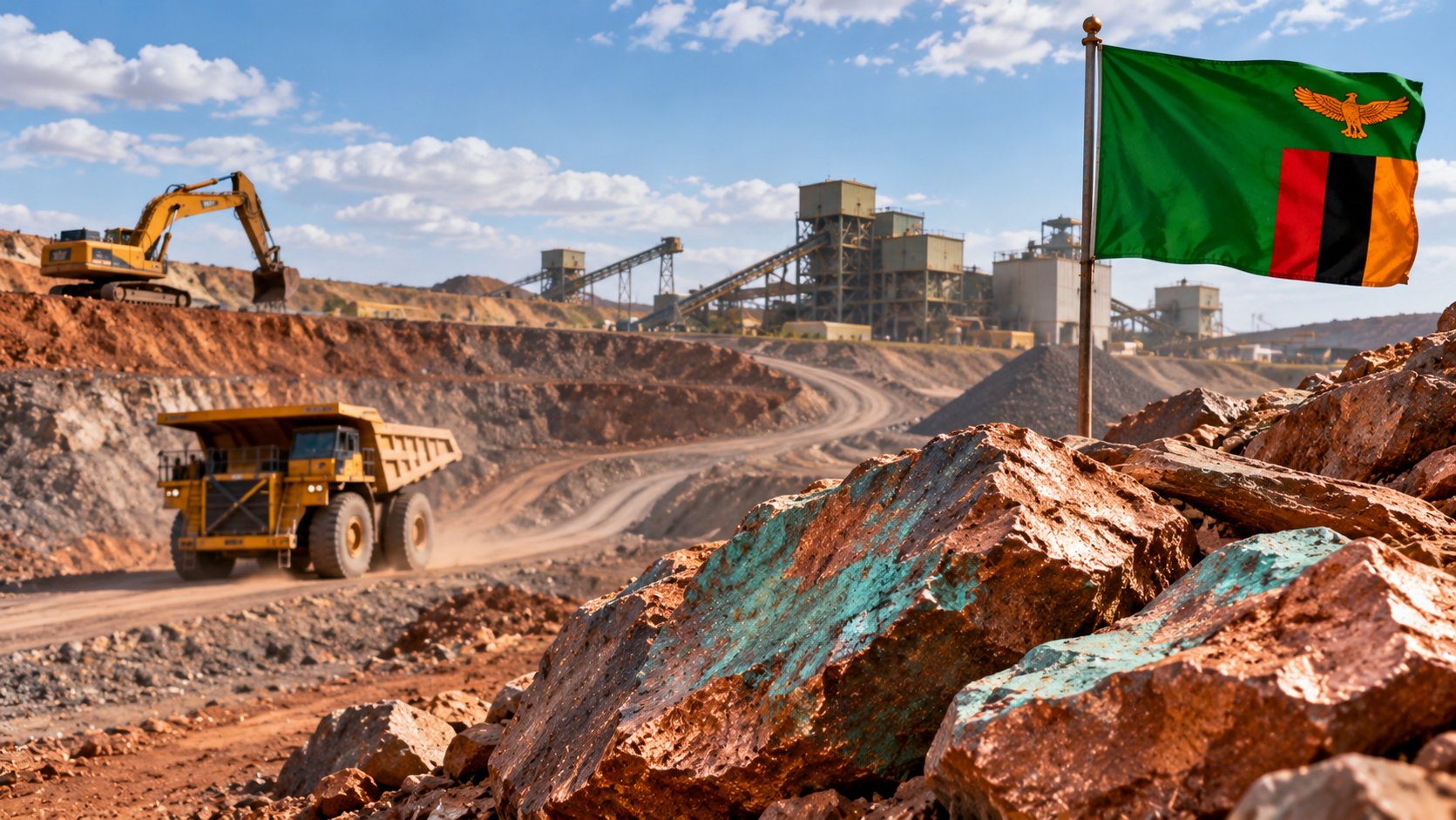
Zambia has attracted more than $12 billion in mining investment since 2022 as the country seeks to expand copper production and strengthen its position in the global minerals market.
President Hakainde Hichilema says the investment will help Zambia become a major supplier of minerals used in electric vehicles, renewable energy and other industries.
However, workers, environmental campaigners and local businesses are questioning whether the mining boom is delivering enough benefits to ordinary Zambians.
According to Al Jazeera, the debate has intensified as foreign companies expand their operations across the country’s mineral-rich Copperbelt region.
Foreign investors expand mining operations
Several international mining companies are investing in Zambia’s copper industry.
Major investors include Canada’s First Quantum Minerals and Barrick Mining Corporation, India’s Vedanta Resources and China Nonferrous Metal Mining Group.
Meanwhile, Abu Dhabi-based International Resources Holding has committed $1.1 billion to recapitalise Mopani Copper Mines.
The investment gave the company a 51% stake in Mopani, while Zambia’s state-owned ZCCM Investments Holdings retained 49%.
Smaller Chinese-owned mineral-processing facilities have also expanded in the Copperbelt.
Some purchase minerals from artisanal and small-scale miners. However, their growth has raised concerns about workplace safety and environmental oversight.
The government has introduced tax incentives and a more predictable fiscal framework to encourage investment.
Zambia targets 3 million tonnes of copper
Zambia wants to increase annual copper production to 3 million tonnes by 2031.
That would represent a major increase from the country’s recent production levels of less than one million tonnes annually.
To support exploration, the government is conducting a nationwide aerial geophysical survey.
According to the Ministry of Mines and Minerals Development, the survey is approximately 98% complete.
Officials hope the project will identify previously unexplored mineral deposits and attract further investment.
Zambia also holds deposits of cobalt, nickel, lithium, manganese and rare earth minerals.
These resources are increasingly important for electric vehicles, batteries and renewable energy technologies.
African countries explore battery manufacturing
Zambia is also seeking to move beyond exporting minerals for processing overseas.
Historically, much of its copper has been exported to China and other industrialised economies.
However, the government wants to develop more domestic processing and manufacturing capacity.
Zambia and the Democratic Republic of the Congo are exploring cooperation with South Africa to develop an electric vehicle battery industry.
The proposed partnership would combine minerals from Zambia and DR Congo with South Africa’s established automotive manufacturing sector.
Hichilema discussed the initiative during the Zambia Mining and Investment Forum in Lusaka on October 19.
The project could help African countries capture more value from their natural resources.
Nevertheless, developing the industry will require investment in infrastructure, skilled workers and reliable electricity.
Mining workers seek better conditions
Despite the growth in investment, trade unions say working conditions have not improved significantly.
Stephen Mwaanga, secretary of the National Union of Miners and Allied Workers, told Al Jazeera that mineworkers were seeing limited benefits from higher copper prices.
He said mining companies were also facing increased production costs, particularly for fuel and electricity.
Zambia relies heavily on hydropower, making its electricity supply vulnerable to drought.
Recent drought conditions have placed additional pressure on the country’s energy system.
As a result, mining companies have increasingly depended on imported electricity and alternative power sources.
Mwaanga called for a balance between improving workers’ conditions and addressing the financial challenges facing mining companies.
Environmental damage raises concerns
Environmental protection has become another major issue surrounding Zambia’s mining expansion.
In February 2025, a tailings dam failure at Chinese-owned Sino-Metals Leach Zambia released acidic mining waste into the Chambishi Stream.
The contamination spread into the Mwambashi and Kafue river systems.
A subsequent assessment by the Zambia Environmental Management Agency documented ecological damage and the effects on affected waterways.
The incident raised concerns about water quality, farming and the livelihoods of nearby communities.
Human rights campaigner Eugene Mulenga told Al Jazeera that increasing mining activity was affecting farmers and poorer households that depend on local water resources.
Environmental advocates are therefore calling for stronger monitoring and greater accountability from mining companies.
Government pushes local business participation
Zambia is introducing measures to ensure local companies benefit from the mining industry’s expansion.
Under new local-content regulations, mining companies must allocate at least 20% of their annual procurement budgets for core mining goods and services to local suppliers in 2026.
The requirement is scheduled to increase to 25% after one year, with further increases planned.
The policy aims to create business opportunities, support employment and retain more mining revenue within Zambia.
However, its success will depend on implementation and the ability of domestic suppliers to meet industry requirements.
Can Zambia turn mineral wealth into prosperity?
Zambia’s mining boom presents significant economic opportunities.
Growing global demand for copper and other critical minerals could support investment, manufacturing and job creation.
However, higher production alone will not guarantee improvements in living standards.
Workers are seeking better employment conditions, while communities want stronger environmental protections.
Local businesses also hope to secure a larger share of mining contracts.
As Zambia works towards its ambitious production targets, the challenge will be ensuring that its mineral wealth generates lasting benefits for the wider population.