
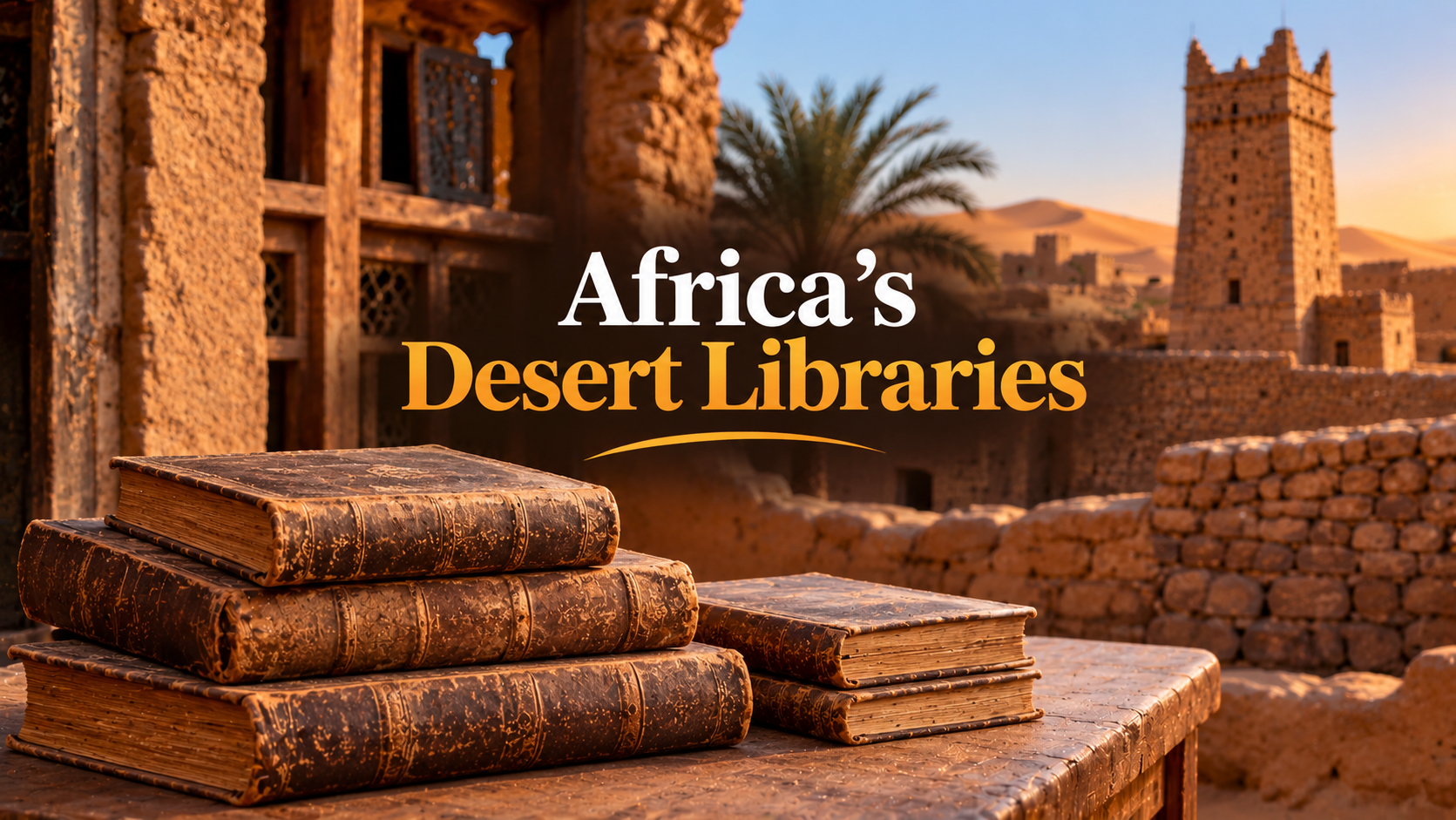
Mauritania’s desert libraries hold an extraordinary collection of ancient manuscripts. Some of these handwritten books have survived for hundreds of years.
The historic town of Chinguetti sits deep in the Sahara Desert. Despite its remote location, it once served as an important centre of trade and learning.
Today, families continue to preserve manuscripts covering history, science, literature and other subjects.
These collections offer a fascinating glimpse into Africa’s intellectual heritage.
Mauritania’s desert libraries have a rich history
Chinguetti is a historic town in northern Mauritania. For centuries, traders and travellers passed through the settlement while crossing the Sahara.
As trade expanded, the town became an important meeting place for scholars and merchants.
Travellers exchanged goods, knowledge and ideas. Meanwhile, local families began collecting and preserving handwritten books.
Over time, Chinguetti developed a reputation as a centre of learning.
Today, its ancient buildings and libraries continue to attract interest from historians and visitors.
What makes Chinguetti’s manuscripts special?
Mauritania’s desert libraries contain manuscripts covering many different subjects.
For example, some books explore mathematics, astronomy, medicine and poetry. Others preserve historical records and linguistic knowledge.
These collections reveal an important part of Africa’s intellectual history.
Although oral traditions played a major role across the continent, written scholarship also flourished.
Furthermore, the manuscripts show how knowledge travelled between communities through trade and education.
Many documents have remained in the care of local families for generations.
How families protect Mauritania’s ancient books
One remarkable feature of Chinguetti is its tradition of family-owned libraries.
Instead of keeping every manuscript in a public institution, families have preserved their collections privately.
Some libraries also welcome visitors who want to learn about the town’s history.
However, protecting these fragile books is difficult.
Desert dust, temperature changes and ageing materials can damage manuscripts.
Therefore, preservation efforts remain essential to protecting these valuable collections.
Local custodians and conservation specialists continue working to safeguard this heritage.
Why is Chinguetti a UNESCO World Heritage site?
Chinguetti belongs to a group of four historic Mauritanian towns recognised by UNESCO.
The other towns are Ouadane, Tichitt and Oualata.
Together, they form the Ancient Ksour of Ouadane, Chinguetti, Tichitt and Oualata World Heritage site.
These settlements reflect centuries of trade and cultural exchange across the Sahara.
In addition, their traditional architecture shows how communities adapted to desert life.
Visitors can still discover narrow streets, historic stone buildings and distinctive local traditions.
Why Mauritania’s desert libraries matter today
Mauritania’s desert libraries offer more than a collection of old books.
They preserve evidence of Africa’s long history of scholarship and cultural exchange.
Moreover, the manuscripts show how families protected knowledge long before modern digital libraries existed.
Today, these collections face environmental and conservation challenges.
Nevertheless, their survival remains an extraordinary achievement.
Chinguetti reminds us that some of Africa’s greatest historical treasures are hidden in unexpected places.
Deep in the Sahara, centuries of knowledge continue to survive through the dedication of local communities.