
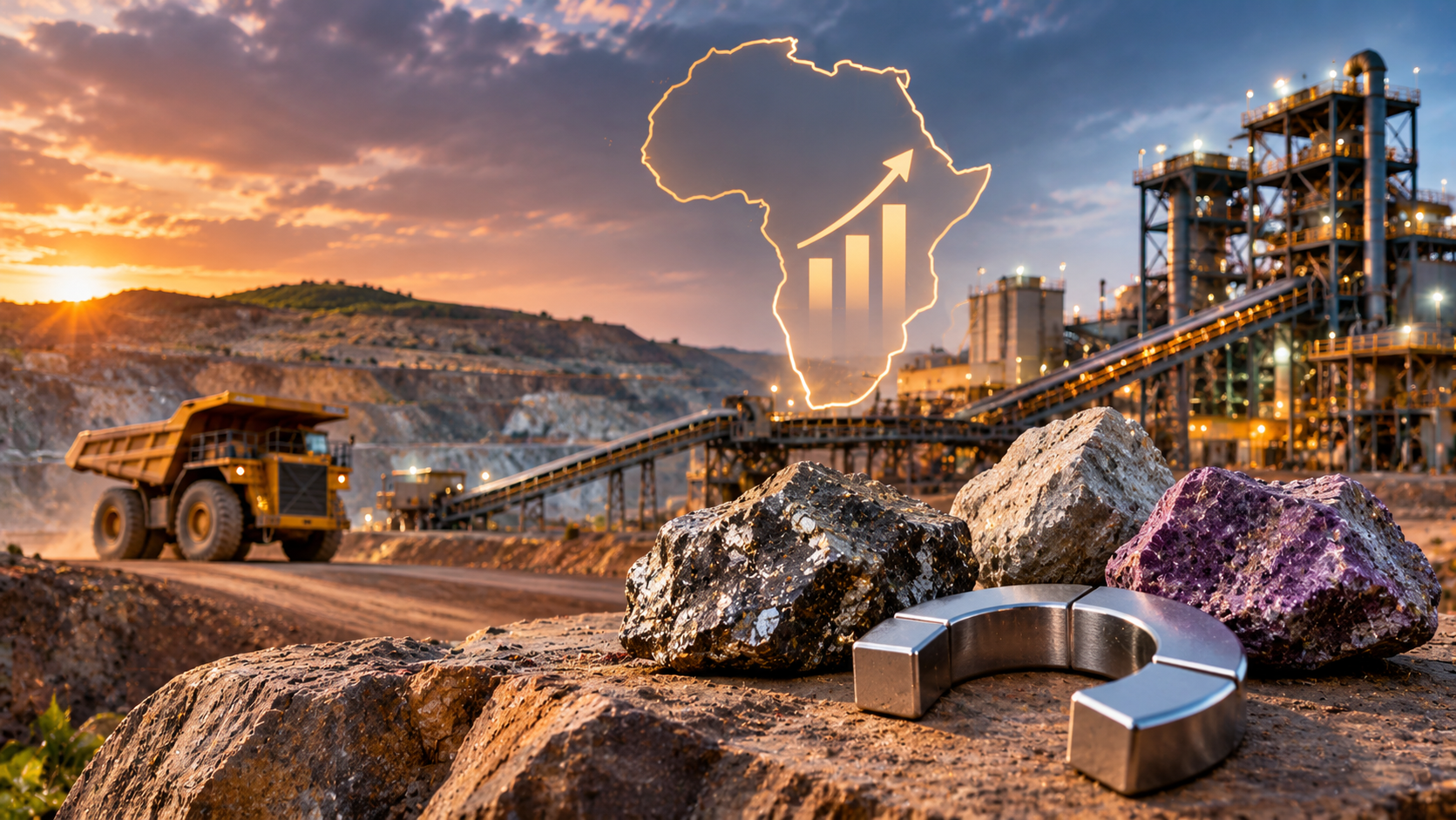
Lorem ipsum dolor sit amet, consectetur adipiscing elit, sed do eiusmod tempor incididunt ut labore et dolore magna aliqua. Ut enim ad minim veniam, quis nostrud exercitation ullamco laboris nisi ut aliquip ex ea commodo Africa could become an important player in the global rare earth industry as demand for advanced magnets continues to grow.
New market forecasts suggest the rare earth permanent magnet industry could reach $39.23 billion by 2034.
The expansion offers African countries an opportunity to attract investment, develop processing facilities and increase their role in global technology supply chains.
According to Business Insider Africa, several African nations are already pursuing rare earth projects as international manufacturers seek alternatives to China.
However, experts warn that Africa must expand local processing to capture more value from its mineral resources.
Rare earth magnet market set for growth
Rare earth elements play an important role in modern technology.
Manufacturers use them in electric vehicles, wind turbines, electronics and advanced industrial equipment.
Some rare earth elements are especially important for producing powerful permanent magnets.
According to Polaris Market Research, the global rare earth permanent magnet market could grow from $21.81 billion in 2025 to $39.23 billion by 2034.
That represents an estimated annual growth rate of 6.7%.
Meanwhile, the supply of rare earth permanent magnets outside China is projected to grow by 10.8% annually between 2026 and 2034.
These forecasts highlight growing international interest in alternative supply chains.
China dominates global rare earth production
China currently holds a leading position in the global rare earth industry.
Its influence extends beyond mining to processing, refining and magnet manufacturing.
As a result, many countries depend on Chinese suppliers for essential materials.
However, concerns about supply security have encouraged governments and companies to seek alternatives.
Business Insider Africa cited Bloomberg reporting based on Argus Media data showing major price differences between markets.
For example, yttrium was reportedly priced at around $1.15 million per tonne in Europe, compared with $9,144 in China.
Dysprosium and terbium also commanded significantly higher prices outside China.
These differences underline the challenges facing countries trying to develop independent supply chains.
African rare earth projects attract investment
Several African countries are attracting international investment in rare earth development.
In August, Reuters reported that the US International Development Finance Corporation committed $62.8 million to projects in Malawi, Angola, Madagascar and South Africa.
South Africa’s Phalaborwa project accounted for approximately $50 million of that commitment.
However, none of the four projects had begun production when the funding was reported.
The investments nevertheless reflect growing interest in Africa’s mineral resources.
Meanwhile, governments and companies are exploring ways to develop domestic processing capacity.
Nigeria plans major processing facility
Nigeria is seeking to expand its role beyond raw mineral extraction.
A $400 million rare earth and critical metals processing facility is under development in Uke, Nasarawa State.
The project is being developed by Hasetins Commodities Limited.
According to Business Insider Africa, the facility is expected to add 12,000 tonnes of annual processing capacity.
Once fully operational, the company’s total capacity could reach 18,000 tonnes annually.
The investment could strengthen Nigeria’s position in mineral processing.
However, the planned capacity remains a projection until the facility becomes operational.
Gabon seeks to revive major mineral project
Gabon is also pursuing opportunities in the rare earth industry.
The country hopes to revive the long-delayed Mabounié deposit, which contains niobium and rare earth resources.
A proposed $2 billion development involves Emirati-backed New Energy Metals and Chinese engineering company ENFI.
The project is expected to include several processing facilities within Gabon.
Construction is planned to begin in 2027.
However, the project has not yet entered production.
If completed, it could help Gabon expand its industrial capabilities and retain more value from its mineral resources.
Local processing could strengthen African economies
Africa’s rare earth potential extends beyond the minerals found underground.
Processing and refining are essential stages in the production of materials used by global manufacturers.
Without these facilities, African countries could remain dependent on exporting raw minerals.
Other countries would then capture much of the value generated through refining and manufacturing.
Developing local processing could create industrial jobs, strengthen technical skills and attract additional investment.
However, building a competitive industry will require reliable infrastructure, financing and specialised expertise.
Environmental safeguards and responsible mining practices will also be important.
Africa seeks a greater role in global supply chains
The projected expansion of the rare earth magnet market presents an opportunity for African economies.
Projects in South Africa, Nigeria, Gabon and other countries show growing interest in the sector.
Meanwhile, international efforts to diversify supply chains could create new partnerships.
However, Africa’s future role will depend on whether planned projects reach production and processing capacity expands.
The $39.23 billion forecast represents the projected value of the global market, not revenue guaranteed to African producers.
Ultimately, investment in local manufacturing and mineral processing could help African countries capture a greater share of this growing industry.. Duis aute irure dolor in reprehenderit in voluptate velit esse cillum dolore eu fugiat nulla pariatur. Excepteur sint occaecat cupidatat non proident, sunt in culpa qui officia deserunt mollit anim id est laborum.