
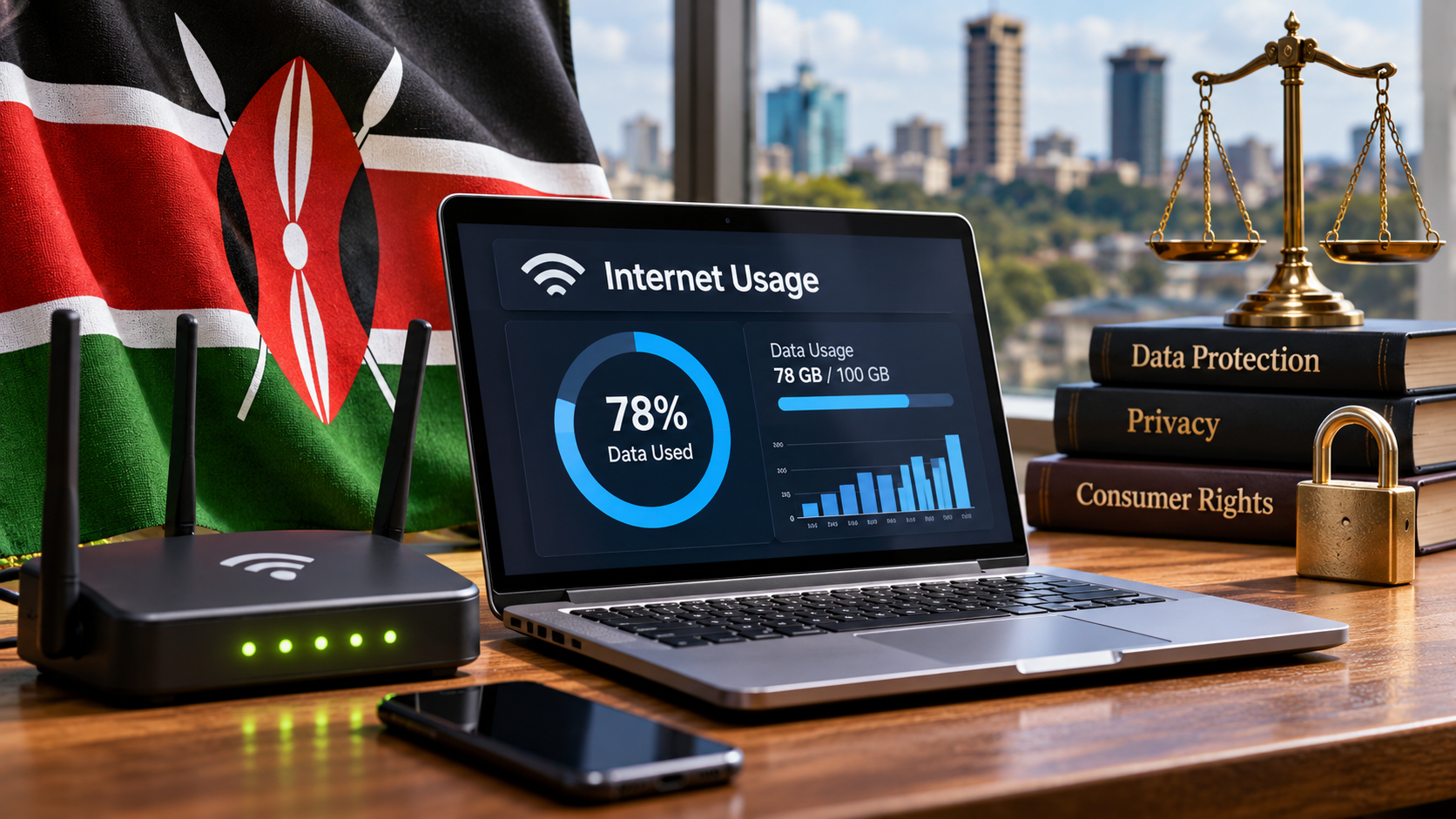
Kenya’s proposed internet billing law has sparked concerns over privacy, surveillance risks and rising internet costs.
The Kenya Information and Communications (Amendment) Bill, 2025, would require internet providers to introduce usage-based billing and assign customers unique meter numbers.
Supporters say the proposal could improve billing transparency and protect consumers from unfair charges.
However, telecommunications companies, regulators and civil society organisations have raised concerns about its potential impact.
According to Al Jazeera, Kenya’s parliament is reviewing the proposal as debate grows over digital rights and internet affordability.
Kenya’s internet billing proposal explained
The bill was introduced by Aldai Member of Parliament Marianne Jebet Kitany.
It seeks to make consumption-based internet billing compulsory for service providers.
Under the proposal, companies would monitor how much data subscribers use.
Each customer would also receive a unique meter number linked to their internet consumption.
Providers would then issue bills based on recorded usage.
In addition, companies would submit information about their billing systems to Kenya’s communications regulator.
The bill aims to ensure consumers pay fairly for the internet they use.
However, critics question whether mandatory metering is necessary.
Privacy concerns over internet monitoring
Civil society organisations have warned that the proposed system could create risks for personal information.
The legislation does not explicitly require providers to record private messages or browsing histories.
However, it would create identifiable records linked to individual subscribers.
Critics want clearer rules governing how this information would be stored, accessed and shared.
The International Commission of Jurists Kenya has questioned whether mandatory metering is necessary to protect consumers.
Demas Kiprono, a representative of the organisation, has raised concerns about the collection of identifiable usage data.
Kenya already has a Data Protection Act, introduced in 2019.
Therefore, opponents want lawmakers to clarify how existing privacy protections would apply.
Court case highlights data protection debate
Concerns about telecommunications data have also emerged in a separate legal case.
University student David Ooga Mokaya was arrested in November 2024 over a social media post concerning President William Ruto.
He faced charges of publishing false information.
However, a court acquitted him in February 2026 after finding that prosecutors had failed to prove their case.
Mokaya later filed a petition concerning the handling of his personal information.
He alleged that telecommunications records and other data had been shared with investigators without his consent.
A court subsequently issued temporary orders restricting the disclosure of his personal information without appropriate legal authority.
However, the allegations remain part of separate legal proceedings.
The case does not establish that Kenya’s proposed internet billing system would be used for surveillance.
Nevertheless, it has added to wider discussions about data privacy.
Regulator warns of higher internet costs
Kenya’s Communications Authority has urged lawmakers not to make usage-based billing compulsory.
In a submission to parliament on November 3, the regulator warned about possible effects on affordability and consumer choice.
Low-income households, students and small businesses could face particular challenges.
For example, software updates, streaming services and background applications can consume large amounts of data.
As a result, some customers could find their monthly internet costs harder to predict.
However, people who use relatively little data might benefit from consumption-based pricing.
The financial impact would depend on providers’ prices and individual usage patterns.
The proposed bill does not set specific retail internet prices.
Telecom companies raise business concerns
Telecommunications providers have also questioned the proposal.
Telkom Kenya chief executive Mugo Kibati told lawmakers that approximately 96% of data subscriptions already involve mobile internet.
These services are generally billed according to usage.
Therefore, the proposed changes would mainly affect fixed broadband connections.
Telkom warned that mandatory metering could increase compliance costs and affect investment.
The company also raised concerns about subscriber privacy.
Meanwhile, the Kenya Private Sector Alliance warned that unpredictable connectivity costs could affect businesses.
Smaller companies could face additional difficulties if billing systems become more complex.
Alternatives to mandatory internet metering
Kenya’s Communications Authority has proposed several alternatives.
These include automatic notifications when customers reach 50%, 80% and 100% of their data allowances.
The regulator also supports free tools that allow subscribers to monitor usage in real time.
Other proposals include monthly spending limits, clearer bills and independent audits.
Telkom Kenya has also called for the protection of unlimited internet packages.
Furthermore, the company wants providers to explain pricing and fair-use policies before customers subscribe.
These measures could improve transparency without requiring every provider to adopt the same billing model.
Kenya weighs consumer rights and digital access
The proposed legislation has highlighted the challenge of balancing consumer protection with privacy and affordability.
Supporters argue that clearer billing could help prevent unfair charges.
However, critics warn that compulsory metering could create unnecessary costs and data protection risks.
Internet access also plays an important role in education, business and public participation.
Therefore, any changes to billing rules could affect a wide range of users.
Kenya’s parliament must now consider whether mandatory metering offers sufficient benefits.
The final outcome remains uncertain as lawmakers review the proposal.
For consumers, the central question is whether the new rules would make internet services fairer without compromising privacy, affordability or choice.