
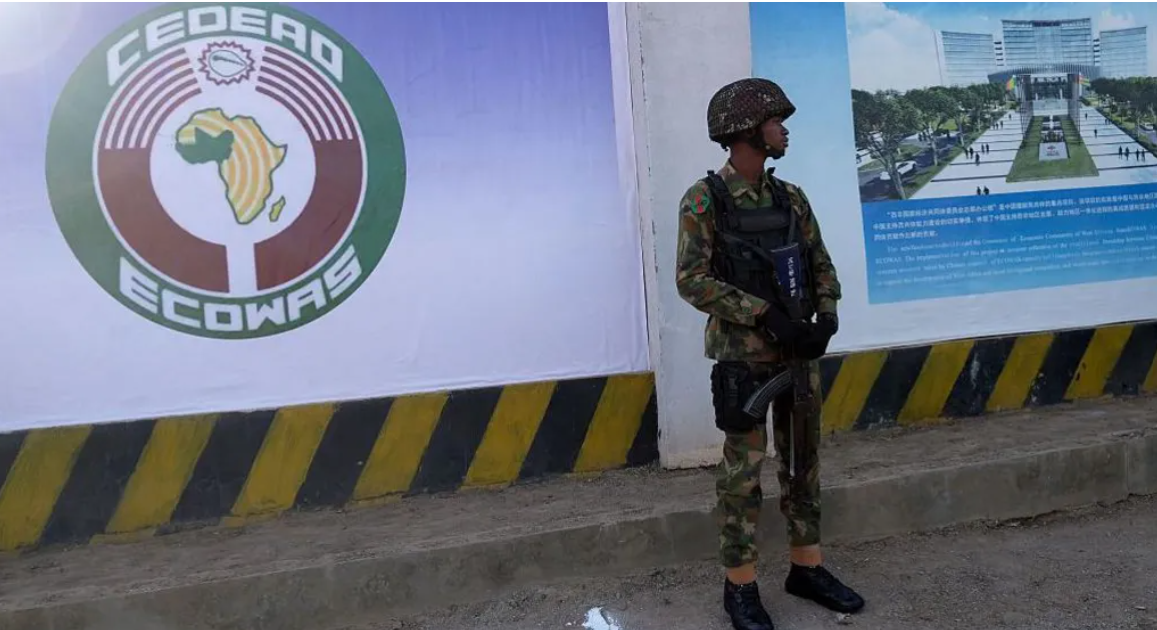
Around 200 West African soldiers, mostly from Nigeria and Ivory Coast, remain in Benin to support government forces after Sunday’s failed coup, the country’s foreign minister has confirmed.
The attempted takeover was halted when Nigeria deployed fighter jets that pushed the mutineers out of a military base and the state broadcaster, where they had briefly declared control. This is the first public confirmation of how many foreign soldiers were involved, although it is unclear whether some have already withdrawn.
Benin’s foreign minister, Olushegun Adjadi Bakari, said that part of the regional force had stayed on “as part of the sweep and clean-up operation”. A manhunt is continuing for those involved, with the reported leader believed to be hiding in neighbouring Togo.
The mutineers justified their actions by accusing President Patrice Talon of mismanaging the country, particularly the deteriorating security in northern Benin.
Ecowas deployed troops from Nigeria, Ghana, Sierra Leone and Ivory Coast to secure key sites and prevent any resurgence. Nigeria described the coup attempt as a “direct assault on democracy”.
An Ivory Coast security source told media that around 50 Ivorian soldiers were sent as part of the mission. Bakari said that by the time Benin requested support, the coup attempt had already collapsed, adding that what was needed was precise aerial backing to hit mutineer positions without endangering civilians.
Nigeria’s foreign minister, Yusuf Maitama Tuggar, said rapid diplomatic, military and intelligence coordination between the two countries helped defeat the plot.
Talks are under way over how long the regional troops will remain. Bakari stressed that any decision will be made jointly with Benin’s defence and security forces.
It is unclear whether French special forces, who reportedly assisted loyalist troops, are still in the country.
With the region facing intense pressure following a succession of successful coups, Ecowas is signalling that it will no longer tolerate the toppling of elected governments. Bakari described the bloc as “an important tool” for defending democratic norms.
Benin’s army has suffered casualties near the northern border in recent years, as jihadist groups linked to Islamic State and al Qaeda push southwards from Niger and Burkina Faso.
President Talon, a close ally of Western governments, is expected to step down next year after finishing his second term. Elections are scheduled for April.