
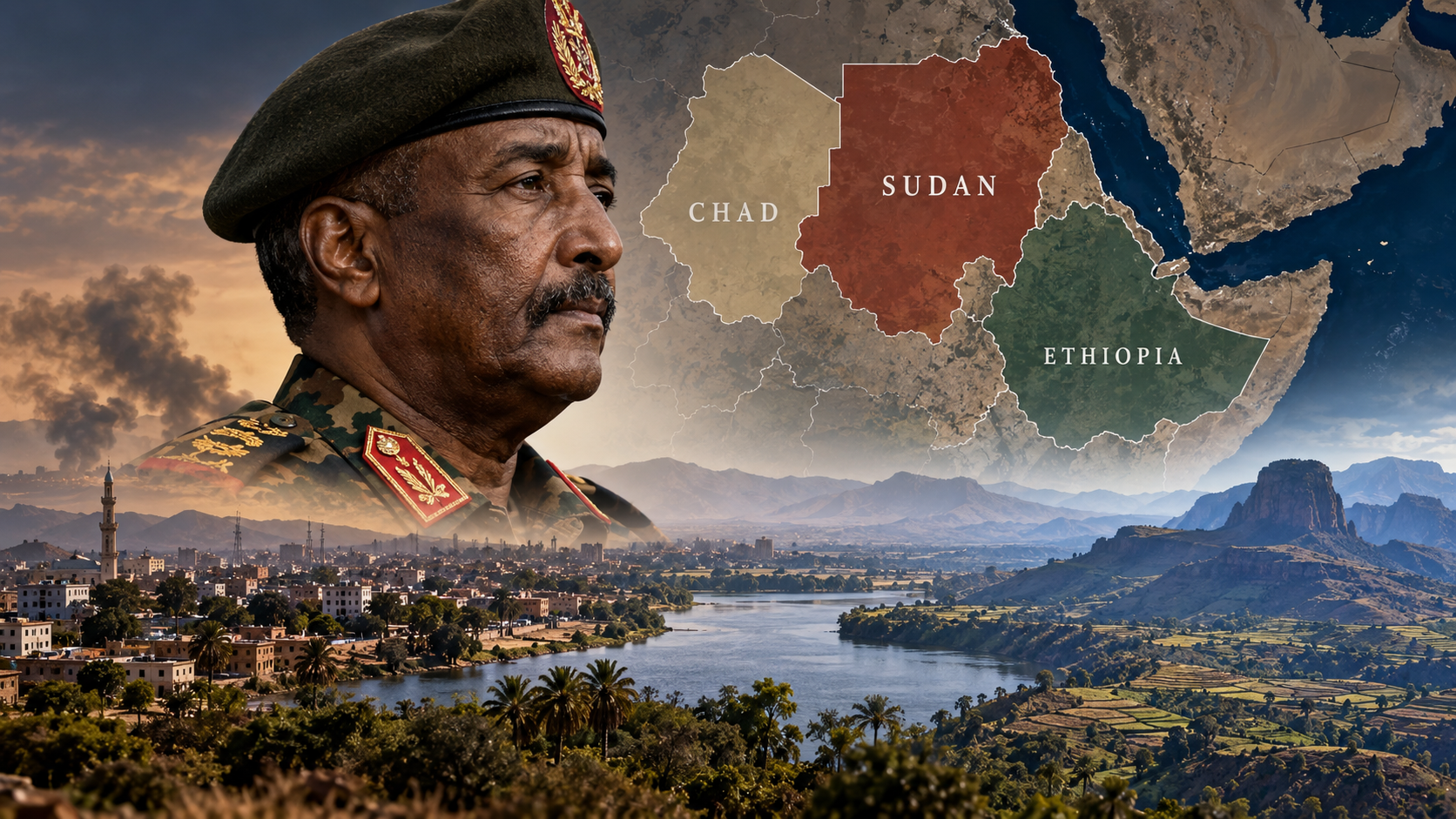
Burhan regional tensions are drawing greater attention as Sudan’s war intersects with renewed fighting in Ethiopia and disputes involving neighbouring Chad.
Competing accusations of support for armed groups and reported cross-border military activity have increased concerns about instability spreading across the region.
The developments have also brought the military leadership of Sudanese army chief Abdel Fattah al-Burhan under renewed scrutiny.
Burhan regional tensions grow over Ethiopia
Ethiopia’s military chief, Field Marshal Birhanu Jula, has accused Sudan and Egypt of supporting armed groups seeking to remove Prime Minister Abiy Ahmed’s government.
He said the armed opposition would struggle to sustain its campaign without outside assistance. However, the accusations against Sudan have not been independently established.
The allegations followed the formation of the Ethiopian Peoples’ Forces Alliance for Survival.
The alliance brings together seven armed movements. They include the Tigray People’s Liberation Front (TPLF), the Amhara Fano National Movement and the Oromo Liberation Army.
The alliance has declared its intention to remove Abiy’s government and establish a transitional administration.
Sudan’s regular armed forces have rejected Ethiopia’s accusations as baseless.
Army spokesperson Asim Awad Abdelwahab instead accused Ethiopia of allowing training, logistical support and drone operations benefiting the Rapid Support Forces (RSF) from its territory.
Ethiopia has denied supporting the RSF. Neither side’s competing allegations have been independently established.
Fighting intensifies in northern Ethiopia
The dispute comes as renewed fighting threatens the peace agreement that ended Ethiopia’s devastating northern war in November 2022.
Fighting intensified on September 23, when Tigrayan forces launched operations against federal troops and took control of three regional airports.
The clashes subsequently spread into neighbouring Afar and Amhara.
The new opposition alliance also includes forces that fought against each other during Ethiopia’s previous war.
Despite different political and territorial objectives, the groups are now united by their opposition to the federal government.
On September 28, pro-government forces claimed to have recaptured the strategic town of Alamata, south of Tigray’s capital, Mekelle.
The pro-government Tigrai Peace Force released footage that it said showed its fighters entering the town. Reuters reported that it could not independently verify the footage.
Questions over Sudanese involvement
The fighting has increased attention on allegations of cross-border involvement.
Reports have previously alleged that Ethiopian fighters operated alongside Sudan’s regular armed forces during Sudan’s war.
Footage circulated following the army’s recapture of Wad Madani in January 2025 appeared to show a Sudanese officer praising Ethiopian fighters for their role in the operation.
The footage was later cited by the RSF in accusing the army of using foreign combatants.
However, the extent and nature of any involvement by Ethiopian fighters have not been independently established.
The issue has gained further significance as tensions increase between Khartoum and Addis Ababa.
Chad dispute adds to Burhan regional tensions
Concerns over Burhan regional tensions have also extended to Sudan’s western border with Chad.
Chad’s military accused Sudanese forces and allied armed groups of carrying out strikes against vehicles in the Ennedi-Est region in August.
According to the Chadian military, the strikes occurred more than 100 kilometres inside Chad.
The accusations prompted N’Djamena to place its forces on high alert and warn that it reserved the right to protect its sovereignty.
Sudanese authorities have disputed accusations concerning the incident and called for an independent investigation before responsibility is established.
The United States and African Union also expressed concern over reports of cross-border strikes.
US senior adviser for Arab and African affairs Massad Boulos warned against the expansion of Sudan’s conflict beyond its borders.
African Union Commission Chairperson Mahmoud Ali Youssouf called for respect for national sovereignty and urged the parties to avoid further escalation.
Fears of wider regional instability
Sudan’s location between the Horn of Africa, the Sahel and the Red Sea makes regional spillover particularly sensitive.
The country already borders states facing their own political, security and humanitarian challenges.
Renewed fighting in Ethiopia adds another source of instability.
At the same time, accusations involving Sudan, Ethiopia and Chad risk increasing mistrust between neighbouring governments.
Regional and international organisations have therefore called for restraint and dialogue.
The growing concern is that Sudan’s war and Ethiopia’s renewed conflict could become increasingly connected through armed groups, competing alliances and allegations of foreign support.
Preventing further cross-border escalation is becoming an increasingly important challenge for regional diplomacy.