
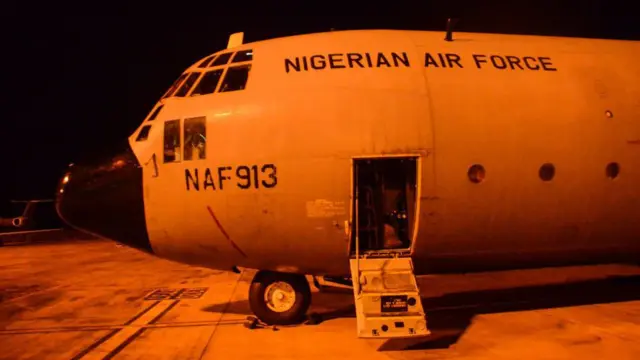
Burkina Faso has accused the Nigerian Air Force of violating its airspace after a C-130 transport aircraft made an emergency landing in the country on Monday, with Burkinabè security sources telling the BBC that 11 Nigerian military officers on board were briefly detained.
Territorial Administration Minister Emile Zerbo said the aircraft entered Burkinabè airspace without authorisation. In a joint statement, the military governments of Burkina Faso, Mali and Niger—members of the Alliance of Sahel States (AES)—said an investigation confirmed “a violation of its airspace and the sovereignty of its member states”.
Nigeria offered a different version of events. The Nigerian Air Force (NAF) said the plane, en route to Portugal, experienced a technical malfunction and landed in Burkina Faso under standard safety procedures. It said the crew was safe and had received “cordial treatment”, without acknowledging any detention.
The aircraft landed in Bobo-Dioulasso, Burkina Faso’s second-largest city, which the NAF said was the nearest suitable airfield for an emergency stop.
But the AES statement insisted the plane entered without clearance and was “forced to land”, calling the incident an “unfriendly act”. It said member states’ air forces had been placed on maximum alert and authorised to neutralise any aircraft violating the bloc’s airspace. The alliance said the aircraft carried two crew members and nine military passengers.
Burkinabè officials told the BBC the officers were later released and allowed to return to Nigeria.
The NAF said preparations were under way to resume the mission to Portugal, stressing its commitment to standard aviation and safety protocols.
Analysts have linked the tensions to the deployment of ECOWAS troops to Benin following an attempted coup on Sunday. Nigeria led the regional response, sending jets and soldiers to help suppress the mutiny.
Burkina Faso, Mali and Niger withdrew from ECOWAS earlier this year after rejecting demands to restore civilian rule and have since distanced themselves from Western partners—particularly France—while deepening ties with Russia.