
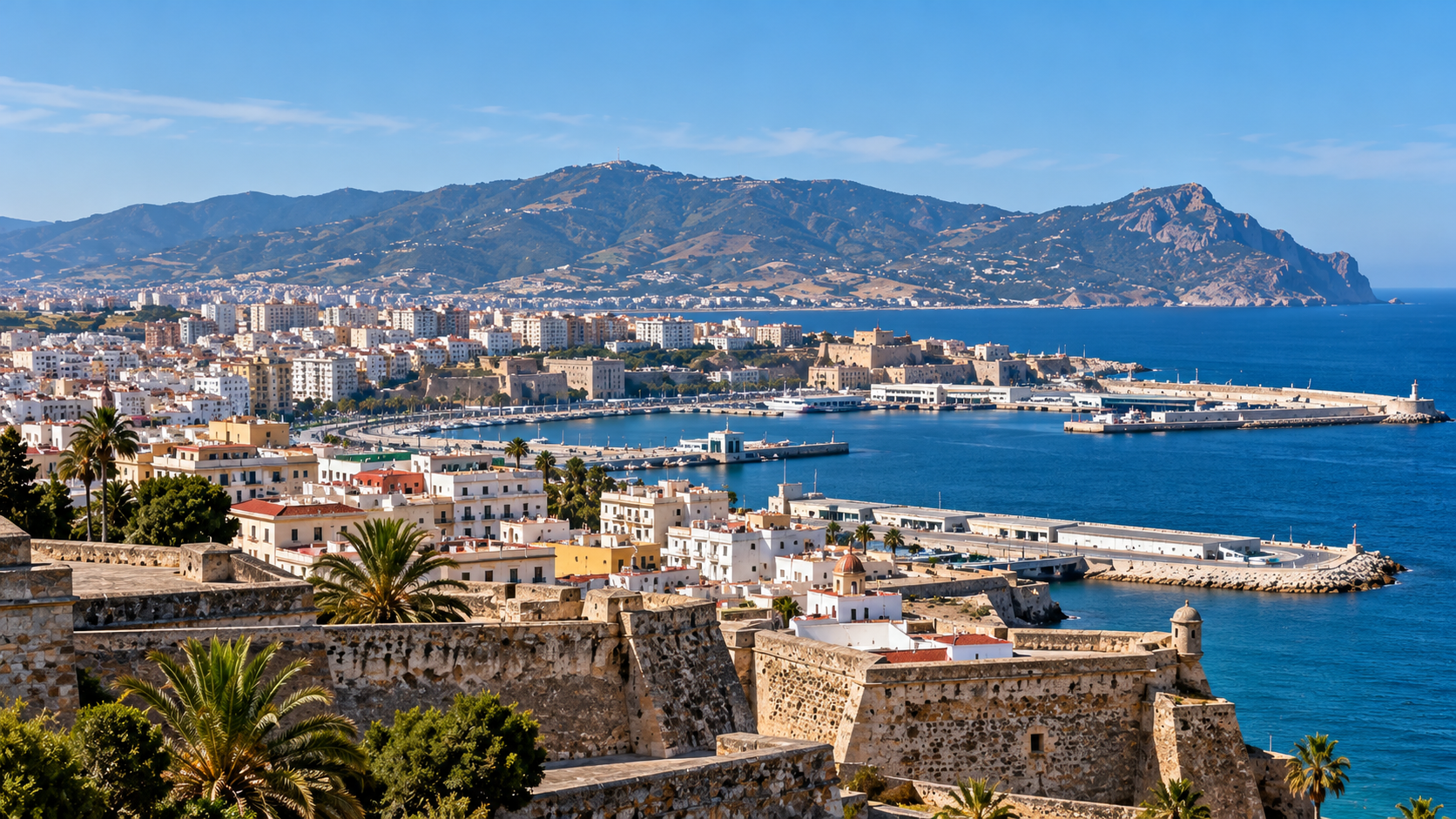
Ceuta and Sebta are two names for the same city on Africa’s northern coast. However, its political status remains a longstanding source of disagreement between Spain and Morocco.
Spain’s King Felipe VI and Queen Letizia are scheduled to visit Ceuta on October 13 and Melilla on October 14.
The trip will mark Felipe’s first visit to either city as king since taking the throne in 2014.
According to Al Jazeera, the royal visit comes amid renewed attention to migration and the unresolved territorial dispute between Madrid and Rabat.
Why is Ceuta also called Sebta?
Ceuta is the Spanish name for the city, while Sebta, also written Sabta, is its Arabic name.
Both names refer to the same place. Their different forms reflect the city’s long history under several political and cultural systems.
The Arabic name existed centuries before the modern dispute between Spain and Morocco.
Today, people in Morocco commonly use Sebta, while Ceuta remains the official Spanish name.
Although the choice of name can carry political meaning, it also reflects ordinary linguistic differences.
How did Ceuta become Spanish territory?
Ceuta has passed through several ruling dynasties over the centuries.
During the medieval period, it came under the influence of Muslim dynasties that governed parts of North Africa and the Iberian Peninsula.
These included the Idrisids, Umayyads, Almoravids, Almohads and Marinids.
In 931, the Umayyad ruler Abd al-Rahman III brought Ceuta under his authority.
Later, the city became connected to different political centres across the western Mediterranean.
However, a major change came in 1415.
Portuguese forces led by King John I captured Ceuta on August 21 that year, ending centuries of Muslim rule.
The city remained under Portuguese control for more than two centuries.
Between 1580 and 1640, Portugal and Spain shared the same monarchy.
When Portugal regained its independence in 1640, Ceuta remained under the Spanish crown.
The Treaty of Lisbon in 1668 confirmed the arrangement.
Why do Spain and Morocco dispute Ceuta?
The dispute centres on sovereignty rather than day-to-day administration.
Spain currently administers Ceuta as an autonomous city and considers it an integral part of Spanish territory.
Morocco, however, claims sovereignty over Ceuta and Melilla.
Rabat points to their geographical location in North Africa and their historical connections with the wider region.
Morocco has maintained its claims since gaining independence in 1956.
Spain rejects those claims and maintains that its sovereignty over both cities is established.
The disagreement reflects different interpretations of history, geography and modern political boundaries.
What makes Melilla different?
Melilla is another Spanish-administered city on the North African coast.
Like Ceuta, it borders Morocco and remains subject to a Moroccan sovereignty claim.
However, its history differs.
Spanish forces took control of Melilla in 1497, bringing it under the Crown of Castile.
Ceuta, meanwhile, first came under Portuguese rule before remaining with the Spanish monarchy.
Today, both cities have autonomous status under Spanish law.
Their political status continues to affect relations between Spain and Morocco.
Why does Ceuta matter for migration?
Ceuta occupies a strategic location near the Strait of Gibraltar.
The city connects North Africa with Spain and the wider European region.
Although Spain administers Ceuta, the city has special customs arrangements and lies outside the European Union’s customs territory.
Its border with Morocco also forms part of the external border of Europe’s Schengen area.
As a result, Ceuta plays an important role in migration and border management.
The city has experienced several periods of heightened migration pressure.
According to Al Jazeera, a major border incident in July brought renewed attention to migration controls and relations between Spain and Morocco.
These developments have made Ceuta an important issue in discussions about European and North African border policies.
Royal visit brings renewed attention to dispute
King Felipe VI and Queen Letizia are expected to visit Ceuta on October 13 before travelling to Melilla the following day.
The visits come at a time when the cities remain politically sensitive.
For Spain, both are established parts of its national territory.
For Morocco, they remain territories over which it maintains sovereignty claims.
The disagreement has persisted despite centuries of political change and continued diplomatic relations between the two countries.
As the royal visit approaches, Ceuta and Melilla are once again drawing attention to the complex history of territorial sovereignty along North Africa’s Mediterranean coast.